If you are arranging first aid training, one of the first things you will probably want to know is how long does a first aid course take?
The answer depends on the qualification you need.
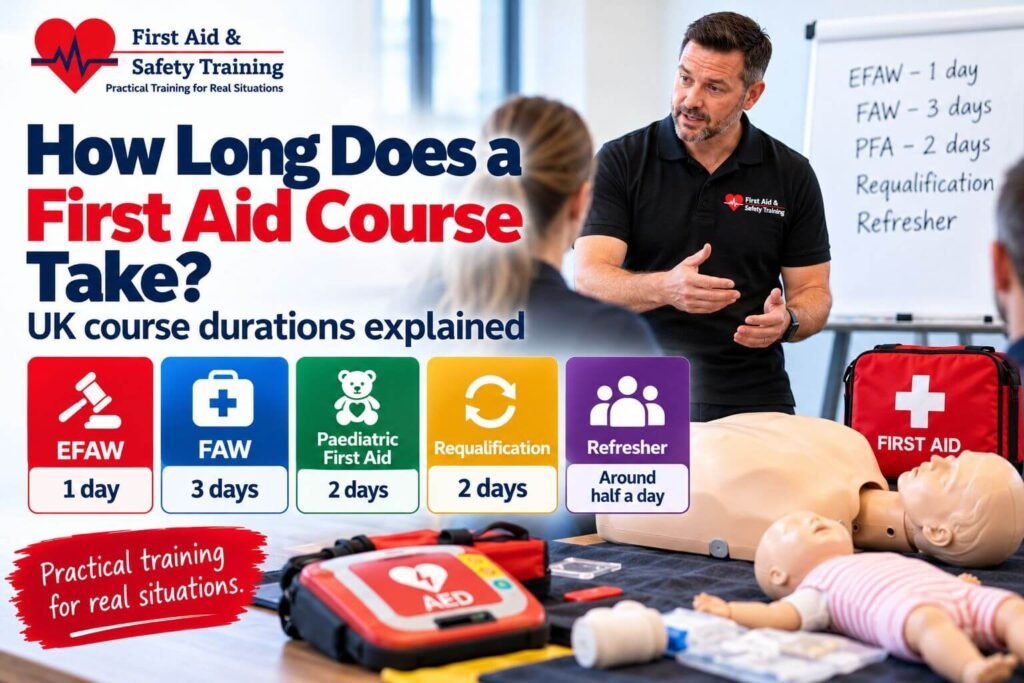
As a simple guide:
- Emergency First Aid at Work, EFAW: normally 1 day
- First Aid at Work, FAW: normally 3 days
- Paediatric First Aid, PFA: normally 2 days
- FAW Requalification: normally 2 days
- Annual workplace first aid refresher: normally around half a day
Some qualifications can also use blended learning, where part of the course is completed online before attending face-to-face practical training.
The right course should not be chosen purely on how quickly it can be completed. Employers need to consider their workplace first-aid needs, while people working with babies and children may need a specific paediatric qualification.
Here is what to expect from the main UK first aid courses.
How Long Is an Emergency First Aid at Work Course?
An Emergency First Aid at Work, EFAW, course is normally completed in:
1 day
The regulated EFAW qualification has a minimum guided learning time of 6 hours.
It is designed to provide the essential skills needed to deal with common workplace first-aid emergencies.
Training includes subjects such as:
- Assessing an incident
- Managing an unresponsive casualty
- CPR
- Using an AED
- Choking
- External bleeding
- Shock
- Minor injuries
Because EFAW is a practical qualification, learners need opportunities to demonstrate their skills rather than simply watch presentations or videos.
At First Aid and Safety Training, our EFAW courses involve practical exercises throughout the day so learners can practise the actions they may need during a real emergency.
Who Is EFAW Suitable For?
EFAW is commonly used in workplaces where a first-aid needs assessment identifies it as an appropriate level of training.
That can include many lower-risk workplaces.
However, the fact that EFAW takes only one day does not mean every employer should automatically choose it.
The employer should first consider the hazards, workforce, working patterns and likely injuries or illnesses within the organisation.
A workplace with more significant risks may require the broader First Aid at Work qualification or additional training.
You can read our guide to the legal requirement for first aid at work for more information about deciding what provision your workplace requires.
How Long Is a First Aid at Work Course?
A full First Aid at Work, FAW, qualification is normally completed over:
3 days
The regulated qualification involves substantially more learning than EFAW because it prepares first aiders to respond to a wider range of workplace injuries and illnesses.
FAW includes the emergency skills found within EFAW alongside additional subjects.
Depending on the qualification specification, these include areas such as:
- Fractures
- Head injuries
- Spinal injuries
- Chest injuries
- Burns and scalds
- Eye injuries
- Poisoning
- Anaphylaxis
- Asthma
- Heart attack
- Stroke
- Diabetes
- Seizures
Learners also spend more time developing and demonstrating practical first-aid skills.
This is why FAW cannot simply be compressed into a one-day course.
Why Does First Aid at Work Take Three Days?
The difference between EFAW and FAW is not simply that one course has a longer presentation.
FAW covers considerably more material.
Learners need time to understand different emergencies, practise first-aid skills and demonstrate that they can apply them appropriately.
Assessment also forms part of a regulated first-aid qualification.
For example, knowing theoretically how to perform CPR is different from demonstrating effective CPR on a training manikin.
Similarly, reading about how to manage an injured casualty cannot replace practical experience of casualty assessment, positioning, bandaging and other first-aid skills.
The additional time gives learners an opportunity to build competence rather than simply work through a list of topics.
Can a First Aid at Work Course Be Completed Through Blended Learning?
Yes, where the qualification and training arrangements permit it.
Blended learning combines online learning with face-to-face practical training.
Instead of completing every part of the course in a classroom, the learner completes an approved element remotely and then attends practical training and assessment.
This can make training easier to organise for some businesses.
However, blended learning does not mean completing an entire practical first-aid qualification online.
Skills such as CPR, AED use and practical casualty management need appropriate hands-on training and assessment.
An online video can explain how CPR works.
It cannot determine whether you are compressing a manikin’s chest correctly.
That practical element remains an important part of first-aid training.
How Long Does a Paediatric First Aid Course Take?
A full Paediatric First Aid, PFA, course normally takes:
2 days
This qualification is designed for people who may need to provide first aid to babies and children.
It is particularly relevant within early years environments.
Paediatric first aid covers subjects including:
- Assessing an emergency involving a child or baby
- Infant CPR
- Child CPR
- AED use
- Choking
- Unconsciousness
- Bleeding
- Shock
- Head injuries
- Fractures
- Burns
- Anaphylaxis
- Asthma
- Seizures
- Childhood illnesses
- Other paediatric emergencies
The course is longer than EFAW because first aid involving babies and children requires additional knowledge and practical skills.
Why Does Paediatric First Aid Take Two Days?
Children are not simply smaller adults.
There are important differences in first-aid procedures, particularly around resuscitation and choking.
For example, paediatric resuscitation training includes different approaches for:
- Babies
- Children
- Adolescents
Learners need time to practise these techniques using appropriate training manikins.
A full PFA course also covers a broader range of conditions and emergencies that may be encountered when caring for children.
That is particularly important for people working in nurseries, schools and other childcare environments.
Can Paediatric First Aid Use Blended Learning?
Yes, an appropriate Paediatric First Aid qualification may be delivered using a blended format.
Part of the required learning can be completed remotely, followed by the necessary face-to-face practical training and assessment.
For busy early years settings, this can reduce the amount of time staff need to spend away from the workplace while still retaining the practical element of the qualification.
Again, it is important to distinguish blended first-aid training from an online-only first-aid course.
The two are not the same.
How Long Does a First Aid at Work Requalification Course Take?
A First Aid at Work Requalification course is normally:
2 days
It is intended for existing FAW-qualified first aiders who need to renew their qualification.
Because learners have previously completed the full qualification, the requalification course can normally be completed over a shorter period than the initial three-day FAW course.
However, there are rules around eligibility and certificate expiry.
Do not assume that someone whose qualification expired a long time ago can automatically attend a two-day requalification course instead of completing the full FAW qualification again.
If a certificate is approaching its expiry date, arrange requalification training early rather than leaving it until the last minute.
Is a First Aid Refresher Course the Same as Requalification?
No.
This is an important distinction.
An annual first aid refresher is designed to help qualified first aiders maintain their skills between formal qualifications.
HSE strongly recommends annual refresher training for FAW and EFAW first aiders.
A refresher might revisit practical subjects such as:
- Casualty assessment
- CPR
- AED use
- Choking
- Recovery position
However, completing annual refresher training does not renew a three-year FAW or EFAW qualification.
When the qualification reaches the end of its validity period, the first aider needs the appropriate qualification or requalification training.
Our guide to First Aid Refresher vs Requalification explains this in more detail.
How Long Is an Annual First Aid Refresher?
An annual workplace first-aid refresher is normally around:
Half a day
The exact duration depends on the training being delivered.
Because this is refresher training rather than a replacement qualification, the emphasis should be on maintaining practical competence.
CPR is a good example.
Someone may have performed CPR correctly during their original course but then gone an entire year without practising it.
A practical refresher provides an opportunity to get back onto a manikin, practise the technique and reinforce the actions needed during cardiac arrest.
How Long Does an Online First Aid Course Take?
This question needs a little caution.
There are many online courses advertised as “first aid courses”, and their duration can range from less than an hour to several hours.
However:
An online awareness course is not automatically equivalent to a practical regulated first-aid qualification.
This matters particularly when an employer needs someone to act as a workplace first aider.
Watching first-aid videos and completing an online multiple-choice test does not provide the same practical assessment as demonstrating CPR, AED use and other first-aid skills.
Online learning can be extremely useful.
We use it where appropriate within blended learning.
The distinction is that blended learning combines remote learning with the required practical training and assessment.
If you are comparing courses, always check exactly what qualification or certificate you will receive.
Can I Complete a First Aid Course in One Day?
Yes, if the qualification you need is designed to be completed in one day.
EFAW is the obvious example.
A properly delivered Emergency First Aid at Work qualification can normally be completed in a single training day.
However, you cannot simply shorten every first-aid qualification to fit a one-day schedule.
A full FAW qualification requires considerably more learning.
Likewise, a full Paediatric First Aid qualification requires more time than a one-day emergency course.
If you see a course advertised as providing a complete FAW qualification in a few hours, check exactly what is being offered before booking.
Can I Complete First Aid Training in the Evening?
Short awareness sessions and refresher training can sometimes be delivered during evenings.
Full regulated qualifications have specific learning and assessment requirements, so delivery needs to allow enough time to complete them properly.
Some courses can be split across different sessions rather than delivered on consecutive days.
This can help organisations that cannot release several employees from work simultaneously.
For example, training might be arranged around shifts or operational requirements while still meeting the qualification requirements.
Does a First Aid Course Have to Be Completed on Consecutive Days?
Not necessarily.
A multi-day course does not always need to be delivered on consecutive days, provided the delivery arrangement complies with the relevant qualification requirements.
This can be useful for employers.
Taking several key employees away from work for three consecutive days may be difficult.
Alternative scheduling can sometimes make the course easier to manage without reducing the amount of training learners receive.
When arranging onsite training, discuss your requirements with the training provider before booking.
How Long Does a First Aid Certificate Last?
For the main workplace qualifications:
EFAW certificates are normally valid for 3 years.
FAW certificates are normally valid for 3 years.
Paediatric First Aid qualifications are also normally valid for:
3 years.
This is separate from how long the actual course takes.
For example, a learner may complete EFAW in one day and then hold the qualification for three years.
During that period, HSE recommends annual refresher training for workplace first aiders to help maintain their competence.
How Soon Should I Book Requalification Training?
Do not wait until the day before a certificate expires.
Businesses should keep a record showing:
- Who their first aiders are
- Which qualification each person holds
- The certificate expiry date
- When refresher training is due
- When requalification needs arranging
Booking early gives you more choice of course dates and reduces the risk of losing first-aid cover.
It is especially important where only a small number of employees hold the required qualification.
If your only FAW-qualified employee’s certificate expires, your first-aid arrangements may no longer reflect the needs identified by your workplace assessment.
How Much Time Should an Employer Allow for First Aid Training?
Allow the whole training period, not simply the headline teaching hours.
Learners need to arrive, register, complete training, take breaks and undertake the required assessments.
For onsite courses, businesses should also avoid expecting employees to repeatedly leave the training room to answer calls, attend meetings or carry out normal duties.
First-aid training requires participation.
Someone who spends significant parts of the course dealing with work may miss important learning and may not be able to demonstrate the required competence.
When you allocate someone to first-aid training, give them the time to complete it properly.
Can First Aid Training Be Delivered at Our Workplace?
Yes.
Onsite training can be particularly useful when several employees need the same qualification.
Instead of sending people individually to different open courses, the trainer comes to your workplace.
This can reduce:
- Employee travel
- Mileage
- Time away from the workplace
- Disruption caused by different training dates
It can also allow relevant workplace risks to form part of discussions and scenarios.
At First Aid and Safety Training, our regulated EFAW, FAW and PFA courses can be delivered to groups of up to 12 learners.
For businesses training larger groups, onsite delivery can also be considerably more cost-effective than purchasing individual open-course places.
Our guide to how much a first aid course costs in the UK explains the difference between open and onsite course pricing.
How Long Does First Aid Training Take for 12 People?
The qualification duration does not become shorter simply because more people attend.
A group of 12 completing EFAW still needs the required course delivery and assessment.
In fact, practical training needs to be properly organised so everyone has sufficient opportunity to participate.
That is one reason we cap our regulated first-aid courses at 12 learners.
The objective is not to get as many people through the room as quickly as possible.
We want learners to practise.
They should use the manikins, handle AED trainers, work through scenarios, demonstrate first-aid skills and receive feedback.
A practical qualification needs practical involvement.
Which First Aid Course Do I Need?
The shortest course is not necessarily the correct course.
For workplace first aid, employers should start with a first-aid needs assessment.
Consider:
- Number of employees
- Workplace hazards
- Likely injuries and illnesses
- Shift patterns
- Lone workers
- Multiple sites or buildings
- Distance from emergency medical services
- Previous incidents
- Employees with particular needs
The assessment helps determine whether your organisation requires an appointed person, EFAW-trained first aiders, FAW-qualified first aiders or additional specialist training.
People working with babies and young children may instead need an appropriate Paediatric First Aid qualification.
Choosing the correct qualification first prevents course duration from driving the wrong decision.
First Aid Course Duration at a Glance
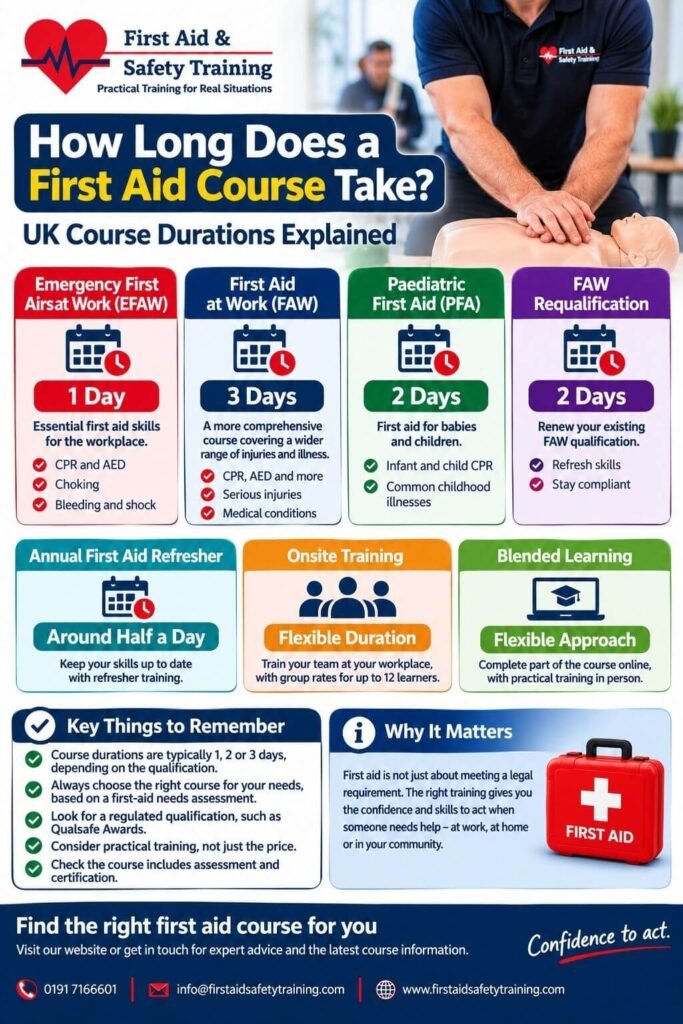
| Course | Typical duration | Common purpose |
|---|---|---|
| Emergency First Aid at Work, EFAW | 1 day | Essential workplace emergency first aid |
| First Aid at Work, FAW | 3 days | More comprehensive workplace first aid |
| Paediatric First Aid, PFA | 2 days | First aid for babies and children |
| FAW Requalification | 2 days | Renewing an existing FAW qualification |
| Annual First Aid Refresher | Around half a day | Maintaining skills between qualifications |
The important word here is typical.
Delivery arrangements can differ, particularly where approved blended learning is used.
Always check the exact structure of the qualification you are booking.
Does a Longer First Aid Course Mean Better Training?
Not automatically.
Course duration should reflect the qualification and the amount of learning required.
Three days of poor training does not become good training simply because it lasts longer.
Likewise, a well-delivered one-day EFAW course can provide excellent training when EFAW is the correct qualification for the learner.
Look at the complete package.
Consider:
Is it the right qualification?
Who awards it?
Is it regulated?
Is practical training included?
Will learners be assessed?
Does the provider use appropriate equipment?
Are class sizes manageable?
Does the course meet your needs?
These questions are more useful than choosing solely by duration or price.
Are FAST First Aid Courses Regulated Qualifications?
First Aid and Safety Training is an approved Qualsafe Awards Centre.
Our relevant EFAW, FAW and Paediatric First Aid courses lead to Qualsafe Awards regulated qualifications.
That means FAST delivers and assesses the training in accordance with the awarding organisation’s requirements rather than creating our own qualification and certificate.
We think this distinction is important when people compare first-aid training.
A course may have the same name and appear to cover similar subjects while leading to a different type of certificate.
Check what you are actually receiving before you book.
How Long Does a First Aid Course Take? The Simple Answer
For most people searching how long does a first aid course take, the answer is straightforward:
EFAW – 1 day
FAW – 3 days
Paediatric First Aid – 2 days
FAW Requalification – 2 days
Annual refresher – around half a day
Blended learning may change how that time is divided between online learning and face-to-face attendance, but practical first-aid skills still need appropriate hands-on training and assessment.
Most importantly, do not choose your course simply because it is the quickest.
Choose the qualification that gives you the skills you need and, for employers, meets the requirements identified through your workplace first-aid needs assessment.
Find the Right First Aid Course
First Aid and Safety Training provides practical first-aid courses for individuals, businesses and organisations across the North East.
Whether you need a one-day EFAW qualification, the full three-day FAW course or Paediatric First Aid training, we can help you choose the appropriate option.
Our courses focus on practical learning so learners have opportunities to practise the skills they may need in a real emergency.
You can explore our first aid training courses, book a first aid course or contact First Aid and Safety Training to discuss onsite training for your organisation.
You can also find First Aid and Safety Training on Google and see our business information and customer reviews.