Skip to content

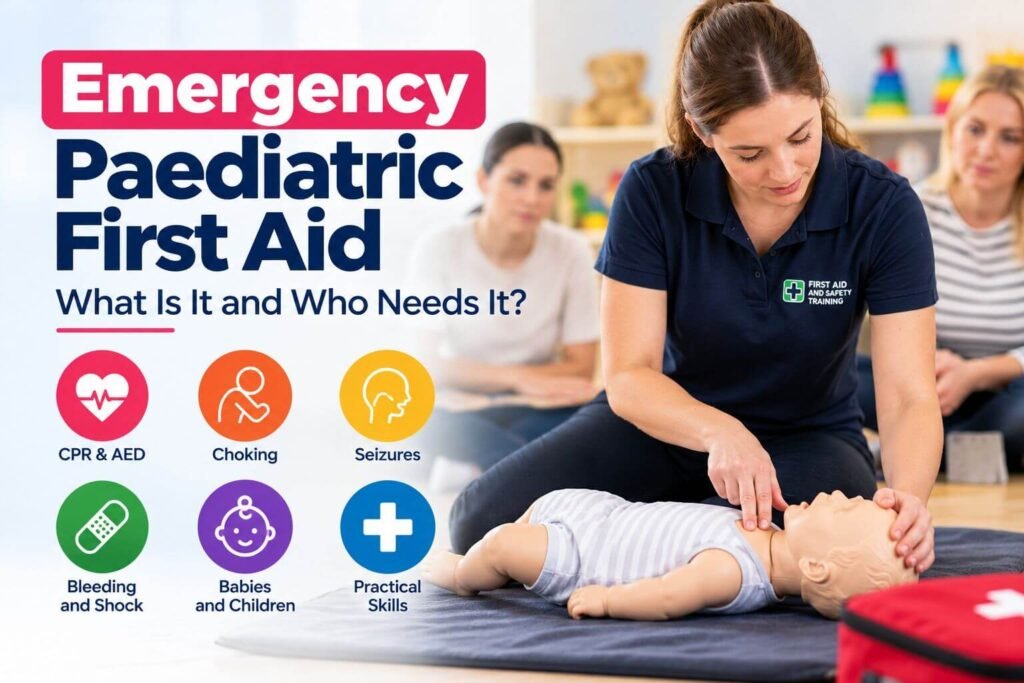
Emergency Paediatric First Aid is a one-day first aid qualification designed for people who care for babies and children.
The course concentrates on the immediate action needed during a paediatric emergency. It covers essential skills such as assessing an incident, CPR, choking, seizures, bleeding and shock.
Emergency Paediatric First Aid is different from the broader Full Paediatric First Aid qualification. Therefore, understanding which course you need is particularly important for nurseries, childminders and other Early Years providers.
In this guide, we explain what Emergency Paediatric First Aid is, what the course covers, how long it takes and how it fits within current Early Years Foundation Stage requirements.
What Is Emergency Paediatric First Aid?
Emergency Paediatric First Aid, often shortened to EPFA, provides training in the immediate first aid response to emergencies involving infants and children.
It is a practical qualification rather than simply an online awareness course.
Learners develop the skills needed to assess an emergency and provide first aid while further medical assistance is being arranged.
The course focuses on situations where prompt action can make a significant difference, including:
- An unresponsive baby or child
- Cardiac arrest
- Choking
- Seizures
- Serious bleeding
- Shock
If you are comparing Full PFA, Emergency PFA and other training options, our guide to choosing the right type of Paediatric First Aid training explains the main differences.
How Long Is an Emergency Paediatric First Aid Course?
Emergency Paediatric First Aid requires a minimum of 6 hours of training, excluding breaks.
For most learners, this means completing the qualification over one training day.
In comparison, Full Paediatric First Aid requires a minimum of 12 hours.
The shorter duration reflects the narrower syllabus. Emergency PFA concentrates on essential emergency skills, whereas the full qualification covers a much wider range of illnesses and injuries.
You can compare course lengths in our guide to Paediatric First Aid training duration.
What Does Emergency Paediatric First Aid Cover?
Emergency Paediatric First Aid focuses on the immediate response to potentially serious incidents involving babies and children.
Learners are taught how to:
- Understand the role and responsibilities of a paediatric first aider
- Assess an emergency situation safely
- Help an infant or child who is unresponsive and breathing normally
- Respond when an infant or child is unresponsive and not breathing normally
- Perform infant and child CPR
- Respond to a seizure
- Recognise and treat choking
- Control external bleeding
- Recognise and respond to shock caused by severe blood loss
The course combines first aid knowledge with practical skills.
For a broader look at the additional illnesses and injuries included in Full PFA, see our guide to what a full Paediatric First Aid course covers.
Does Emergency Paediatric First Aid Include CPR?
Yes. CPR is one of the most important practical elements of Emergency Paediatric First Aid.
Learners practise resuscitation techniques for both infants and children.
Training includes how to:
- Recognise an unresponsive casualty
- Open the airway
- Check for normal breathing
- Recognise abnormal breathing
- Give initial rescue breaths
- Perform chest compressions
- Combine compressions with rescue breaths
- Summon emergency assistance
- Continue CPR until further help arrives or the casualty shows clear signs of recovery
Paediatric CPR differs from adult CPR in several important ways. Practical training allows learners to practise these differences using infant and child manikins.
Current UK resuscitation practice is underpinned by guidance from the Resuscitation Council UK.
Does Emergency Paediatric First Aid Cover Choking?
Yes. Learners are taught how to recognise and respond to choking in babies and children.
First, they learn to distinguish between a mild obstruction and severe choking.
Someone with a mild obstruction may still be able to cough effectively. However, severe airway obstruction can quickly become life-threatening.
Treatment also differs between infants and children.
For a child, training may include:
- Encouraging an effective cough
- Back blows
- Abdominal thrusts when required
- Summoning emergency assistance
- Starting CPR if the child becomes unresponsive
For an infant, learners practise back blows and chest thrusts instead of abdominal thrusts.
These practical differences make hands-on training particularly important.
Does the Course Cover Seizures?
Yes. Emergency Paediatric First Aid includes the management of a baby or child experiencing a seizure.
Learners develop an understanding of how to protect the casualty from injury and monitor their condition.
They also learn when emergency medical assistance may be required.
A seizure can be frightening to witness. Training gives learners a structured approach so they can concentrate on keeping the child safe rather than trying to restrain them or place something in their mouth.
Does Emergency PFA Cover Bleeding and Shock?
Yes.
The course includes the management of external bleeding.
Learners are taught how to assess a bleeding injury and take appropriate action to control blood loss.
Emergency PFA also covers shock caused by severe blood loss.
Babies and children can deteriorate quickly. Therefore, recognising significant bleeding and taking prompt action forms an important part of emergency training.

Is Emergency Paediatric First Aid a Practical Course?
Yes.
The practical nature of the course is one of its most important features.
Learners need the opportunity to practise emergency skills rather than simply read about them or watch videos.
Practical activities can include:
- Infant CPR
- Child CPR
- Choking procedures
- Management of an unconscious casualty
- Bleeding control
- Casualty assessment
An instructor can observe these skills, provide feedback and correct technique where necessary.
As a result, practical training helps turn first aid knowledge into something a learner may be able to use during a real emergency.
Can Emergency Paediatric First Aid Be Completed Online?
Not as an online-only course where the qualification is being used to meet the EYFS Paediatric First Aid criteria.
Under the current EYFS criteria, Emergency Paediatric First Aid must be undertaken face-to-face and last for a minimum of six hours, excluding breaks.
This is different from Full Paediatric First Aid, where an appropriate blended learning model can combine online learning with face-to-face practical training.
Therefore, anyone considering an online course should check carefully what qualification it actually provides.
We explain the distinction in our guide to online, blended and face-to-face Paediatric First Aid training.
Is Emergency Paediatric First Aid Accepted for EYFS?
Emergency Paediatric First Aid has a role within the current Early Years Foundation Stage requirements, but it is important not to confuse it with Full Paediatric First Aid.
The current EYFS statutory framework sets out Paediatric First Aid requirements for registered Early Years providers in England.
Settings need to ensure that at least one person with a current Full Paediatric First Aid certificate is on the premises and available whenever children are present.
An appropriately qualified person must also accompany children on outings.
Therefore, having staff with Emergency Paediatric First Aid does not remove the requirement for the setting to maintain the required Full PFA coverage.
Can Emergency PFA Count Towards EYFS Staff Ratios?
In some circumstances, yes.
Current EYFS requirements allow certain staff holding either a Full Paediatric First Aid certificate or an Emergency Paediatric First Aid certificate to be included within the relevant qualified staff ratios, subject to the applicable conditions.
However, this should not be confused with the separate requirement to have appropriate Full Paediatric First Aid coverage within the setting.
In practical terms, a nursery may have staff with a mixture of Full PFA and Emergency PFA qualifications.
The provider still needs to make sure its overall arrangements comply with the current EYFS framework.
When deciding who needs which qualification, employers should consider staff roles, working patterns, holidays, sickness, outings and the number of children present.
What Is the Difference Between Emergency and Full Paediatric First Aid?
The biggest differences are course duration and syllabus breadth.
| Emergency Paediatric First Aid | Full Paediatric First Aid |
|---|---|
| Minimum 6 hours | Minimum 12 hours |
| Face-to-face for EYFS criteria | Can use an appropriate blended format |
| Focuses on immediate emergencies | Covers a much broader range of illnesses and injuries |
| Includes CPR and choking | Includes CPR and choking |
| Includes seizures | Includes seizures and wider medical conditions |
| Includes bleeding and shock | Includes bleeding, shock and wider injury management |
| Narrower qualification | More comprehensive qualification |
Full PFA goes further into areas such as anaphylaxis, asthma, diabetes, meningitis, sepsis, burns, poisoning, fractures and head, neck and spinal injuries.
Our article explaining what learners cover during Full Paediatric First Aid provides a more detailed breakdown.
Who Needs Emergency Paediatric First Aid?
Emergency PFA may be suitable for people working with babies and children where the qualification is appropriate to their role and the organisation’s requirements.
This can include some:
- Nursery staff
- Early Years practitioners
- School staff
- Teaching assistants
- Children’s activity staff
- Sports coaches
- Holiday club workers
- Youth workers
- Childcare staff
However, you should not choose Emergency PFA simply because it is shorter than the Full Paediatric First Aid course.
The correct qualification depends on why you need the training.
For Early Years providers, this means considering the current EYFS requirements as well as the person’s role within the setting.
Do Childminders Need Full or Emergency Paediatric First Aid?
Childminders should pay particular attention to the qualification requirements applying to their registration and responsibilities.
Where a person may be responsible for children without another appropriately qualified person available, relying on a shorter Emergency PFA qualification may not provide the Full PFA coverage required.
Before booking, childminders should check the current EYFS requirements published by the Department for Education.
If you are unsure, it is usually better to establish which qualification you require before paying for a course.
What About Nurseries and Early Years Settings?
Nurseries need to consider Paediatric First Aid across the whole setting rather than simply training one person.
Questions to consider include:
- Who holds Full PFA?
- Who holds Emergency PFA?
- When do their certificates expire?
- Are qualified staff available throughout opening hours?
- What happens during lunch breaks?
- What happens when someone is sick or on holiday?
- Who accompanies children on outings?
- Are sufficient qualified staff available while children are eating?
- Do staffing arrangements continue to meet EYFS requirements?
Training should therefore form part of a wider staffing and first aid plan.
A qualification may last three years, but the organisation still needs appropriate first aid coverage every day.
Is Emergency Paediatric First Aid Suitable for Schools?
It can be useful for school staff, particularly those working with younger children.
However, schools need to consider more than Paediatric First Aid alone.
Where a school provides Early Years education, the relevant EYFS requirements need to be met.
At the same time, the school is also a workplace.
Employers therefore need to assess first aid provision for employees and others affected by their activities. The Health and Safety Executive’s workplace first aid guidance explains how employers should determine adequate and appropriate provision.
Depending on the school’s needs assessment, this may mean combining Paediatric First Aid with workplace qualifications such as Emergency First Aid at Work or First Aid at Work.
Is Emergency Paediatric First Aid Suitable for Sports Coaches?
Paediatric first aid skills can be extremely useful for coaches and activity providers working with children.
However, the most appropriate qualification depends on the organisation, governing body requirements, activities taking place and the ages of participants.
A sports organisation should therefore consider its own risk assessment and any requirements imposed by its governing body or insurer.
For some environments, broader workplace first aid or additional trauma training may also be appropriate.
How Is Emergency Paediatric First Aid Assessed?
Learners need to demonstrate that they can perform the required practical first aid skills.
Assessment may take place throughout the course rather than as one single practical examination at the end.
The important point is that completing the qualification requires more than simply sitting in a classroom.
Learners need to show that they can apply the techniques they have been taught.
That practical assessment is another reason an online-only awareness course should not be confused with an Emergency Paediatric First Aid qualification.
How Long Is an Emergency Paediatric First Aid Certificate Valid?
An Emergency Paediatric First Aid qualification is normally valid for three years.
However, organisations should not simply record the expiry date and forget about first aid until renewal is due.
Skills can fade when they are not regularly used.
Employers and childcare providers should maintain training records, monitor expiry dates and consider opportunities to refresh practical skills between formal courses.
Where a certificate is required for EYFS purposes, renewal should be arranged before it expires.
Our guide to Paediatric First Aid certificate renewal and expiry explains the three-year validity period in more detail.
Does Emergency PFA Replace Full Paediatric First Aid?
No.
Emergency PFA and Full PFA are separate qualifications with different course lengths and syllabus coverage.
Emergency PFA should not be viewed as a quicker way of obtaining the same qualification.
The shorter course provides important emergency skills, but Full PFA covers substantially more.
Which qualification is appropriate depends on your role and the requirements applying to your workplace or childcare setting.
If you are uncertain, our Paediatric First Aid course comparison guide is a good place to start.
Emergency Paediatric First Aid Training With FAST
First Aid and Safety Training provides practical Paediatric First Aid training for individuals and organisations across the North East.
We are an approved Qualsafe Awards Centre, and our relevant first aid courses lead to regulated qualifications awarded by Qualsafe Awards, an Ofqual-recognised awarding organisation.
Our approach is practical.
Learners get the opportunity to practise important skills rather than simply listening to a presentation about what they should do.
For organisations, we can also discuss whether Emergency PFA or Full PFA is the more appropriate option for the people being trained.
You can explore our Paediatric First Aid training options or contact First Aid and Safety Training to discuss training for your nursery, school, childcare setting or organisation.
If you are comparing the available qualifications first, read our guide to the different Paediatric First Aid course options.
You can also find First Aid and Safety Training on Google Maps and read feedback from previous learners.
Build the Confidence to Act
Emergency Paediatric First Aid is designed to give learners the essential skills needed when a baby or child requires immediate help.
The qualification is shorter than Full Paediatric First Aid, but the skills it teaches are significant.
Learning how to assess an emergency, perform CPR, respond to choking, manage a seizure and control serious bleeding can give someone a much clearer idea of what to do when faced with a real incident.
Good first aid training should provide more than a certificate.
It should help give you the confidence to act.