Skip to content

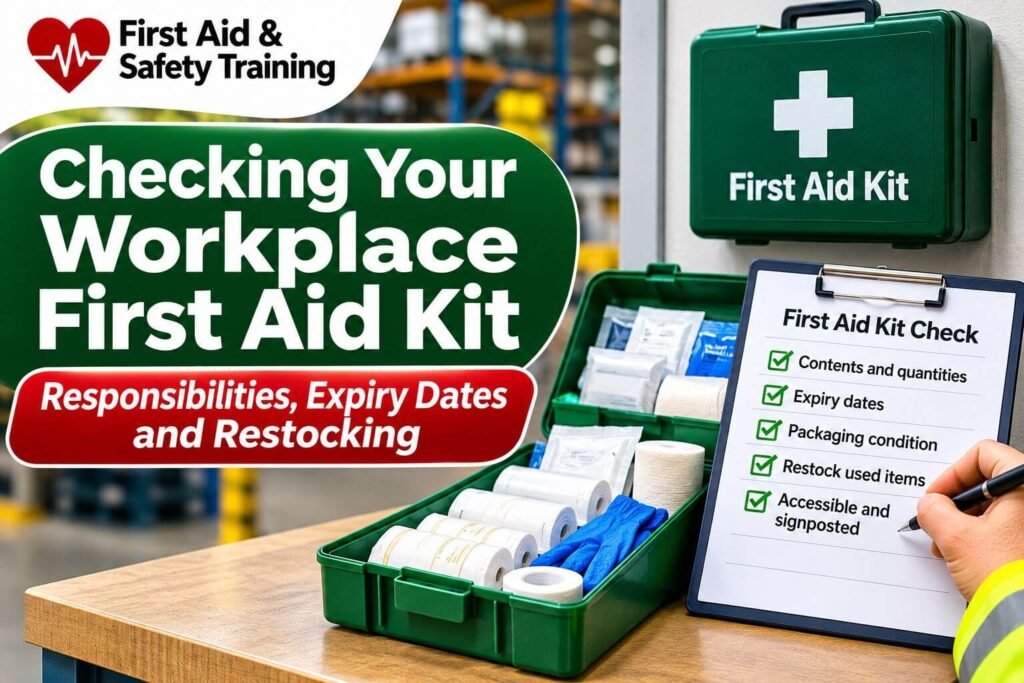
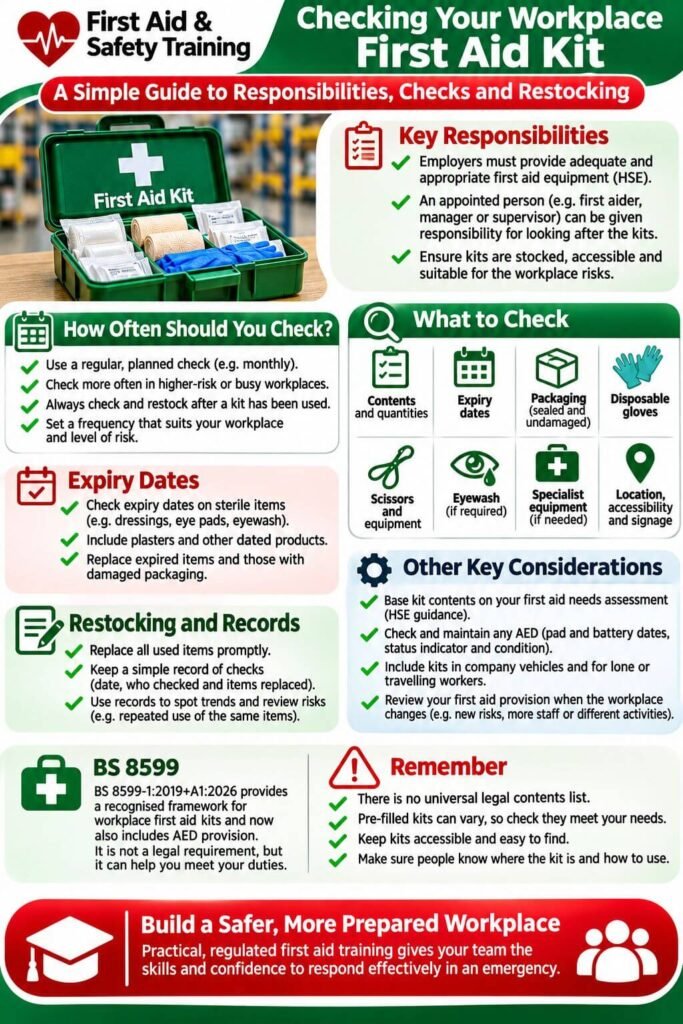
Checking your workplace first aid kit regularly is an important part of maintaining effective first aid arrangements.
Buying a first aid kit and putting it on the wall is not the end of an employer’s responsibility.
First aid supplies get used. Sterile products expire. Packaging becomes damaged. Equipment gets moved, and changes to the workplace can mean that the kit you originally purchased is no longer appropriate.
Employers should therefore have a simple system for making sure their first aid kits remain suitably stocked, accessible and appropriate for the risks within their workplace.
In this guide, we look at who is responsible for checking workplace first aid kits, what should be inspected and when equipment needs to be replaced.
Who Is Responsible for Workplace First Aid Kits?
Under the Health and Safety (First-Aid) Regulations 1981, employers must provide adequate and appropriate first aid equipment, facilities and people so employees can receive immediate help if they are injured or become ill at work.
The overall legal responsibility sits with the employer.
However, responsibility for routine first aid arrangements can be allocated to an appropriate person within the organisation.
The Health and Safety Executive explains that where an appointed person is required, their role includes looking after first aid equipment and facilities and calling the emergency services when necessary.
In practice, an organisation might therefore nominate an:
- appointed person
- first aider
- health and safety representative
- office manager
- facilities manager
- supervisor
- other responsible member of staff
to carry out regular checks.
The important thing is that responsibility is clearly allocated.
A system that relies on everyone assuming somebody else has checked the kit is not much of a system.
You can read more about the wider legal responsibilities in our guide to the legal requirements for first aid at work.
How Often Should You Check a Workplace First Aid Kit?
There is not a single statutory interval that says every workplace first aid kit must be checked every particular number of days.
The frequency should be sensible for your workplace.
For many organisations, a regular scheduled check, such as monthly, provides a practical starting point.
However, some workplaces may need more frequent checks.
Consider factors including:
- how frequently first aid supplies are used
- number of employees
- workplace hazards
- number of first aid kits
- whether kits are spread across several buildings or floors
- whether kits are used by mobile or travelling workers
- previous incidents
- likelihood of items being removed without being reported
A busy manufacturing environment may need a different checking regime from a small, low-hazard office.
The key is to have a routine that works for your organisation rather than allowing kits to go unchecked for long periods.
Check Your First Aid Kit After It Has Been Used
Do not simply wait for the next scheduled inspection if you know a kit has been used.
After a first aid incident, check what equipment has been removed and replace it.
For example, an incident involving a significant wound could use several pairs of gloves, dressings and other supplies in a matter of minutes.
If those items are not replaced, the next first aider may open the kit during another emergency and discover that essential equipment is missing.
Encourage first aiders and other employees to report whenever supplies have been used.
What Should You Check in a Workplace First Aid Kit?
Checking your workplace first aid kit should involve more than looking inside and deciding that it appears reasonably full.
A useful inspection should consider:
- contents
- quantities
- expiry dates
- sterile packaging
- condition of equipment
- cleanliness
- accessibility
- signage
- whether the contents still match the workplace risks
It can help to use a simple checklist so that the same areas are reviewed each time.
Check That the Correct Contents Are Present
There is no mandatory universal list of items that every workplace first aid kit must contain.
The contents should reflect the findings of your organisation’s first aid needs assessment.
For a low-hazard workplace, HSE provides a suggested minimum stock as guidance, including:
- general first aid guidance
- individually wrapped sterile plasters
- sterile eye pads
- triangular bandages
- safety pins
- large sterile unmedicated wound dressings
- medium sterile unmedicated wound dressings
- disposable gloves
This is guidance rather than a legal shopping list.
A higher-risk workplace may require considerably different or additional equipment.
Our separate guide to workplace first aid kit requirements explains this in more detail.
Check Quantities, Not Just Whether an Item Is Present
Finding one plaster in a box does not necessarily mean the plaster requirement is adequately stocked.
Compare the actual quantities with whatever stock level your organisation has decided is appropriate.
Look for commonly used items such as:
- plasters
- disposable gloves
- cleansing wipes
- sterile dressings
- bandages
These may disappear much faster than other equipment.
Keeping a small amount of replacement stock can make restocking easier, particularly in larger workplaces.
Check Expiry Dates
Some first aid supplies have expiry dates and should be checked regularly.
This is particularly important for sterile products.
Examples may include:
- sterile wound dressings
- sterile eye dressings
- sterile saline or eyewash
- some burns products
- other sterile supplies
Follow the manufacturer’s expiry information.
An expiry date helps provide assurance about matters such as sterility and product performance up to the stated date when the product has been stored correctly.
If an item has expired, replace it.
A useful system is to identify products approaching expiry before they actually expire, giving you time to order replacements.
Do Plasters Expire?
Individually wrapped sterile plasters normally carry expiry information from the manufacturer.
Over time, packaging integrity, sterility and adhesive performance cannot simply be assumed indefinitely.
Include plasters when checking expiry dates rather than treating them as permanent stock.
Also inspect them for damaged or opened packaging.
Do Bandages Expire?
This depends on the product.
Some sterile bandages and dressings carry expiry dates. Other non-sterile items may not.
Check the manufacturer’s packaging rather than assuming.
Even where an item has no stated expiry date, inspect its condition.
Bandages that are damp, dirty, contaminated, damaged or badly stored should not remain in a first aid kit simply because they have no expiry date printed on them.
Check Sterile Packaging
Expiry dates are only part of the inspection.
A sterile dressing with an expiry date two years away is not suitable if the packaging has been ripped open.
Look for:
- tears
- punctures
- opened wrappers
- water damage
- contamination
- damaged seals
Replace anything where the integrity of sterile packaging has been compromised.
Check Disposable Gloves
Disposable gloves are an important part of infection control during first aid.
Make sure you have enough pairs available and that packaging and gloves remain in good condition.
Consider the environment in which they are stored.
Extreme temperatures, direct sunlight, chemicals and poor storage conditions can potentially affect equipment over time.
If gloves appear damaged, brittle, contaminated or otherwise unsuitable, replace them.
Check Scissors and Reusable Equipment
Not everything in a first aid kit is disposable.
Where your kit contains scissors or other reusable equipment, inspect their condition.
Check that scissors:
- are present
- are clean
- work correctly
- are not badly damaged or corroded
Any reusable equipment should remain suitable for its intended purpose.
Should Medicines Be Kept in a Workplace First Aid Kit?
HSE recommends that tablets and medicines should not generally be kept in the workplace first aid box.
Personal medication is a separate issue and may require appropriate workplace arrangements depending on the individual and circumstances.
Avoid gradually allowing a workplace first aid box to turn into an unofficial medicine cupboard containing painkillers, old creams and miscellaneous medication.
Check Eyewash Provision
Eyewash requirements depend on the workplace and the risks identified.
If mains tap water is not readily available for eye irrigation, sterile water or sterile normal saline may need to be provided.
Workplaces involving particular chemical hazards may require additional arrangements identified through their risk assessment and safety information for the substances involved.
Where bottles of sterile eyewash are provided:
- check expiry dates
- check seals
- check for damage
- replace used bottles
- make sure they remain accessible
Do not assume a couple of small bottles automatically provide sufficient provision for every chemical hazard.
Check Specialist First Aid Equipment
Your first aid needs assessment may identify equipment beyond a standard workplace kit.
Depending on the risks, this might include:
- burns equipment
- additional eyewash provision
- critical injury equipment
- trauma dressings
- haemostatic dressings
- tourniquets
- additional PPE
- other hazard-specific supplies
These items need checking too.
Specialist equipment should not be bought, placed in a cupboard and then forgotten about.
Where equipment requires specific skills, make sure appropriate people are trained to use it.
What About BS 8599 Workplace First Aid Kits?
BS 8599 provides a recognised framework for workplace first aid kits.
The current standard is BS 8599-1:2019+A1:2026, which covers workplace first aid kit contents and now also addresses the provision of Automated External Defibrillators in the workplace.
Using a BS 8599 kit does not remove the need for a first aid needs assessment.
It is also important to understand that BS 8599 is not itself a legal requirement.
The employer still needs to decide what is adequate and appropriate for the particular workplace.
We explain the latest changes in our guide to BS 8599-1:2019+A1:2026 and the updated workplace first aid standard.
Check Your AED as Well
An Automated External Defibrillator is not simply another item inside a conventional first aid kit, but where your workplace has an AED it should form part of your wider emergency equipment checks.
AEDs are designed to carry out automatic self-checks, but somebody should still be responsible for making sure the device appears ready for use.
Depending on the model, routine checks may include:
- checking the AED status indicator
- checking electrode pad expiry dates
- checking battery condition or replacement dates
- making sure the pads are sealed
- checking accessories are present
- confirming the AED has not been damaged
- ensuring the cabinet or storage location is accessible
- replacing equipment following use
Always follow the manufacturer’s instructions for your particular AED.
If the device indicates a fault, do not simply assume it will correct itself.
The 2026 amendment to BS 8599-1 also gives AED provision a more prominent place within workplace first aid planning.
Check the Location of Your First Aid Kit
A perfectly stocked first aid kit is of little use if nobody can find it.
During your inspection, check that the kit:
- remains in its designated location
- is easy to access
- is clearly identifiable
- has not been obstructed
- can be reached when the workplace is operating
Consider whether employees know where first aid equipment is located.
Appropriate first aid signage can make equipment easier to identify quickly.
Avoid Locking Emergency Equipment Away
First aid equipment needs to be accessible when it is required.
If supplies are kept somewhere that requires locating a particular keyholder before they can be accessed, that can introduce unnecessary delay.
Security may be necessary for some equipment or environments, but the arrangements should still allow appropriate first aid supplies to be accessed promptly when needed.
Do You Need More Than One First Aid Kit?
Possibly.
The number and location of first aid kits should reflect your workplace.
Consider:
- size of the site
- number of floors
- separate buildings
- distance between work areas
- number of employees
- workplace hazards
- shift patterns
- remote areas
- mobile workers
One enormous first aid kit in reception may not be a sensible solution for a large warehouse, multi-storey building or extensive site.
Your first aid needs assessment should consider accessibility as well as contents.
Do Company Vehicles Need Checking?
Where first aid kits are provided in company vehicles, include them in your inspection system.
Vehicle kits are particularly easy to overlook because they are spread across a fleet rather than stored in one building.
Checks might include:
- whether the kit is still in the vehicle
- whether it has been used
- condition of the container
- expiry dates
- damaged packaging
- missing supplies
BS 8599-2 deals specifically with motor vehicle first aid kits.
The appropriate provision should reflect the vehicle, its use and the risks involved.
Don’t Forget Lone and Travelling Workers
Your first aid needs assessment should consider employees who work away from your main premises.
That might include:
- delivery drivers
- engineers
- maintenance staff
- sales staff
- construction workers
- employees visiting customer sites
- lone workers
- employees working in remote locations
HSE provides suggested contents for travelling first aid kits, but again these are guidance rather than a mandatory universal list.
If personal or travelling kits are issued, include them in your checking and replacement arrangements.
Should You Record Workplace First Aid Kit Checks?
A complicated paperwork system is not necessary for every small workplace.
However, keeping a simple record can be very useful.
For example:
First aid kit: Main Office
Location: Reception
Checked: 27 October 2026
Checked by: A. Person
Items replaced: 6 plasters, 2 pairs gloves
Expiry issue: Eye dressing expires December 2026, replacement ordered
Next check: November 2026
For organisations with multiple kits, a record helps show:
- which kits have been checked
- when they were checked
- who checked them
- what was missing
- what needs replacing
- whether repeated shortages are occurring
It also makes handovers easier when responsibility changes.
Use First Aid Kit Checks to Spot Patterns
Regular checks can tell you more than whether you need another box of plasters.
If one particular type of equipment is repeatedly being used, ask why.
For example, repeated use of dressings because employees are frequently cutting their hands should not simply result in buying more dressings.
It may indicate that the underlying workplace risk needs reviewing.
First aid deals with the consequences of an incident. It does not replace effective health and safety controls designed to prevent the incident happening.
Review Your First Aid Needs When the Workplace Changes
Do not assume that because your first aid arrangements were suitable three years ago they must still be suitable today.
Review your provision when circumstances change.
Examples include:
- moving premises
- increasing employee numbers
- introducing new machinery
- changing work activities
- using new chemicals
- adding additional buildings or floors
- changing shift patterns
- employing lone or remote workers
- identifying new risks
- experiencing an incident that highlights a gap in provision
The result may be that you need different equipment, additional kits or additional trained personnel.
A Simple Workplace First Aid Kit Checking Routine
A practical routine could look like this:
1. Locate the kit
Make sure it is where it should be and easily accessible.
2. Check against your agreed contents
Confirm that required equipment is present in appropriate quantities.
3. Check expiry dates
Identify expired products and items approaching expiry.
4. Inspect packaging and condition
Look for damage, contamination, moisture or opened sterile products.
5. Restock used equipment
Replace anything removed since the previous check.
6. Check additional emergency equipment
Where applicable, check specialist first aid equipment and the readiness of your AED.
7. Record the check
Note the date, person responsible and anything requiring replacement or further action.
This does not need to become complicated.
The aim is simply to make sure that when somebody opens the kit during an emergency, the equipment they reasonably expect to find is actually there and ready to use.
Checking Your Workplace First Aid Kit Is Only Part of First Aid Readiness
A fully stocked first aid kit does not make a workplace prepared on its own.
Employers also need to consider:
- first aid needs assessment
- appropriate numbers of trained first aiders
- cover during working hours
- information for employees
- accessibility of equipment
- emergency procedures
- appropriate first aid facilities
- specialist risks
- AED provision where appropriate
Most importantly, somebody needs to know what to do when an emergency actually happens.
First Aid Training for Your Workplace
First Aid and Safety Training provides practical, regulated workplace first aid qualifications for organisations across the North East.
Our Emergency First Aid at Work course is suitable for many lower-risk workplaces and designated emergency first aiders.
For workplaces requiring a greater level of provision, our First Aid at Work course provides more comprehensive training.
We can also deliver onsite first aid training across the North East for organisations wanting to train groups of employees at their own premises.
If you are reviewing your workplace first aid arrangements and are unsure which course is appropriate, contact First Aid and Safety Training and we can help you identify the right training option.
You can also view our South Shields training location and customer reviews on Google.
Real Skills, Real Confidence.