Skip to content

If you work with babies or children, you may be wondering how long does Paediatric First Aid last?
There are actually two answers to that question.
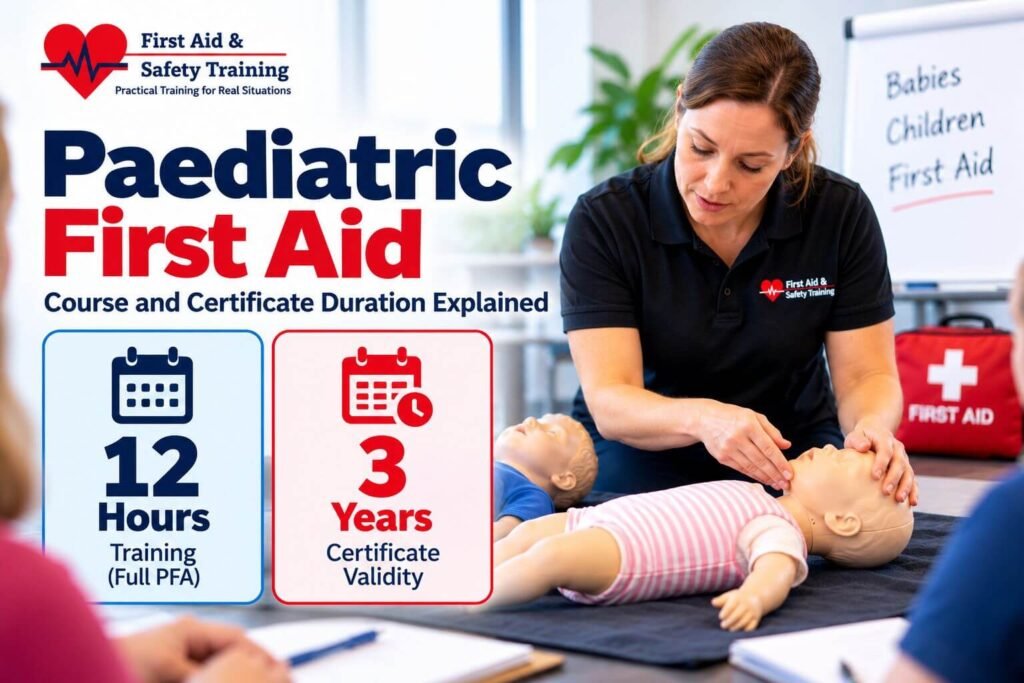
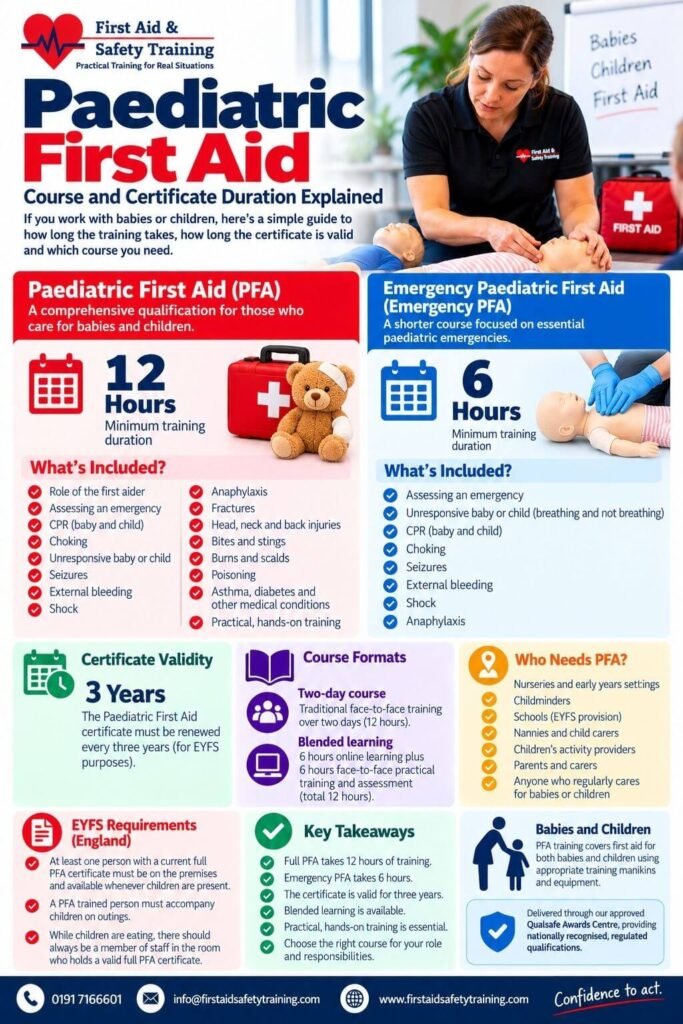
A full Paediatric First Aid, PFA, course requires a minimum of 12 hours of training, while the resulting certificate must be renewed every three years when it is being used to meet the Early Years Foundation Stage, EYFS, requirements in England. GOV.UK
Depending on how the course is delivered, those 12 hours may be completed through face-to-face training or an appropriate blended-learning programme combining online learning with practical face-to-face training and assessment.
There is also a shorter Emergency Paediatric First Aid course, which has a minimum duration of six hours.
Understanding the difference is particularly important for nurseries, childminders, schools and other early years providers because the shorter emergency course does not replace the full PFA course in every situation.
How Long Is a Full Paediatric First Aid Course?
A full Paediatric First Aid course involves a minimum of:
12 hours of training
Traditionally, this is often described as a two-day Paediatric First Aid course.
However, PFA does not always mean spending two complete days in a classroom.
An appropriate blended course can divide the learning between online study and face-to-face practical training.
For example, a common structure is:
6 hours online learning
plus
6 hours face-to-face practical training and assessment
Current local-authority PFA programmes use this 6+6 structure, and the overall course remains a 12-hour Paediatric First Aid programme. Devon County Council
The important point is that blended learning changes how the training is delivered, not the standard the learner needs to achieve.
How Long Does a Paediatric First Aid Certificate Last?
For EYFS purposes, a Paediatric First Aid certificate must be renewed every:
3 years
The current EYFS statutory framework is explicit about this requirement. GOV.UK
For example, if you complete your qualification in October 2026, you should not simply wait until sometime in 2029 to start thinking about renewal.
Check the actual expiry date shown on the certificate and arrange the required training in good time.
This is particularly important where an early years setting relies on a relatively small number of PFA-qualified employees.
An expired certificate can affect whether your staffing arrangements continue to meet the relevant requirements.
Why Does Full Paediatric First Aid Take 12 Hours?
Paediatric First Aid covers considerably more than CPR.
Learners need to develop the knowledge and practical skills required to respond to emergencies involving both babies and children.
The current EYFS criteria for effective PFA training cover areas including:
- Assessing an emergency
- Unresponsive babies and children
- Paediatric CPR
- Choking
- Seizures
- External bleeding
- Shock
- Anaphylaxis
- Fractures
- Head, neck and back injuries
- Foreign bodies
- Eye injuries
- Bites and stings
- Burns and scalds
- Electric shock
- Poisoning
- Febrile convulsions
- Asthma
- Meningitis
- Extreme heat and cold
- Diabetes
The training also needs to include appropriate practical equipment so learners can practise and demonstrate the required techniques.
Twelve hours therefore gives learners time to cover a substantial syllabus rather than simply learning basic CPR.
Is Paediatric First Aid a One-Day or Two-Day Course?
A full PFA course is a 12-hour programme, so it is commonly described as a two-day qualification.
However, blended learning means the learner may only need to attend one face-to-face practical training day.
For example:
Traditional delivery: approximately two training days.
Blended delivery: part completed online, followed by the required practical face-to-face element.
This distinction can be extremely useful for early years employers.
Releasing several nursery employees for two full working days can be difficult. Blended learning can reduce the amount of time staff spend away from the setting while still allowing practical skills to be taught and assessed properly.
Can Paediatric First Aid Be Completed Online?
Not as an online-only course if you need a full course meeting the EYFS criteria.
Online learning can form part of an appropriate blended Paediatric First Aid course, but practical first-aid skills require hands-on training and assessment.
This makes sense when you consider what learners actually need to do.
You can learn the theory behind CPR online.
A video can demonstrate how to manage a choking baby.
An online module can explain the signs of anaphylaxis.
But a screen cannot properly replace physically practising skills such as CPR on appropriate manikins and demonstrating practical competence.
The current EYFS criteria require suitable resuscitation and other equipment, including baby and junior models, so trainees can practise and demonstrate techniques. GOV.UK
Online learning is therefore useful as part of the training, rather than a substitute for all practical training.
What Is Emergency Paediatric First Aid?
Emergency Paediatric First Aid is a shorter course concentrating on essential paediatric emergencies.
The minimum duration is:
6 hours
The emergency PFA course must be undertaken face to face and covers areas including:
- Assessing an emergency
- An unresponsive baby or child who is breathing
- An unresponsive baby or child who is not breathing normally
- Seizures
- Choking
- External bleeding
- Shock
- Anaphylaxis
This is useful training, but it should not automatically be treated as interchangeable with the full 12-hour Paediatric First Aid course.
What Is the Difference Between Emergency PFA and Full PFA?
The biggest differences are duration and scope.
| Emergency Paediatric First Aid | Full Paediatric First Aid | |
|---|---|---|
| Minimum training time | 6 hours | 12 hours |
| Main focus | Paediatric emergencies | Broader paediatric first aid |
| Practical training | Yes | Yes |
| CPR and choking | Yes | Yes |
| Anaphylaxis | Yes | Yes |
| Wider injuries and illnesses | More limited | Yes |
| Suitable as the required full EYFS PFA certificate | No | Yes |
This last point is particularly important.
A person may legitimately hold an Emergency Paediatric First Aid qualification, but that does not turn a six-hour course into the full PFA course required for certain EYFS responsibilities.
Who Needs the Full Paediatric First Aid Course?
For early years provision in England, the current EYFS statutory framework requires:
At least one person with a current full Paediatric First Aid certificate to be on the premises and available whenever children are present.
A person holding the appropriate certificate must also accompany children on outings. GOV.UK
Settings should not simply stop at the number one.
The EYFS also tells providers to consider the number of children, number of staff and layout of the premises so a paediatric first aider can respond quickly to an emergency. GOV.UK
A large nursery spread across several rooms may therefore need more PFA-trained people than a simple interpretation of “at least one” might suggest.
What Changed in the EYFS in 2026?
There is an important requirement for early years providers to be aware of.
Under the current EYFS framework, while children are eating, there should always be a member of staff in the room who holds a valid full Paediatric First Aid certificate. GOV.UK
This makes PFA coverage even more important when settings organise:
- Meal times
- Snack times
- Staff breaks
- Different rooms
- Shift patterns
- Holidays
- Sickness
- Outings
Having one qualified person somewhere in the building may not provide the coverage a setting actually needs throughout its working day.
Do All Nursery Staff Need Paediatric First Aid?
The EYFS does not simply state that every person working in a nursery must hold full PFA.
However, there are specific requirements affecting staff qualifications and staff-to-child ratios.
The current Department for Education guidance states that staff who obtained a Level 2 or Level 3 early years qualification on or after 30 June 2016 must obtain either full PFA or Emergency PFA within three months of starting work if they are to be included in the required staff-to-child ratios at Level 2 or Level 3. GOV.UK
Separate requirements still apply to having a person with a full PFA certificate available when children are present.
This distinction matters when settings plan their training.
Do not assume that because several employees hold Emergency PFA, the setting automatically has the required full PFA provision.
Should Nurseries Train More Than the Minimum Number of Staff?
There can be strong practical reasons to do so.
Imagine a nursery relies on one person holding the required full PFA certificate.
What happens when that person:
- Takes annual leave?
- Calls in sick?
- Attends training?
- Takes their lunch break?
- Accompanies children on an outing?
- Leaves the organisation?
- Is working in another part of the building?
The Department for Education encourages settings to have more than one PFA-trained member of staff present with young children, and providers must consider whether a paediatric first aider can respond quickly. GOV.UK
Training several staff members can make first-aid provision much more resilient.
Do Childminders Need Paediatric First Aid?
Childminders operating within the EYFS framework have their own statutory framework and need to meet the applicable Paediatric First Aid requirements.
For someone working alone as a childminder, first-aid competence is particularly important.
There may be no colleague nearby to take over during an emergency.
That makes practical training involving babies and children especially valuable rather than treating PFA purely as a certificate needed for registration or compliance.
Does Paediatric First Aid Cover Babies as Well as Children?
Yes.
A proper Paediatric First Aid course includes first aid for both babies and children.
This is one of the reasons appropriate training equipment matters.
Learners should practise using baby and child manikins rather than simply watching an adult CPR demonstration.
Resuscitation techniques differ according to the casualty’s age.
Choking procedures also differ for babies and older children.
Practical training gives learners an opportunity to experience those differences before they are faced with a genuine emergency.
Does Paediatric First Aid Include CPR?
Yes.
Paediatric CPR is a fundamental part of the qualification.
Learners practise responding to an unresponsive baby or child who is not breathing normally.
Training includes the appropriate resuscitation sequence and practical CPR techniques for different age groups.
At First Aid and Safety Training, this is taught practically using appropriate training manikins.
Knowing the sequence from a book is useful.
Being able to perform it confidently is far more important.
Does Paediatric First Aid Include AED Training?
Yes, appropriate AED awareness and use form part of modern resuscitation training.
AEDs, or automated external defibrillators, can be used during cardiac arrest.
Learners should understand how an AED fits into CPR and become familiar with following the device’s instructions.
AED trainers allow this to be practised safely during a course without delivering a real shock.
Does Paediatric First Aid Cover Choking?
Yes.
Choking is particularly important in paediatric training because procedures differ between babies and older children.
Learners need to recognise when a child is genuinely choking and understand the appropriate sequence of actions.
The practical element matters here too.
Someone caring for babies or young children should not encounter a serious choking emergency for the first time with only an online video to draw upon.
Does Paediatric First Aid Cover Allergies and Anaphylaxis?
Yes.
Full PFA training includes recognising and responding to anaphylaxis, and the EYFS criteria include anaphylaxis within both emergency and full PFA content. GOV.UK
However, PFA is a broad first-aid qualification.
It is not primarily an allergy-management qualification.
A school, nursery or other organisation wanting more detailed training around allergy awareness, prevention, recognising reactions, emergency procedures and the use of adrenaline auto-injectors may benefit from dedicated allergy and anaphylaxis training.
First Aid and Safety Training also provides specialist Allergy and Anaphylaxis training, including our regulated Level 3 qualification.
We will shortly be adding a separate guide explaining how long allergy and anaphylaxis training takes, so this article can link directly to that once it is published.
Does PFA Cover Asthma?
Yes.
Full Paediatric First Aid includes common medical emergencies affecting babies and children, including asthma.
Learners need to understand how to recognise that a child is experiencing breathing difficulties, provide appropriate first aid and know when emergency medical assistance is required.
This forms part of the wider medical-emergencies content that distinguishes full PFA from shorter emergency training.
What Happens When a Paediatric First Aid Certificate Expires?
If the certificate is being relied upon to meet EYFS requirements, do not allow it simply to lapse.
The framework states that PFA training must be renewed every three years. GOV.UK
An expired certificate is no longer a current PFA certificate.
For an early years provider, that could create an immediate problem if the person was required to satisfy the setting’s PFA arrangements.
This is why we recommend recording:
- Employee name
- Qualification held
- Training date
- Certificate expiry date
- Planned renewal date
Do not leave renewal until the final week.
Book the course early enough to maintain continuous cover.
Is There a Shorter PFA Requalification Course?
Do not assume paediatric renewal works in exactly the same way as FAW requalification.
The EYFS requirement is that the PFA training leading to the certificate or renewal certificate meets the relevant criteria, including the required training duration.
For a full EYFS-compliant PFA certificate, the training leading to the certificate or renewal is a minimum of 12 hours. Salford City Council
In practical terms, someone renewing full PFA should expect to complete the appropriate full renewal training rather than assuming there is automatically a short half-day refresher that renews the certificate.
Should You Wait Three Years Before Practising Paediatric First Aid Again?
No rule says you should forget about first aid until renewal day.
Three years is a long time to retain practical skills that you may rarely use.
Think about CPR.
Hopefully, a nursery practitioner will never need to resuscitate a child.
That is obviously a good thing.
However, it also means they may go years without performing CPR outside a training environment.
Short practical refreshers between formal qualifications can help staff maintain confidence and familiarity with emergency procedures.
They do not replace the required renewal qualification, but they can be valuable.
Is Paediatric First Aid Only for Nursery Staff?
No.
PFA training can be useful for anyone regularly responsible for babies or children.
That can include:
- Nursery practitioners
- Childminders
- Preschool staff
- School staff
- Teaching assistants
- Nannies
- Sports coaches
- Children’s activity providers
- Youth workers
- Parents and carers
Whether someone specifically needs the full regulated qualification depends on their role and the requirements that apply to their setting.
Someone learning first aid for personal reasons may have different requirements from an early years practitioner who needs a certificate for work.
Does a School Need Paediatric First Aid?
Schools with early years provision need to consider the EYFS requirements applying to those children.
Department for Education guidance confirms that early years providers, including schools, must meet the PFA requirements in the EYFS framework. GOV.UK
Schools may also have first-aid needs beyond early years.
For example, a school might need to consider:
- Workplace first aid for employees
- Paediatric First Aid for EYFS provision
- First aid arrangements for pupils
- Educational visits
- Sports activities
- Pupils with known medical conditions
- Allergy and anaphylaxis procedures
This means one type of first-aid course does not necessarily meet every training need across an entire school.
Is Paediatric First Aid the Same as First Aid at Work?
No.
There is some overlap in core first-aid principles, but the qualifications have different purposes.
First Aid at Work, FAW, is designed around workplace first-aid requirements.
Paediatric First Aid, PFA, is specifically focused on emergencies involving babies and children and is particularly important within early years provision.
An FAW certificate should not simply be assumed to replace the full PFA certificate required by the EYFS.
Likewise, PFA should not automatically be treated as the workplace first-aid qualification identified through an employer’s first-aid needs assessment.
Some organisations may need both types of training.
How Long Does PFA Take Compared With Other First Aid Courses?
Here is the simple comparison:
| Course | Typical training duration |
|---|---|
| Emergency First Aid at Work, EFAW | 1 day / minimum 6 guided learning hours |
| First Aid at Work, FAW | 3 days / minimum 18 guided learning hours |
| Emergency Paediatric First Aid | Minimum 6 hours |
| Full Paediatric First Aid | Minimum 12 hours |
| FAW Requalification | 2 days / minimum 12 guided learning hours |
If you want to compare these qualifications in more detail, read our guide to how long a first aid course takes.
Can Paediatric First Aid Be Delivered at Our Nursery or School?
Yes.
Onsite PFA training can be particularly useful for nurseries, schools and other organisations that need several employees qualified at the same time.
Instead of sending staff individually to different open courses, training can be arranged specifically for your organisation.
At First Aid and Safety Training, we deliver PFA training for groups of up to 12 learners.
Onsite delivery can help reduce travel and make organising staff training easier.
It also provides an opportunity to discuss first-aid situations that are particularly relevant to the environment in which learners actually work.
How Much Does Paediatric First Aid Cost?
At First Aid and Safety Training, our current open-course guide price for Paediatric First Aid is approximately:
£147 per learner
For onsite PFA training, we use a minimum group size of six learners.
Additional learners can then be added up to our maximum of 12, with the total current course price capped at approximately £1,470 for 12 learners.
That effectively means a full group receives 12 places for the cost of 10 at the current pricing structure.
Prices can change, so always check the current course page or request a quotation before booking.
For a wider comparison of course costs, see our guide to how much a first aid course costs in the UK.
Are FAST Paediatric First Aid Courses Regulated Qualifications?
Yes.
First Aid and Safety Training is an approved Qualsafe Awards Centre.
Our relevant Paediatric First Aid training leads to a Qualsafe Awards regulated qualification.
Qualsafe Awards is an Ofqual-recognised awarding organisation.
That means the qualification is externally awarded and quality assured rather than being a certificate created solely by FAST.
This is particularly useful for organisations that want a nationally regulated qualification with external awarding-organisation oversight.
The EYFS itself recognises nationally regulated qualifications delivered under Ofqual awarding organisations as one of the routes providers may consider when selecting competent PFA training. GOV.UK
How Long Does Paediatric First Aid Last? The Simple Answer
If you are asking how long does Paediatric First Aid last, remember these two numbers:
12 hours
A full Paediatric First Aid course requires at least 12 hours of training.
3 years
The PFA certificate must be renewed every three years when used to meet EYFS requirements. GOV.UK
For Emergency Paediatric First Aid, the minimum course duration is six hours.
Blended learning can make the full qualification easier to organise by combining appropriate online learning with face-to-face practical training, but it does not remove the need for practical skills and assessment.
For nurseries and other early years settings, also remember that simply having one certificate on file is not the whole picture.
Your PFA arrangements need to work when children are actually present.
That means thinking about staffing, rooms, outings, breaks, absences and, under the current EYFS framework, ensuring a member of staff holding a valid full PFA certificate is in the room while children are eating. GOV.UK
Book Paediatric First Aid Training
First Aid and Safety Training provides practical Paediatric First Aid training for individuals, nurseries, schools, childminders and other organisations across the North East.
Our relevant PFA training is delivered through our approved Qualsafe Awards Centre, giving successful learners a regulated qualification backed by an Ofqual-recognised awarding organisation.
Whether you need one place on an open course or want to arrange training for a team at your premises, we can help you choose the appropriate option.
Explore our first aid training courses, book a first aid course or contact First Aid and Safety Training to discuss Paediatric First Aid training for your organisation.
For early years providers, the current EYFS statutory framework on GOV.UK provides the underlying requirements for Paediatric First Aid in England.
You can also find First Aid and Safety Training on Google and see our business information and customer reviews.