Skip to content
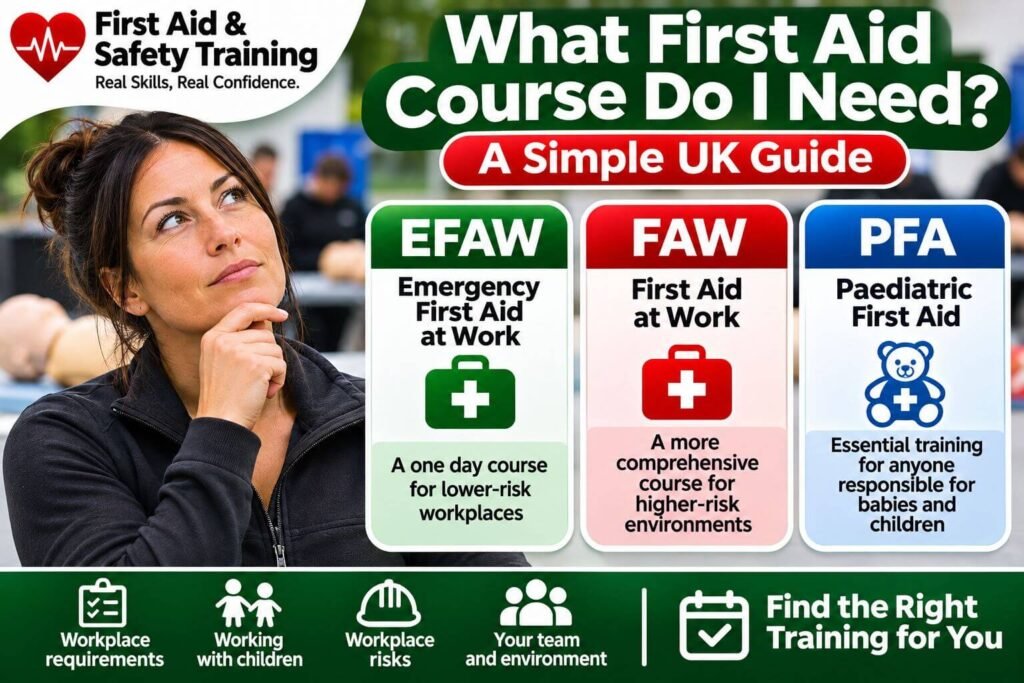
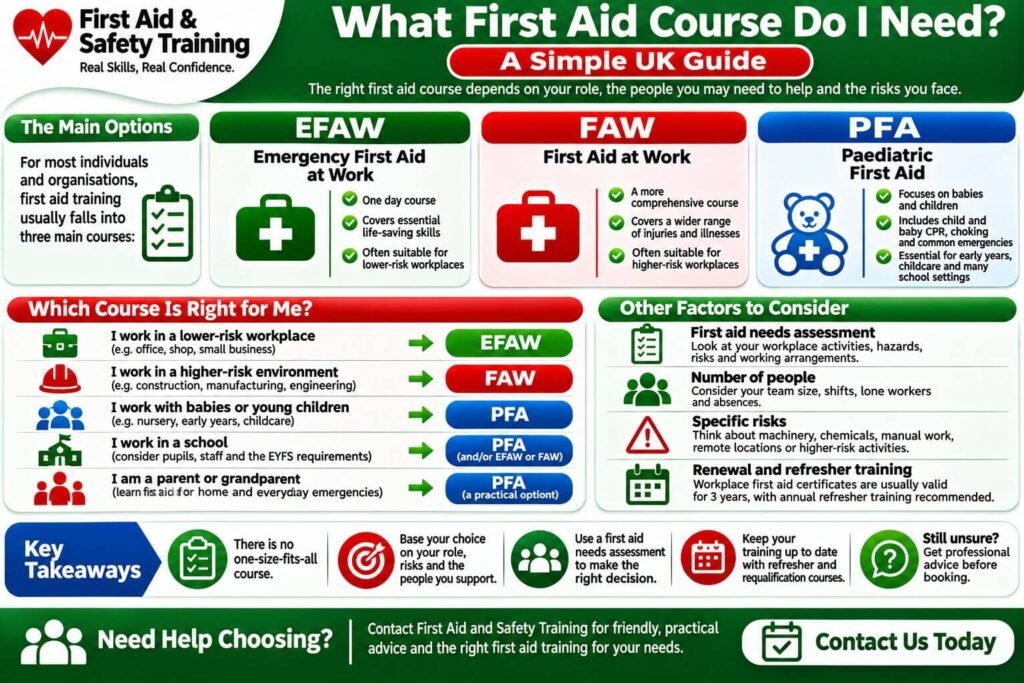
If you are asking what first aid course do I need, the answer depends on why you need first aid training, who you may need to help and the risks you are likely to encounter.
Someone responsible for first aid in a small office may need different training from a first aider working in construction, manufacturing or engineering. A nursery practitioner has different requirements again, while a parent learning first aid for personal reasons may not need a workplace qualification at all.
For most people, the choice comes down to:
- Emergency First Aid at Work
- First Aid at Work
- Paediatric First Aid
- specialist or additional first aid training
The important thing is to choose a course that matches what you actually need rather than simply booking the shortest or cheapest option.
What First Aid Course Do I Need for Work?
For most workplaces, the two qualifications you are most likely to consider are:
Emergency First Aid at Work, EFAW
or
First Aid at Work, FAW
The Health and Safety Executive describes EFAW and FAW as the main building blocks of workplace first aid training.
EFAW enables a first aider to provide emergency first aid to somebody who becomes injured or ill at work.
FAW includes the EFAW syllabus but goes further, preparing the first aider to deal with a broader range of specific injuries and illnesses.
The correct choice should come from your first aid needs assessment.
Start with Your First Aid Needs Assessment
Employers should not choose first aid training simply by looking at the number of employees.
Your first aid needs assessment should consider factors such as:
- the type of work you do
- workplace hazards
- the likelihood of those hazards causing harm
- the size of your workforce
- working patterns
- shifts
- holidays and absences
- previous accidents
- lone workers
- travelling workers
- remote workers
- distance from emergency medical services
- members of the public and other non-employees
- any additional first aid risks specific to your organisation
The assessment helps determine both which first aid course you need and how many trained people you need.
You can read our guide to how many first aiders a workplace needs for more help with this part of your planning.
When Is Emergency First Aid at Work Suitable?
Emergency First Aid at Work is commonly known as EFAW.
It is normally delivered over one day.
EFAW is often appropriate where a workplace needs trained first aiders but its first aid needs assessment indicates that the broader FAW qualification is not required.
It can be particularly suitable for many lower-risk working environments.
Examples might include:
- offices
- small shops
- professional services
- some hospitality businesses
- community organisations
- smaller workplaces with relatively low-risk activities
However, the type of business alone does not determine the answer.
Two businesses with the same number of employees could have completely different first aid requirements because their activities and risks are different.
What Does Emergency First Aid at Work Cover?
EFAW concentrates on the essential skills needed to respond to common workplace emergencies.
Training includes areas such as:
- assessing an emergency
- casualty assessment
- CPR
- using an AED
- an unresponsive casualty
- choking
- seizures
- bleeding
- shock
- minor injuries
It is practical training designed to give learners the confidence to act during an emergency.
If you are unsure how EFAW differs from the longer qualification, our guide to the different types of first aid training provides a wider comparison.
When Do I Need First Aid at Work?
First Aid at Work is usually referred to as FAW.
It provides a broader level of training than EFAW.
FAW is particularly relevant where a first aid needs assessment identifies more significant workplace risks or a need for first aiders who can deal with a wider range of injuries and illnesses.
This can include workplaces involving:
- machinery
- tools
- hazardous materials
- manual work
- construction
- manufacturing
- engineering
- warehouses
- agriculture
- more significant injury risks
- larger or more complex working environments
HSE specifically notes that workplaces with more significant health and safety risks, such as those using machinery or hazardous materials, are more likely to need a trained first aider.
The needs assessment should still make the final determination.
What Does First Aid at Work Cover?
FAW includes the emergency skills taught within EFAW but expands into a broader range of conditions and injuries.
Depending on the current qualification specification, this can include areas such as:
- CPR and AED use
- unconscious casualties
- choking
- severe bleeding
- shock
- burns
- fractures
- head injuries
- chest injuries
- eye injuries
- poisoning
- anaphylaxis
- asthma
- seizures
- diabetes
- stroke
- heart attack
- spinal injuries
- heat and cold emergencies
- minor injuries
The course gives workplace first aiders a much wider knowledge base.
That is why choosing between EFAW and FAW should be based on the risks people may realistically encounter.
EFAW or FAW: Which One Do I Need?
A simple way to think about the difference is:
EFAW
Best suited where the needs assessment identifies a requirement for emergency workplace first aid skills without the wider FAW syllabus.
FAW
Best suited where the needs assessment identifies a need to deal with a broader range of workplace injuries and illnesses.
Do not automatically assume:
small business = EFAW
or
large business = FAW.
Employee numbers matter, but so do hazards, working arrangements and the nature of the business.
A small engineering workshop could present considerably greater first aid risks than a much larger office.
Does the Law Say Which First Aid Course I Must Take?
The Health and Safety (First-Aid) Regulations 1981 require employers to provide adequate and appropriate first aid equipment, facilities and personnel so employees can receive immediate help if they are injured or become ill at work.
The law does not simply state that every employer must put somebody through one particular course.
Employers need to assess their circumstances and make appropriate arrangements.
Where the assessment identifies that trained first aiders are required, their training should be appropriate to the circumstances.
Our guide to the legal requirement for first aid at work explains these responsibilities in more detail.
Does HSE Approve First Aid Courses?
This is an area where there is still some outdated information online.
HSE no longer approves ordinary workplace first aid training organisations or individual FAW and EFAW courses.
That approval requirement ended in 2013.
Employers are responsible for selecting a competent training provider.
One option is a provider offering regulated qualifications through a recognised awarding organisation.
First Aid and Safety Training is a Qualsafe Awards Approved Training Centre, and our regulated workplace first aid qualifications are awarded through Qualsafe Awards, an Ofqual-recognised awarding organisation.
This gives employers a clear externally quality-assured route when choosing their training.
What If My Workplace Is Very Low Risk?
Your needs assessment may conclude that a trained first aider is not required.
In those circumstances, the minimum workplace arrangements still include an appointed person to take charge of first aid arrangements.
An appointed person’s role can include:
- looking after first aid equipment and facilities
- taking charge of first aid arrangements
- calling an ambulance or other professional help when required
An appointed person does not have to undertake formal first aid training simply to perform that role.
However, many organisations choose to provide first aid training because they want staff to have practical emergency skills rather than only meeting the minimum arrangements.
An appointed person who successfully completes EFAW can become a workplace first aider.
What First Aid Course Do I Need If I Work with Children?
If you work with babies or young children, you may need Paediatric First Aid rather than relying solely on a workplace EFAW or FAW qualification.
Paediatric first aid covers emergencies involving babies and children, including important differences in:
- CPR
- choking
- casualty assessment
- medical emergencies
- injuries
Standard workplace first aid training should not simply be treated as a substitute for paediatric first aid where specific paediatric requirements apply.
This is particularly important in early years settings.
What First Aid Course Do Nursery Staff Need?
Early years providers in England must meet the Paediatric First Aid requirements contained within the Early Years Foundation Stage, EYFS, statutory framework.
The EYFS requires at least one person with a current full Paediatric First Aid certificate to be available on the premises at all times when children are present and to accompany children on outings.
There are also specific PFA requirements affecting staff holding relevant Level 2 and Level 3 childcare qualifications.
If you work in:
- a nursery
- preschool
- early years provision
- childcare
you should check your responsibilities carefully rather than simply booking EFAW.
Our Paediatric First Aid training is designed for people responsible for babies and children.
You can also read what Paediatric First Aid covers if you want to understand the course content before booking.
What First Aid Course Do School Staff Need?
Schools can have more than one type of first aid requirement.
Staff first aid arrangements need to consider employees, while schools should also consider pupils and other people who may require assistance.
Where early years children are involved, the EYFS Paediatric First Aid requirements may also apply.
A school could therefore require a mixture of:
- EFAW
- FAW
- Paediatric First Aid
- additional training relevant to particular pupils or risks
One course does not necessarily cover every requirement within a school.
Do I Need Paediatric First Aid or Emergency Paediatric First Aid?
There are different levels of paediatric first aid training.
For people who need to satisfy specific EYFS requirements, it is particularly important to establish whether you need the full Paediatric First Aid qualification rather than assuming a shorter emergency course will meet your needs.
The full course provides broader training for people with responsibility for babies and children.
If your employer or childcare setting has told you that you need Paediatric First Aid, check exactly which qualification they require before booking.
What Course Do I Need If I Am a Parent or Grandparent?
Parents and grandparents do not normally need a workplace qualification simply to learn first aid.
Your priority is learning useful skills for emergencies involving babies and children.
These could include:
- baby CPR
- child CPR
- choking
- seizures
- bleeding
- burns
- head injuries
- allergic reactions
- common childhood emergencies
You can read our child and baby CPR guide to understand some of the important differences from adult CPR.
If you want practical training, look for a course or workshop specifically designed around first aid for babies and children.
What First Aid Course Do I Need for Construction?
Construction can involve significant workplace hazards.
These may include:
- falls from height
- machinery
- power tools
- vehicles
- severe bleeding
- crush injuries
- fractures
- electrical incidents
The employer’s first aid needs assessment should determine the appropriate level of provision.
Depending on the size, hazards and circumstances of the site, FAW may be more appropriate than relying solely on basic emergency training.
Additional training may also be necessary where specific risks have been identified.
What Course Do I Need for a Factory, Warehouse or Engineering Business?
Again, start with the needs assessment.
Factors could include:
- machinery
- cutting equipment
- vehicles
- forklifts
- chemicals
- manual handling
- falls
- severe bleeding
- burns
- crush injuries
- electrical risks
- shift patterns
- number of employees
A business with these types of hazards may decide that the broader First Aid at Work qualification is appropriate.
Specialist training can then be added where the risk assessment identifies a particular need.
Do I Need Additional Training for Severe Bleeding?
Possibly.
HSE guidance specifically tells employers to consider whether life-threatening bleeding is a foreseeable workplace risk.
That may be particularly relevant in environments involving:
- cutting machinery
- power tools
- construction
- agriculture
- engineering
- glass
- metalwork
- remote work
Additional training and equipment may be appropriate where the needs assessment identifies the risk.
Our guide to severe bleeding first aid explains the principles of direct pressure, wound packing and tourniquet use.
What If Someone at Work Has a Specific Medical Condition?
Your needs assessment may identify circumstances requiring additional consideration.
Examples might include employees or others at particular risk from:
- severe allergies
- asthma
- diabetes
- epilepsy
- other known medical conditions
This does not mean employers should attempt to turn workplace first aiders into healthcare professionals.
It means first aid arrangements should reflect foreseeable needs.
For example, an organisation where severe allergy is a recognised risk may benefit from additional allergy and anaphylaxis training.
Do I Need a Separate CPR and AED Course?
EFAW and FAW already include CPR and AED training.
Therefore, if you are completing one of these qualifications for your workplace role, you would not normally need a separate basic CPR and AED course simply to learn those skills.
However, a dedicated CPR and AED course can be useful where an organisation wants to train a larger number of people specifically in:
- recognising cardiac arrest
- CPR
- AED use
without putting everyone through a complete workplace first aid qualification.
This can be particularly useful for community organisations, sports settings and workplaces that want wider emergency preparedness.
Do I Need First Aid Training to Use an AED?
You do not need to hold a first aid qualification before using an AED in an emergency.
AEDs are designed to provide spoken and visual instructions to the rescuer.
If somebody is in cardiac arrest, do not delay using an available AED because nobody present has an AED certificate.
Training is still extremely valuable because it gives people confidence to recognise cardiac arrest, start CPR and use the AED quickly.
Our guide on how to use an AED explains the process.
What First Aid Course Do I Need for Sport?
The right training depends on:
- the sport
- participants’ ages
- level of activity
- governing body requirements
- location
- access to emergency medical help
- foreseeable injuries
A children’s sports club may need to consider paediatric skills.
A remote outdoor activity may require additional training beyond a standard workplace course.
Always check whether your governing body, employer or organisation specifies a particular qualification.
What First Aid Course Do I Need for Outdoor or Remote Work?
Standard EFAW or FAW training may form the basis of your first aid provision, but remote environments can create additional problems.
Consider:
- how long an ambulance may take to arrive
- communication difficulties
- weather
- hypothermia
- heat illness
- difficult terrain
- evacuation
- prolonged casualty care
- activity-specific injuries
The farther you are from professional medical help, the more important the first aid needs assessment becomes.
Additional or specialist training may be appropriate.
What If I Need First Aid for an SIA Licence?
The security industry has specific first aid requirements linked to certain SIA licence-linked qualifications.
Do not assume that any certificate with the words “first aid” on it will automatically meet those requirements.
Check the current SIA requirements for your particular licence and training before booking.
We have a separate guide explaining what first aid course is required for an SIA licence, which looks at this in more detail.
What If I Already Have a First Aid Certificate?
Check:
- which qualification you hold
- when it expires
- whether it still matches your role
EFAW and FAW certificates used for workplace first aid purposes are normally valid for three years.
Before the certificate expires, the first aider should complete the appropriate requalification training.
HSE also strongly recommends annual refresher training to help first aiders maintain their basic skills.
Our guide to first aid refresher vs requalification explains the important difference between keeping your skills fresh and renewing an expiring qualification.
Is an Annual Refresher a New Qualification?
No.
Annual refresher training helps first aiders practise and maintain important skills.
It does not replace the appropriate requalification course when your workplace first aid certificate is due to expire.
This is one reason it is important to know exactly what training you are booking.
Can I Complete My First Aid Course Online?
That depends on the course.
Some first aid qualifications can use an approved blended learning format, where suitable theory is completed online and practical training and assessment take place face to face.
However, a video-only or online-only course should not automatically be treated as equivalent to a practical regulated first aid qualification.
First aid includes practical skills that learners need to demonstrate.
If you require training for a workplace, childcare setting, professional role or licence, check that the format you choose satisfies the relevant requirements.
Does My First Aid Qualification Need to Be Regulated?
Not every person learning first aid for personal interest needs a regulated qualification.
However, where an employer needs evidence that a first aider has completed appropriate workplace training, choosing a regulated qualification provides a clear quality-assured route.
HSE recognises regulated qualifications from awarding organisations as one of the routes employers can consider when selecting a competent training provider.
The qualification is regulated through the recognised awarding organisation, rather than the training company itself being “Ofqual approved”.
That distinction matters.
How Long Do First Aid Courses Take?
The length depends on the qualification.
As a general guide:
- Emergency First Aid at Work is normally one day
- First Aid at Work involves considerably more training and assessment
- Paediatric First Aid involves the required paediatric learning and practical assessment and may be delivered through an appropriate blended format
Our guide to how long a first aid course takes compares the main options in more detail.
Do not choose solely on duration.
The shortest course is only the right course if it meets your needs.
How Much Does a First Aid Course Cost?
Prices depend on factors including:
- qualification
- course length
- awarding organisation fees
- training materials
- open course or onsite delivery
- number of learners
If several employees need the same training, onsite delivery can often be a practical option because the trainer comes to your workplace.
Our guide to how much a first aid course costs in the UK explains the different factors that influence pricing.
Open Course or Onsite First Aid Training?
Once you know what first aid course you need, the next decision is often how you want it delivered.
Open Courses
Open courses are useful for:
- individuals
- businesses training one or two people
- people renewing qualifications
- organisations that cannot release a full group at once
You attend one of our scheduled courses alongside learners from other organisations.
Onsite Training
Onsite training can be particularly useful when several employees need the same qualification.
Benefits include:
- training at your workplace
- less employee travel
- easier scheduling
- training a team together
- discussing examples relevant to your working environment
Explore our onsite first aid training across the North East if you are organising training for a team.
What First Aid Course Do I Need? Quick Guide
If you are still unsure, this is a useful starting point:
I work in a lower-risk workplace
Consider Emergency First Aid at Work, subject to your first aid needs assessment.
I work in a higher-risk workplace
Consider First Aid at Work, particularly where your needs assessment identifies a wider range of foreseeable injuries or illnesses.
I work in a nursery or early years setting
Check your EYFS Paediatric First Aid requirements. You may need the full Paediatric First Aid qualification.
I work with children outside early years
Consider whether Paediatric First Aid is appropriate alongside any workplace first aid requirements.
I am a parent or grandparent
Look for practical baby and child first aid training rather than assuming you need a workplace qualification.
I need first aid for a professional licence
Check the exact requirements of the relevant regulator or governing body before booking.
My workplace has specialist risks
Complete your first aid needs assessment and consider whether you need additional training alongside EFAW or FAW.
I only want to learn CPR and AED skills
A focused CPR and AED course may be suitable if you do not require a wider workplace first aid qualification.
Still Unsure What First Aid Course You Need?
You do not need to guess.
If you are responsible for first aid at work, start with your first aid needs assessment.
The Health and Safety Executive’s guidance on assessing first aid needs explains the factors employers should consider.
HSE also provides guidance on first aiders and first aid training.
For early years settings, the Government’s first aid guidance for schools and early years providers explains how workplace and Paediatric First Aid requirements interact.
If you would prefer to talk it through, contact First Aid and Safety Training.
Tell us:
- what your organisation does
- approximately how many people you employ
- the main hazards involved
- who your first aid provision needs to cover
- whether you already have trained first aiders
We can help you understand the available training options so that you can make an informed decision.
First Aid Training Across the North East
First Aid and Safety Training provides regulated first aid qualifications and practical first aid training for individuals and organisations across the North East.
Our main courses include:
We also provide onsite training for organisations that need to train groups of employees.
Explore our North East first aid training options or contact us and we can help you identify the most appropriate training for your requirements.
You can also view our South Shields training centre and customer reviews on Google Maps.
Real Skills, Real Confidence.
If you are asking what first aid course do I need, the answer depends on why you need first aid training, who you may need to help and the risks you are likely to encounter.
Someone responsible for first aid in a small office may need different training from a first aider working in construction, manufacturing or engineering. A nursery practitioner has different requirements again, while a parent learning first aid for personal reasons may not need a workplace qualification at all.
For most people, the choice comes down to:
- Emergency First Aid at Work
- First Aid at Work
- Paediatric First Aid
- specialist or additional first aid training
The important thing is to choose a course that matches what you actually need rather than simply booking the shortest or cheapest option.
What First Aid Course Do I Need for Work?
For most workplaces, the two qualifications you are most likely to consider are:
Emergency First Aid at Work, EFAW
or
First Aid at Work, FAW
The Health and Safety Executive describes EFAW and FAW as the main building blocks of workplace first aid training.
EFAW enables a first aider to provide emergency first aid to somebody who becomes injured or ill at work.
FAW includes the EFAW syllabus but goes further, preparing the first aider to deal with a broader range of specific injuries and illnesses.
The correct choice should come from your first aid needs assessment.
Start with Your First Aid Needs Assessment
Employers should not choose first aid training simply by looking at the number of employees.
Your first aid needs assessment should consider factors such as:
- the type of work you do
- workplace hazards
- the likelihood of those hazards causing harm
- the size of your workforce
- working patterns
- shifts
- holidays and absences
- previous accidents
- lone workers
- travelling workers
- remote workers
- distance from emergency medical services
- members of the public and other non-employees
- any additional first aid risks specific to your organisation
The assessment helps determine both which first aid course you need and how many trained people you need.
You can read our guide to how many first aiders a workplace needs for more help with this part of your planning.
When Is Emergency First Aid at Work Suitable?
Emergency First Aid at Work is commonly known as EFAW.
It is normally delivered over one day.
EFAW is often appropriate where a workplace needs trained first aiders but its first aid needs assessment indicates that the broader FAW qualification is not required.
It can be particularly suitable for many lower-risk working environments.
Examples might include:
- offices
- small shops
- professional services
- some hospitality businesses
- community organisations
- smaller workplaces with relatively low-risk activities
However, the type of business alone does not determine the answer.
Two businesses with the same number of employees could have completely different first aid requirements because their activities and risks are different.
What Does Emergency First Aid at Work Cover?
EFAW concentrates on the essential skills needed to respond to common workplace emergencies.
Training includes areas such as:
- assessing an emergency
- casualty assessment
- CPR
- using an AED
- an unresponsive casualty
- choking
- seizures
- bleeding
- shock
- minor injuries
It is practical training designed to give learners the confidence to act during an emergency.
If you are unsure how EFAW differs from the longer qualification, our guide to the different types of first aid training provides a wider comparison.
When Do I Need First Aid at Work?
First Aid at Work is usually referred to as FAW.
It provides a broader level of training than EFAW.
FAW is particularly relevant where a first aid needs assessment identifies more significant workplace risks or a need for first aiders who can deal with a wider range of injuries and illnesses.
This can include workplaces involving:
- machinery
- tools
- hazardous materials
- manual work
- construction
- manufacturing
- engineering
- warehouses
- agriculture
- more significant injury risks
- larger or more complex working environments
HSE specifically notes that workplaces with more significant health and safety risks, such as those using machinery or hazardous materials, are more likely to need a trained first aider.
The needs assessment should still make the final determination.
What Does First Aid at Work Cover?
FAW includes the emergency skills taught within EFAW but expands into a broader range of conditions and injuries.
Depending on the current qualification specification, this can include areas such as:
- CPR and AED use
- unconscious casualties
- choking
- severe bleeding
- shock
- burns
- fractures
- head injuries
- chest injuries
- eye injuries
- poisoning
- anaphylaxis
- asthma
- seizures
- diabetes
- stroke
- heart attack
- spinal injuries
- heat and cold emergencies
- minor injuries
The course gives workplace first aiders a much wider knowledge base.
That is why choosing between EFAW and FAW should be based on the risks people may realistically encounter.
EFAW or FAW: Which One Do I Need?
A simple way to think about the difference is:
EFAW
Best suited where the needs assessment identifies a requirement for emergency workplace first aid skills without the wider FAW syllabus.
FAW
Best suited where the needs assessment identifies a need to deal with a broader range of workplace injuries and illnesses.
Do not automatically assume:
small business = EFAW
or
large business = FAW.
Employee numbers matter, but so do hazards, working arrangements and the nature of the business.
A small engineering workshop could present considerably greater first aid risks than a much larger office.
Does the Law Say Which First Aid Course I Must Take?
The Health and Safety (First-Aid) Regulations 1981 require employers to provide adequate and appropriate first aid equipment, facilities and personnel so employees can receive immediate help if they are injured or become ill at work.
The law does not simply state that every employer must put somebody through one particular course.
Employers need to assess their circumstances and make appropriate arrangements.
Where the assessment identifies that trained first aiders are required, their training should be appropriate to the circumstances.
Our guide to the legal requirement for first aid at work explains these responsibilities in more detail.
Does HSE Approve First Aid Courses?
This is an area where there is still some outdated information online.
HSE no longer approves ordinary workplace first aid training organisations or individual FAW and EFAW courses.
That approval requirement ended in 2013.
Employers are responsible for selecting a competent training provider.
One option is a provider offering regulated qualifications through a recognised awarding organisation.
First Aid and Safety Training is a Qualsafe Awards Approved Training Centre, and our regulated workplace first aid qualifications are awarded through Qualsafe Awards, an Ofqual-recognised awarding organisation.
This gives employers a clear externally quality-assured route when choosing their training.
What If My Workplace Is Very Low Risk?
Your needs assessment may conclude that a trained first aider is not required.
In those circumstances, the minimum workplace arrangements still include an appointed person to take charge of first aid arrangements.
An appointed person’s role can include:
- looking after first aid equipment and facilities
- taking charge of first aid arrangements
- calling an ambulance or other professional help when required
An appointed person does not have to undertake formal first aid training simply to perform that role.
However, many organisations choose to provide first aid training because they want staff to have practical emergency skills rather than only meeting the minimum arrangements.
An appointed person who successfully completes EFAW can become a workplace first aider.
What First Aid Course Do I Need If I Work with Children?
If you work with babies or young children, you may need Paediatric First Aid rather than relying solely on a workplace EFAW or FAW qualification.
Paediatric first aid covers emergencies involving babies and children, including important differences in:
- CPR
- choking
- casualty assessment
- medical emergencies
- injuries
Standard workplace first aid training should not simply be treated as a substitute for paediatric first aid where specific paediatric requirements apply.
This is particularly important in early years settings.
What First Aid Course Do Nursery Staff Need?
Early years providers in England must meet the Paediatric First Aid requirements contained within the Early Years Foundation Stage, EYFS, statutory framework.
The EYFS requires at least one person with a current full Paediatric First Aid certificate to be available on the premises at all times when children are present and to accompany children on outings.
There are also specific PFA requirements affecting staff holding relevant Level 2 and Level 3 childcare qualifications.
If you work in:
- a nursery
- preschool
- early years provision
- childcare
you should check your responsibilities carefully rather than simply booking EFAW.
Our Paediatric First Aid training is designed for people responsible for babies and children.
You can also read what Paediatric First Aid covers if you want to understand the course content before booking.
What First Aid Course Do School Staff Need?
Schools can have more than one type of first aid requirement.
Staff first aid arrangements need to consider employees, while schools should also consider pupils and other people who may require assistance.
Where early years children are involved, the EYFS Paediatric First Aid requirements may also apply.
A school could therefore require a mixture of:
- EFAW
- FAW
- Paediatric First Aid
- additional training relevant to particular pupils or risks
One course does not necessarily cover every requirement within a school.
Do I Need Paediatric First Aid or Emergency Paediatric First Aid?
There are different levels of paediatric first aid training.
For people who need to satisfy specific EYFS requirements, it is particularly important to establish whether you need the full Paediatric First Aid qualification rather than assuming a shorter emergency course will meet your needs.
The full course provides broader training for people with responsibility for babies and children.
If your employer or childcare setting has told you that you need Paediatric First Aid, check exactly which qualification they require before booking.
What Course Do I Need If I Am a Parent or Grandparent?
Parents and grandparents do not normally need a workplace qualification simply to learn first aid.
Your priority is learning useful skills for emergencies involving babies and children.
These could include:
- baby CPR
- child CPR
- choking
- seizures
- bleeding
- burns
- head injuries
- allergic reactions
- common childhood emergencies
You can read our child and baby CPR guide to understand some of the important differences from adult CPR.
If you want practical training, look for a course or workshop specifically designed around first aid for babies and children.
What First Aid Course Do I Need for Construction?
Construction can involve significant workplace hazards.
These may include:
- falls from height
- machinery
- power tools
- vehicles
- severe bleeding
- crush injuries
- fractures
- electrical incidents
The employer’s first aid needs assessment should determine the appropriate level of provision.
Depending on the size, hazards and circumstances of the site, FAW may be more appropriate than relying solely on basic emergency training.
Additional training may also be necessary where specific risks have been identified.
What Course Do I Need for a Factory, Warehouse or Engineering Business?
Again, start with the needs assessment.
Factors could include:
- machinery
- cutting equipment
- vehicles
- forklifts
- chemicals
- manual handling
- falls
- severe bleeding
- burns
- crush injuries
- electrical risks
- shift patterns
- number of employees
A business with these types of hazards may decide that the broader First Aid at Work qualification is appropriate.
Specialist training can then be added where the risk assessment identifies a particular need.
Do I Need Additional Training for Severe Bleeding?
Possibly.
HSE guidance specifically tells employers to consider whether life-threatening bleeding is a foreseeable workplace risk.
That may be particularly relevant in environments involving:
- cutting machinery
- power tools
- construction
- agriculture
- engineering
- glass
- metalwork
- remote work
Additional training and equipment may be appropriate where the needs assessment identifies the risk.
Our guide to severe bleeding first aid explains the principles of direct pressure, wound packing and tourniquet use.
What If Someone at Work Has a Specific Medical Condition?
Your needs assessment may identify circumstances requiring additional consideration.
Examples might include employees or others at particular risk from:
- severe allergies
- asthma
- diabetes
- epilepsy
- other known medical conditions
This does not mean employers should attempt to turn workplace first aiders into healthcare professionals.
It means first aid arrangements should reflect foreseeable needs.
For example, an organisation where severe allergy is a recognised risk may benefit from additional allergy and anaphylaxis training.
Do I Need a Separate CPR and AED Course?
EFAW and FAW already include CPR and AED training.
Therefore, if you are completing one of these qualifications for your workplace role, you would not normally need a separate basic CPR and AED course simply to learn those skills.
However, a dedicated CPR and AED course can be useful where an organisation wants to train a larger number of people specifically in:
- recognising cardiac arrest
- CPR
- AED use
without putting everyone through a complete workplace first aid qualification.
This can be particularly useful for community organisations, sports settings and workplaces that want wider emergency preparedness.
Do I Need First Aid Training to Use an AED?
You do not need to hold a first aid qualification before using an AED in an emergency.
AEDs are designed to provide spoken and visual instructions to the rescuer.
If somebody is in cardiac arrest, do not delay using an available AED because nobody present has an AED certificate.
Training is still extremely valuable because it gives people confidence to recognise cardiac arrest, start CPR and use the AED quickly.
Our guide on how to use an AED explains the process.
What First Aid Course Do I Need for Sport?
The right training depends on:
- the sport
- participants’ ages
- level of activity
- governing body requirements
- location
- access to emergency medical help
- foreseeable injuries
A children’s sports club may need to consider paediatric skills.
A remote outdoor activity may require additional training beyond a standard workplace course.
Always check whether your governing body, employer or organisation specifies a particular qualification.
What First Aid Course Do I Need for Outdoor or Remote Work?
Standard EFAW or FAW training may form the basis of your first aid provision, but remote environments can create additional problems.
Consider:
- how long an ambulance may take to arrive
- communication difficulties
- weather
- hypothermia
- heat illness
- difficult terrain
- evacuation
- prolonged casualty care
- activity-specific injuries
The farther you are from professional medical help, the more important the first aid needs assessment becomes.
Additional or specialist training may be appropriate.
What If I Need First Aid for an SIA Licence?
The security industry has specific first aid requirements linked to certain SIA licence-linked qualifications.
Do not assume that any certificate with the words “first aid” on it will automatically meet those requirements.
Check the current SIA requirements for your particular licence and training before booking.
We have a separate guide explaining what first aid course is required for an SIA licence, which looks at this in more detail.
What If I Already Have a First Aid Certificate?
Check:
- which qualification you hold
- when it expires
- whether it still matches your role
EFAW and FAW certificates used for workplace first aid purposes are normally valid for three years.
Before the certificate expires, the first aider should complete the appropriate requalification training.
HSE also strongly recommends annual refresher training to help first aiders maintain their basic skills.
Our guide to first aid refresher vs requalification explains the important difference between keeping your skills fresh and renewing an expiring qualification.
Is an Annual Refresher a New Qualification?
No.
Annual refresher training helps first aiders practise and maintain important skills.
It does not replace the appropriate requalification course when your workplace first aid certificate is due to expire.
This is one reason it is important to know exactly what training you are booking.
Can I Complete My First Aid Course Online?
That depends on the course.
Some first aid qualifications can use an approved blended learning format, where suitable theory is completed online and practical training and assessment take place face to face.
However, a video-only or online-only course should not automatically be treated as equivalent to a practical regulated first aid qualification.
First aid includes practical skills that learners need to demonstrate.
If you require training for a workplace, childcare setting, professional role or licence, check that the format you choose satisfies the relevant requirements.
Does My First Aid Qualification Need to Be Regulated?
Not every person learning first aid for personal interest needs a regulated qualification.
However, where an employer needs evidence that a first aider has completed appropriate workplace training, choosing a regulated qualification provides a clear quality-assured route.
HSE recognises regulated qualifications from awarding organisations as one of the routes employers can consider when selecting a competent training provider.
The qualification is regulated through the recognised awarding organisation, rather than the training company itself being “Ofqual approved”.
That distinction matters.
How Long Do First Aid Courses Take?
The length depends on the qualification.
As a general guide:
- Emergency First Aid at Work is normally one day
- First Aid at Work involves considerably more training and assessment
- Paediatric First Aid involves the required paediatric learning and practical assessment and may be delivered through an appropriate blended format
Our guide to how long a first aid course takes compares the main options in more detail.
Do not choose solely on duration.
The shortest course is only the right course if it meets your needs.
How Much Does a First Aid Course Cost?
Prices depend on factors including:
- qualification
- course length
- awarding organisation fees
- training materials
- open course or onsite delivery
- number of learners
If several employees need the same training, onsite delivery can often be a practical option because the trainer comes to your workplace.
Our guide to how much a first aid course costs in the UK explains the different factors that influence pricing.
Open Course or Onsite First Aid Training?
Once you know what first aid course you need, the next decision is often how you want it delivered.
Open Courses
Open courses are useful for:
- individuals
- businesses training one or two people
- people renewing qualifications
- organisations that cannot release a full group at once
You attend one of our scheduled courses alongside learners from other organisations.
Onsite Training
Onsite training can be particularly useful when several employees need the same qualification.
Benefits include:
- training at your workplace
- less employee travel
- easier scheduling
- training a team together
- discussing examples relevant to your working environment
Explore our onsite first aid training across the North East if you are organising training for a team.
What First Aid Course Do I Need? Quick Guide
If you are still unsure, this is a useful starting point:
I work in a lower-risk workplace
Consider Emergency First Aid at Work, subject to your first aid needs assessment.
I work in a higher-risk workplace
Consider First Aid at Work, particularly where your needs assessment identifies a wider range of foreseeable injuries or illnesses.
I work in a nursery or early years setting
Check your EYFS Paediatric First Aid requirements. You may need the full Paediatric First Aid qualification.
I work with children outside early years
Consider whether Paediatric First Aid is appropriate alongside any workplace first aid requirements.
I am a parent or grandparent
Look for practical baby and child first aid training rather than assuming you need a workplace qualification.
I need first aid for a professional licence
Check the exact requirements of the relevant regulator or governing body before booking.
My workplace has specialist risks
Complete your first aid needs assessment and consider whether you need additional training alongside EFAW or FAW.
I only want to learn CPR and AED skills
A focused CPR and AED course may be suitable if you do not require a wider workplace first aid qualification.
Still Unsure What First Aid Course You Need?
You do not need to guess.
If you are responsible for first aid at work, start with your first aid needs assessment.
The Health and Safety Executive’s guidance on assessing first aid needs explains the factors employers should consider.
HSE also provides guidance on first aiders and first aid training.
For early years settings, the Government’s first aid guidance for schools and early years providers explains how workplace and Paediatric First Aid requirements interact.
If you would prefer to talk it through, contact First Aid and Safety Training.
Tell us:
- what your organisation does
- approximately how many people you employ
- the main hazards involved
- who your first aid provision needs to cover
- whether you already have trained first aiders
We can help you understand the available training options so that you can make an informed decision.
First Aid Training Across the North East
First Aid and Safety Training provides regulated first aid qualifications and practical first aid training for individuals and organisations across the North East.
Our main courses include:
We also provide onsite training for organisations that need to train groups of employees.
Explore our North East first aid training options or contact us and we can help you identify the most appropriate training for your requirements.
You can also view our South Shields training centre and customer reviews on Google Maps.
Real Skills, Real Confidence.