Skip to content
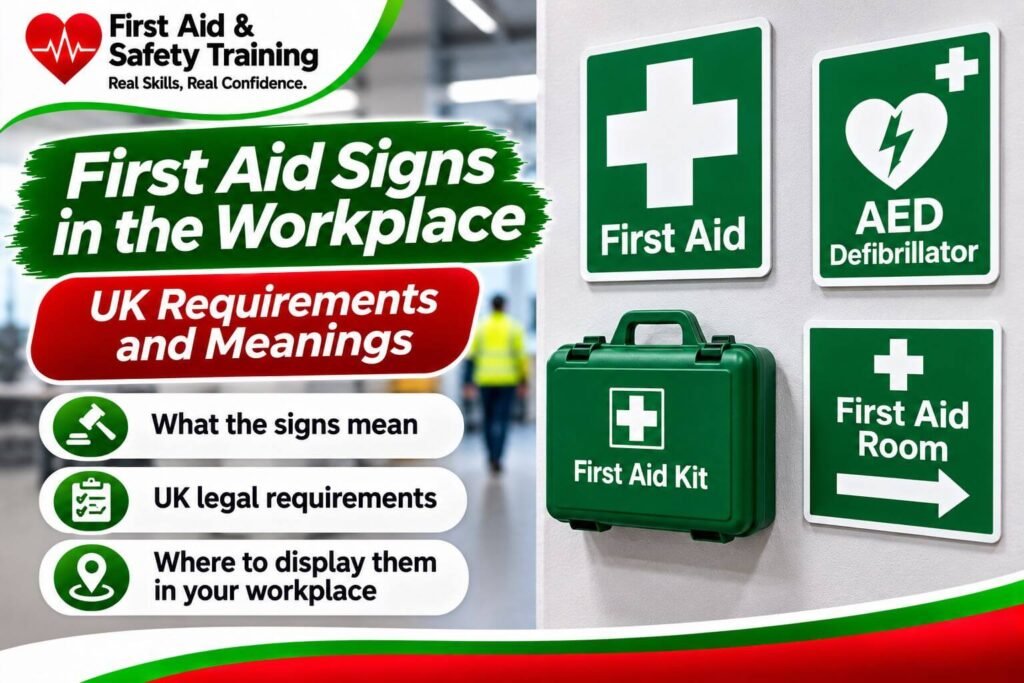
First aid signs play an important role in workplace safety by helping employees, visitors and contractors quickly identify where first aid equipment, facilities and emergency assistance are located.
When an accident or medical emergency happens, knowing where to find a first aid kit, an automated external defibrillator (AED) or a trained first aider can make a significant difference.
However, first aid signs are more than simple green and white symbols. They form part of a workplace’s wider health and safety arrangements and help employers communicate essential information.
Under UK health and safety legislation, employers must provide adequate and appropriate first aid arrangements and ensure employees know how to access them.
At First Aid and Safety Training, we provide practical first aid qualifications for businesses and organisations across the North East of England.
In this guide, we explain what different first aid signs mean, the relevant UK legal requirements, where signs should be displayed and how employers can ensure their workplace is prepared for an emergency.
What Are First Aid Signs?
First aid signs are safety signs used to identify first aid equipment, facilities and emergency assistance.
They help people quickly locate essential resources without needing to ask for directions or search through a building.
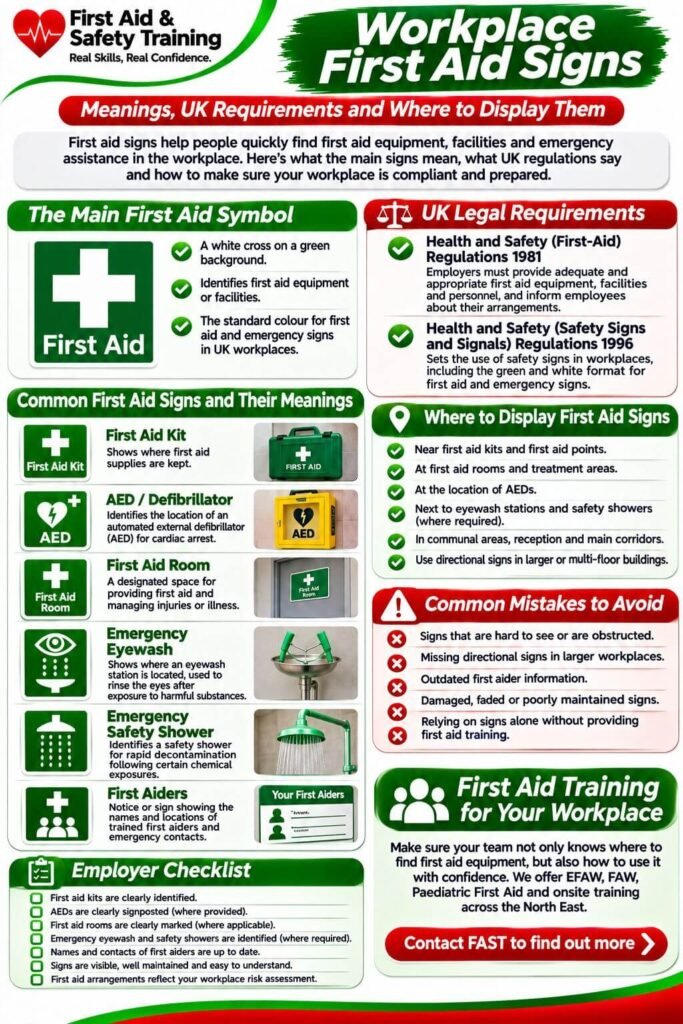
Common examples include signs identifying:
- First aid kits and first aid points.
- First aid rooms.
- Automated external defibrillators (AEDs).
- Emergency eyewash stations.
- Emergency safety showers.
- Stretchers and other emergency equipment.
- The location of first aiders or appointed persons.
These signs are particularly useful in larger workplaces, unfamiliar buildings and environments where employees or visitors may need to find emergency equipment quickly.
First aid signs should be clearly visible, easy to understand and appropriate for the workplace.
What Does the Green and White First Aid Symbol Mean?
<AsyncImage query=”standard UK first aid safety sign white cross green square first aid symbol ISO 7010″ aspectRatio=”5:3″ maxWidth=”340px”/>
The most recognisable first aid symbol is a white cross displayed on a green background.
This symbol indicates the location of first aid equipment or facilities.
The colour combination is important because green is associated with emergency escape routes, first aid and safe conditions under UK safety sign regulations.
The Health and Safety (Safety Signs and Signals) Regulations 1996 specify that emergency escape and first aid signs should generally have:
- A rectangular or square shape.
- A white pictogram.
- A green background covering at least 50% of the sign.
Using consistent colours and symbols helps people recognise safety information quickly, even when they are unfamiliar with a particular workplace.
The green and white first aid symbol is different from the red cross emblem, which has specific protected uses.
For workplace first aid signage, employers should use the appropriate green and white safety symbols.
Common Types of First Aid Signs and Their Meanings
Different first aid signs communicate different information.
Understanding these signs helps employees locate the right equipment or assistance during an emergency.
1. First Aid Kit Signs
<AsyncImage query=”green white first aid sign above green workplace first aid kit mounted on wall” aspectRatio=”5:3″ maxWidth=”340px”/>
A first aid kit sign identifies where first aid supplies are stored.
It usually features a white cross on a green background, sometimes accompanied by the words “First Aid”.
These signs help employees locate essential equipment such as:
- Sterile dressings.
- Bandages.
- Plasters.
- Disposable gloves.
- Other supplies identified by the workplace first aid needs assessment.
First aid kit signs should be positioned so that the equipment can be located without unnecessary delay.
2. First Aid Room Signs
<AsyncImage query=”UK workplace first aid room door sign green white first aid cross first aid room” aspectRatio=”5:3″ maxWidth=”340px”/>
Some workplaces require a designated first aid room.
This may be appropriate in larger or higher-risk workplaces, depending on the findings of the first aid needs assessment.
A first aid room sign identifies a space where injured or unwell employees can receive assistance.
The room should be clearly signposted and accessible to those who may need it.
The Health and Safety Executive advises that first aid rooms should be easily identifiable through appropriate green and white signs.
3. AED and Defibrillator Signs
<AsyncImage query=”UK public access AED defibrillator green white heart lightning symbol sign mounted wall AED cabinet” aspectRatio=”5:3″ maxWidth=”340px”/>
An AED sign identifies the location of an automated external defibrillator.
AEDs are used during cardiac arrest and provide instructions to guide rescuers through the defibrillation process.
Common AED signs feature a heart symbol with a lightning bolt, often alongside a first aid cross.
Clear AED signage can help people locate the device quickly.
Employers and organisations providing AEDs should consider:
- Whether the device is clearly signposted.
- Whether employees know its location.
- Whether it is accessible during working hours.
- Whether it is accessible to visitors where appropriate.
- Whether directional signs are needed in larger buildings.
An AED should be used as soon as possible when someone is unresponsive and not breathing normally, alongside CPR and a call to 999.
4. Emergency Eyewash Signs
<AsyncImage query=”green white emergency eyewash station safety sign eyewash equipment industrial workplace” aspectRatio=”5:3″ maxWidth=”340px”/>
Emergency eyewash signs identify facilities used to rinse the eyes following exposure to certain hazardous substances or contaminants.
They are particularly relevant in environments such as:
- Laboratories.
- Manufacturing facilities.
- Chemical handling areas.
- Workshops.
- Industrial workplaces.
Where emergency eyewash facilities are required, signs should make their location clear.
Employees should also understand the relevant emergency procedures and how to use the equipment safely.
5. Emergency Safety Shower Signs
<AsyncImage query=”industrial emergency safety shower green white safety sign chemical laboratory workplace” aspectRatio=”5:3″ maxWidth=”340px”/>
Emergency safety shower signs identify equipment designed for rapid decontamination following certain hazardous substance exposures.
These facilities may be required in workplaces where employees could be exposed to harmful chemicals.
Safety showers should be clearly identified, readily accessible and supported by appropriate emergency procedures.
6. First Aider Information Notices
Not all first aid information needs to be communicated through pictogram signs.
Employers may also display notices identifying:
- The names of trained first aiders.
- The names of appointed persons.
- Where first aid kits are located.
- How to contact a first aider.
- Emergency telephone numbers.
- Relevant workplace emergency procedures.
These notices can help employees understand what to do and whom to contact when someone needs assistance.
Information should be reviewed whenever first aid personnel or arrangements change.
Are First Aid Signs a Legal Requirement in the UK?
UK employers have legal responsibilities relating to first aid provision and workplace safety signage.
Two important pieces of legislation are relevant.
The Health and Safety (First-Aid) Regulations 1981
These regulations require employers to provide adequate and appropriate first aid equipment, facilities and personnel.
Employers must also inform employees about their first aid arrangements, including the location of equipment, facilities and first aid personnel.
Displaying clear notices and signs is a practical way to communicate this information.
However, employers must consider the needs of their particular workplace.
For example, a small office may have different requirements from a large manufacturing facility.
The Health and Safety (Safety Signs and Signals) Regulations 1996
These regulations address the use of safety signs and signals in workplaces.
Safety signs are required where a significant risk remains that cannot be adequately controlled through other measures and where signage is necessary to help reduce that risk.
The regulations also establish recognised colours and formats for different types of safety signs.
For first aid and emergency escape signs, green backgrounds and white symbols are the standard format.
Importantly, the law does not require every workplace to display an identical number or arrangement of first aid signs.
The appropriate signage depends on the workplace, the location of first aid equipment and the findings of relevant risk assessments.
For further guidance, see the HSE’s Safety Signs and Signals guidance.
Where Should First Aid Signs Be Displayed?
The location of first aid signs is just as important as their design.
A sign is of limited value if it is hidden, difficult to read or positioned away from the equipment it identifies.
Near First Aid Kits
Signs should make first aid kits easy to locate.
For example, a wall-mounted sign above a first aid cabinet may help employees identify the equipment quickly.
At First Aid Rooms
Where a designated first aid room is provided, clear signage should identify the room.
Additional directional signs may be helpful in larger buildings.
Near AEDs
AED signs should identify the location of the defibrillator.
In workplaces with several floors or long corridors, directional signs may help employees and visitors locate the device.
In Communal Areas
First aid information notices may be useful in areas such as:
- Staff rooms.
- Reception areas.
- Main corridors.
- Workplace noticeboards.
- Staff entrances.
- Other frequently used areas.
Across Larger Workplaces
Large sites may require additional signs to help people locate first aid equipment across different departments or buildings.
This may be particularly relevant in warehouses, factories, construction environments and multi-floor premises.
The objective is simple: people should be able to find first aid assistance quickly when it is needed.
How Many First Aid Signs Does a Workplace Need?
There is no universal number of first aid signs that every UK workplace must display.
The appropriate number depends on several factors, including:
- The size of the premises.
- The layout of the building.
- The number and location of first aid kits.
- Whether an AED is available.
- Whether a designated first aid room is provided.
- The number of employees.
- Whether visitors or contractors regularly attend.
- The findings of the workplace risk assessments.
A small office with one clearly accessible first aid kit may require relatively simple signage.
A large warehouse or industrial site may benefit from several first aid points, directional signs and clearly displayed emergency information.
Employers should avoid unnecessary signs that could create confusion.
The aim is to provide clear and useful information rather than simply display as many signs as possible.
First Aid Signs and Workplace First Aid Compliance
First aid signs support workplace safety, but they do not replace the need for appropriate first aid arrangements.
Under the Health and Safety (First-Aid) Regulations 1981, employers must assess their workplace first aid needs.
This involves considering factors such as:
- Workplace hazards.
- The nature of the work.
- The number of employees.
- Shift patterns.
- Lone working.
- Previous accidents.
- The location of the workplace.
- The availability of emergency medical assistance.
The assessment helps determine what equipment, facilities and personnel are required.
Employers must then ensure employees understand how to access these arrangements.
First aid signs can support this process by identifying equipment and facilities, while information notices can explain who is responsible for providing assistance.
For more information, visit the HSE’s First Aid at Work guidance.
What Is the Difference Between First Aid Signs and Other Safety Signs?
Workplace safety signs use different colours to communicate different types of information.
Understanding these colours can help employees recognise important safety messages.
| Sign colour | General meaning | Common example |
|---|---|---|
| Green | Emergency escape, first aid or safe conditions | First aid kit, emergency exit |
| Red | Prohibition, danger alarms or firefighting equipment | No smoking, fire extinguisher |
| Yellow or amber | Warning of hazards | Electrical hazard |
| Blue | Mandatory action | Safety helmet must be worn |
First aid signs generally use green and white, making them visually distinct from warning and prohibition signs.
This consistency is particularly useful in workplaces where employees may need to recognise safety information quickly.
First Aid Signs for Different Types of Workplaces
Different working environments may require different first aid arrangements and signage.
Offices
Office environments may benefit from clearly marked first aid kits, AED signs where devices are provided, and notices identifying first aiders.
Warehouses and Manufacturing
Larger industrial premises may require multiple first aid points and additional directional signs.
Where hazardous substances are present, emergency eyewash or safety shower signage may also be relevant.
Construction Sites
Construction environments can change as work progresses.
First aid signs should remain appropriate to the current site layout and the location of first aid equipment.
Temporary welfare facilities and site offices may be used to display first aid information.
Schools and Nurseries
Schools and childcare settings should ensure staff know where first aid equipment is located and how to access emergency assistance.
Paediatric first aid arrangements may also need to be considered, depending on the setting and applicable requirements.
Leisure Centres and Gyms
Sports and leisure facilities may benefit from clear first aid kit and AED signage, particularly where members of the public use the premises.
Emergency procedures should also be understood by relevant employees.
Common Mistakes Employers Make with First Aid Signs
Even when signs are present, poor positioning or outdated information can reduce their effectiveness.
Signs That Are Difficult to See
First aid signs should not be hidden behind equipment, furniture or other objects.
Missing Directional Information
In larger buildings, identifying a first aid kit or AED only at its exact location may not be enough.
Directional signs can help people find equipment more quickly.
Outdated First Aider Notices
If an employee leaves the organisation or their responsibilities change, first aid notices should be updated.
Poorly Maintained Signs
Damaged, faded or dirty signs may become difficult to recognise.
Employers should include signage in routine workplace inspections.
Relying on Signs Instead of Training
Signs can help people find equipment, but they do not teach someone how to perform CPR, manage severe bleeding or recognise a medical emergency.
Appropriate first aid training remains an important part of workplace emergency preparedness.
Why First Aid Training Is Just as Important as Signage
Knowing where the first aid kit is located is useful.
However, employees also need to understand what to do when an emergency occurs.
For example, if someone collapses and is not breathing normally, the immediate priorities include calling 999, starting CPR and using an AED as soon as possible.
A sign may help someone locate the AED, but practical training helps them understand how to respond.
First aid training can help employees develop skills such as:
- Assessing an emergency.
- Recognising life-threatening conditions.
- Performing CPR.
- Using an AED.
- Managing bleeding.
- Responding to choking.
- Helping an unresponsive casualty.
- Understanding when emergency assistance is required.
At First Aid and Safety Training, we deliver practical first aid qualifications for businesses and organisations across the North East.
Emergency First Aid at Work
Our Emergency First Aid at Work course provides essential emergency first aid skills.
It is suitable for workplaces where the first aid needs assessment identifies EFAW as an appropriate qualification.
First Aid at Work
Our First Aid at Work course provides broader training in workplace injuries and medical emergencies.
It may be appropriate for organisations with more significant first aid needs.
Paediatric First Aid
Our Paediatric First Aid course focuses on emergencies involving babies and children.
It is particularly relevant to childcare providers and other settings with paediatric first aid responsibilities.
We also offer onsite first aid training for businesses wishing to train groups of employees at their own premises.
Workplace First Aid Signs: A Practical Employer Checklist
Employers can use the following checklist when reviewing their first aid signage.
- First aid kits are clearly identified.
- First aid signs use appropriate green and white symbols.
- Signs are visible and unobstructed.
- AEDs are clearly signposted where provided.
- First aid rooms are clearly identified where applicable.
- Emergency eyewash and safety showers are identified where required.
- Employees know who the first aiders or appointed persons are.
- First aid information notices are accurate and up to date.
- Directional signs are provided where useful.
- First aid signs are included in routine workplace checks.
- First aid arrangements reflect the workplace needs assessment.
- Employees receive appropriate information and training.
This checklist can help employers identify areas for improvement.
However, it should be used alongside a suitable first aid needs assessment rather than as a substitute for one.
Frequently Asked Questions About First Aid Signs
What Colour Are First Aid Signs in the UK?
First aid signs generally feature a white symbol on a green background.
This follows the recognised safety sign conventions established under UK regulations.
What Does a White Cross on a Green Background Mean?
A white cross on a green background identifies first aid equipment or facilities.
It is commonly used for first aid kits, first aid points and first aid rooms.
Are First Aid Signs a Legal Requirement?
Employers must provide appropriate first aid arrangements and inform employees about them.
Safety signs are required where the relevant regulations make them necessary.
The number and type of signs depend on the workplace and its risks.
Where Should First Aid Signs Be Placed?
Signs should be positioned where they are clearly visible and help people locate first aid equipment or facilities.
They should not be obstructed by furniture, machinery or other objects.
Do First Aid Kits Need a Green and White Cross?
The HSE advises that first aid boxes should have a white cross on a green background.
This makes them readily identifiable.
Do Workplaces Need AED Signs?
Where an AED is provided, clear signage is good practice to help people locate the device quickly.
The appropriate positioning depends on the workplace layout and the AED’s location.
Do Employers Have to Display the Names of First Aiders?
Employers must inform employees about their first aid arrangements, including the personnel responsible.
Displaying notices with the names and locations of first aiders or appointed persons is a common and practical way to provide this information.
How Often Should First Aid Signs Be Checked?
There is no single inspection interval that applies to every workplace.
Employers should review signs as part of their routine health and safety arrangements and whenever equipment locations, personnel or workplace layouts change.
Can First Aid Signs Replace First Aid Training?
No. First aid signs help people locate equipment and facilities, but they do not replace appropriate first aid training or the need for suitable first aid arrangements.
Improve Your Workplace First Aid Arrangements with FAST
Clear first aid signs help employees and visitors locate essential equipment and assistance when an emergency occurs.
However, effective workplace first aid involves more than displaying the correct symbols.
Employers must also ensure they have suitable first aid equipment, appropriate personnel and arrangements that reflect their workplace risks.
Providing practical first aid training can help employees develop the skills and confidence to respond when someone needs assistance.
At First Aid and Safety Training, we provide recognised first aid qualifications for businesses and organisations across the North East of England, including South Tyneside, Sunderland, Newcastle, Gateshead and Durham.
We are a Qualsafe Awards Approved Training Centre, delivering regulated qualifications awarded by Qualsafe Awards, an Ofqual-recognised awarding organisation.
Our courses focus on practical learning and developing confidence in real emergency situations.
We offer open courses and onsite first aid training for businesses looking to train several employees together.
Real Skills, Real Confidence.
Contact First Aid and Safety Training to discuss your workplace first aid training requirements, arrange onsite training or find the most suitable course for your organisation.