Skip to content


If you already have experience in first aid and enjoy teaching others, becoming a paediatric first aid trainer can be a rewarding next step.
However, knowing paediatric first aid is not enough on its own.
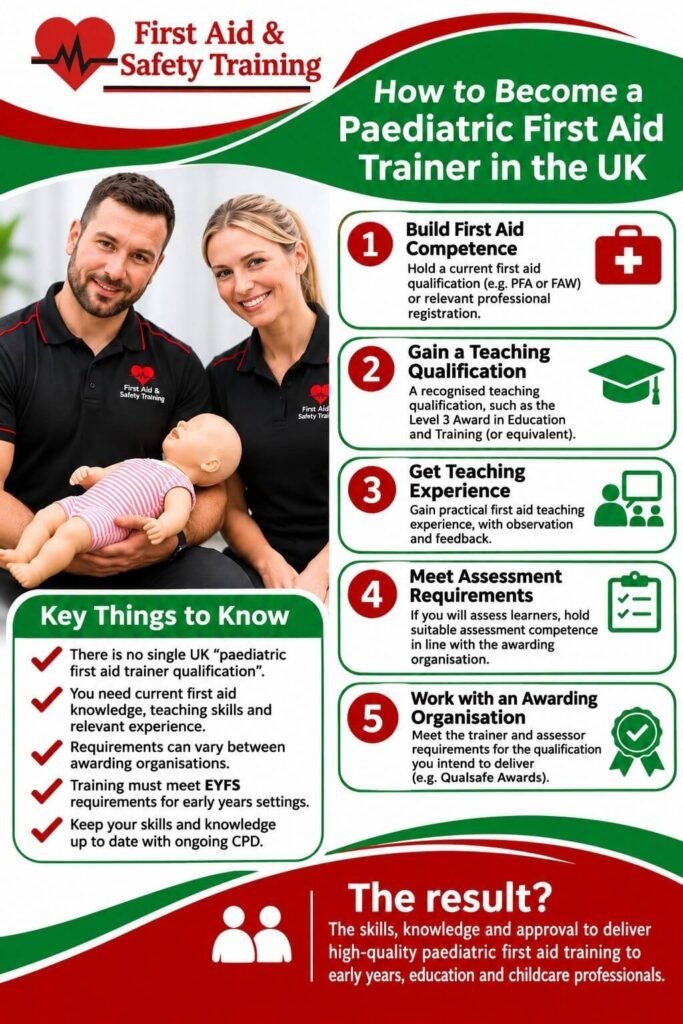
To become a paediatric first aid trainer in the UK, you normally need to demonstrate current first aid knowledge and competence, the ability to teach effectively and, where you will assess learners, suitable assessment competence. You may also need previous first aid teaching experience and approval from the awarding organisation or training provider whose qualifications you intend to deliver.
There is therefore no single certificate that automatically allows someone to teach every paediatric first aid course in the UK.
The route you need to follow depends partly on what you intend to teach and how you intend to deliver it.
What Does a Paediatric First Aid Trainer Do?
A paediatric first aid trainer teaches people how to respond to emergencies involving babies and children.
Learners may include:
- nursery and preschool staff
- childminders
- early years practitioners
- school staff
- nannies and other childcare professionals
- sports and activity providers
- parents and carers
Training can include practical skills such as infant and child CPR, use of an AED, choking, managing an unresponsive casualty, bleeding, shock and anaphylaxis, alongside other childhood illnesses and injuries.
A trainer must be able to do more than explain these subjects.
You need to demonstrate techniques accurately, supervise practical activities, identify unsafe or incorrect practice, answer questions appropriately and assess whether learners have achieved the required standard.
This is particularly important when delivering a regulated paediatric first aid qualification.
Do You Need a Specific Paediatric First Aid Trainer Qualification?
Not necessarily.
There isn’t one universal UK qualification called a “Paediatric First Aid Trainer Qualification” that automatically authorises you to teach every course.
Instead, trainer competence is usually established through a combination of:
- current first aid knowledge and practical competence
- an appropriate teaching or training qualification
- relevant teaching experience
- assessment competence where required
- continuing professional development
- meeting the requirements of the awarding organisation, training centre or scheme you work with
If you want to deliver a regulated qualification, you must also meet the requirements of the awarding organisation concerned.
This distinction is important.
Being an experienced first aider does not automatically make someone a competent trainer. Equally, holding a general teaching qualification does not by itself demonstrate current competence in first aid.
What First Aid Qualification Does a Paediatric First Aid Trainer Need?
The precise requirement depends on the qualification and awarding organisation you intend to work with.
For example, current Qualsafe requirements for its paediatric first aid qualifications require trainers to demonstrate appropriate occupational knowledge and competence in first aid.
Acceptable evidence can include a current regulated First Aid at Work or Paediatric First Aid qualification, or appropriate current professional registration such as a doctor, nurse or paramedic, subject to the detailed requirements of the qualification specification.
If you are planning to work with a particular awarding organisation, always check its current trainer requirements rather than assuming that one qualification will be accepted everywhere.
This is also one reason why maintaining your own practical first aid competence matters even after you begin teaching.
If you are new to paediatric first aid itself, our guide to what paediatric first aid covers explains the subject in more detail.
Do You Need a Teaching Qualification?
You will normally need to demonstrate that you are competent to teach.
A commonly recognised route is a teaching or training qualification such as the Level 3 Award in Education and Training, although this is not the only qualification that may be accepted.
Other teaching qualifications and professional teaching credentials may also meet the relevant requirements.
The Health and Safety Executive’s guidance on selecting a competent first aid training provider identifies a range of training and assessing qualifications that may demonstrate competence.
The important point is not simply having a certificate with the word “trainer” on it.
A first aid trainer needs to be able to:
- plan and structure learning
- explain technical information clearly
- demonstrate practical skills
- adapt delivery to different learners
- manage practical training safely
- check understanding
- provide useful feedback
- assess competence where authorised to do so
Practical teaching ability becomes increasingly important when you start delivering courses independently.
Do You Need Previous First Aid Teaching Experience?
Depending on the awarding organisation, yes.
This is an area that is sometimes overlooked when people research how to become a paediatric first aid trainer.
For example, Qualsafe’s published trainer requirements include evidence of first aid teaching experience. Routes can include an appropriate teaching log or being observed delivering first aid training competently by an appropriately qualified and approved trainer.
This means somebody starting from scratch may need to build supervised or observed teaching experience before being approved to deliver regulated qualifications independently.
The exact evidence required can change, so check the latest qualification specification and centre requirements before planning your route.
Do Paediatric First Aid Trainers Need an Assessor Qualification?
Teaching and assessing are related, but they are not automatically the same role.
When a course leads to a regulated qualification, learners may have to demonstrate practical competence and complete other forms of assessment.
If you are responsible for assessing those learners, you need to meet the assessment requirements of the relevant awarding organisation.
Some recognised teaching qualifications incorporate appropriate assessment competence, while other trainers may need a separate assessing qualification or approved assessment training.
Qualsafe permits the same person to act as both trainer and assessor on its paediatric first aid qualifications provided that person meets the requirements for both roles.
You should therefore check both the trainer requirements and assessor requirements for the qualification you want to deliver.
Why Paediatric First Aid Training Has Specific Responsibilities
Paediatric first aid training is particularly important because it is closely connected with the requirements placed on early years providers.
In England, the Early Years Foundation Stage statutory framework sets criteria for effective paediatric first aid training.
These include appropriate training for people caring for young children, practical assessment of competence, suitable resuscitation equipment including infant and child models, and specified course content.
The framework also requires paediatric first aid certificates to be renewed every three years.
A trainer delivering courses intended to meet EYFS requirements therefore needs to understand what the framework actually requires, rather than simply teaching a generic child first aid course.
If you want to understand the learner requirements in more detail, see our guide to paediatric first aid certificate validity.
Full Paediatric First Aid and Emergency Paediatric First Aid
A prospective trainer should also understand that Paediatric First Aid and Emergency Paediatric First Aid are not interchangeable courses.
Under the EYFS criteria in England, Emergency Paediatric First Aid has a minimum of six hours of training and focuses on essential emergency skills.
Full Paediatric First Aid requires a minimum of 12 hours and covers a wider range of childhood illnesses and injuries.
You can read more about Emergency Paediatric First Aid and who needs it.
Understanding the distinction is essential if you intend to advise nurseries, schools, childminders or other childcare providers about appropriate training.
Can Paediatric First Aid Be Delivered as Blended Learning?
Some full paediatric first aid qualifications can be delivered using an approved blended learning model.
For example, the current Qualsafe blended programme used by First Aid and Safety Training combines six hours of e-learning with a face-to-face practical training and assessment day.
That does not mean a trainer can simply replace practical paediatric first aid training with an online course.
Practical skills must still be taught, practised and assessed appropriately.
Our guide answering whether you can do paediatric first aid online explains this distinction in more detail.
Do You Need to Work Through an Awarding Organisation?
It depends on what you intend to offer.
Someone can provide non-regulated first aid awareness or skills training, provided it is represented accurately and the trainer is competent to deliver it.
However, you cannot independently issue a regulated qualification simply because you hold first aid and teaching qualifications yourself.
If you want learners to achieve a regulated qualification, delivery and assessment must take place through the appropriate approved arrangements for the awarding organisation concerned.
For example, First Aid and Safety Training is an approved Qualsafe Awards Centre. Our regulated workplace and paediatric first aid qualifications are awarded by Qualsafe Awards, an Ofqual-recognised awarding organisation.
This is different from saying that an individual trainer or training company is “Ofqual regulated”.
Ofqual regulates recognised awarding organisations and regulated qualifications.
Do You Need Your Own Training Centre?
No.
There are several ways to work as a paediatric first aid trainer.
You might:
- work for an established first aid training provider
- deliver courses on behalf of an approved centre
- become an associate or freelance trainer
- work within a larger organisation as an internal trainer
- establish your own training business
- eventually seek centre approval with an awarding organisation
Working with an established provider can be particularly useful when you are starting out because it allows you to gain experience of course administration, assessment, quality assurance and practical delivery.
Setting up independently involves considerably more than being able to teach the course.
What Equipment Does a Paediatric First Aid Trainer Need?
Paediatric first aid is practical training, so appropriate training equipment is essential.
Depending on the qualification being delivered, this is likely to include equipment such as:
- adult, child and infant CPR manikins as appropriate
- AED training units
- first aid equipment and dressings
- equipment for practising choking procedures
- training adrenaline auto-injectors where anaphylaxis is taught
- suitable cleaning and hygiene equipment
- course materials and assessment resources
Awarding organisations may specify minimum equipment ratios and particular resources for regulated courses.
You also need a suitable training environment with enough space for learners to practise skills safely.
Buying one manikin and delivering practical training to a large group is not an appropriate substitute for providing learners with sufficient hands-on practice.
Do You Need Insurance?
If you work independently, appropriate business insurance should form part of your planning.
The cover required will depend on how your business operates, but trainers commonly consider areas such as public liability and professional indemnity insurance.
You should discuss your particular activities with an appropriate insurer or broker rather than assuming a generic policy provides suitable cover for first aid training.
If you are delivering on behalf of another organisation, establish clearly whose insurance covers the training and what responsibilities remain with you.
Keeping Your Knowledge and Skills Current
Becoming approved as a trainer is not the end of the process.
First aid guidance changes.
Qualifications are updated.
Assessment requirements can change.
Good trainers therefore maintain their knowledge, practical competence and teaching skills through continuing professional development.
This may include:
- maintaining current first aid qualifications
- attending relevant CPD
- reviewing current Resuscitation Council UK guidance
- following changes to qualification specifications
- keeping up to date with EYFS requirements
- maintaining a record of courses taught
- participating in observations and quality assurance
- regularly practising practical first aid skills
A trainer should be able to explain why a technique is being taught and ensure that their delivery reflects current accepted practice.
A Simple Route to Becoming a Paediatric First Aid Trainer
There isn’t one route that applies to everyone, but a typical progression may look like this:
- Build strong first aid knowledge and practical competence.
- Hold the appropriate current first aid qualification or professional registration.
- Gain an acceptable teaching or training qualification.
- Develop practical experience teaching first aid.
- Meet the relevant assessment requirements if you will assess learners.
- Choose the qualification or training system you want to deliver.
- Meet that awarding organisation or provider’s trainer approval requirements.
- Maintain your competence through ongoing teaching and CPD.
If you ultimately want to run your own first aid training company, you will then have another set of practical considerations including equipment, insurance, course administration, policies, quality assurance, marketing and finding customers.
Thinking Beyond the Trainer Qualification
For many people, becoming qualified and competent to teach is only the beginning.
Once you start delivering courses independently, questions quickly move from how do I become a trainer? to:
- How should I organise my courses?
- What records should I keep?
- What equipment do I need?
- How do I find customers?
- How should I market my training business?
- What systems and resources will make running courses easier?
First Aid Trainers Vault is being developed specifically around the practical needs of first aid trainers and training businesses.
We are not linking to the Vault from this guide yet while the new resource is being developed, but we will update this article as those resources become available.
Want to Become a First Aid Trainer?
If your aim is broader than paediatric training, our forthcoming guide to how to become a first aid trainer in the UK will look at the wider route into delivering workplace first aid qualifications such as Emergency First Aid at Work and First Aid at Work.
If instead you are looking for paediatric first aid training for yourself or your organisation, explore our Paediatric First Aid training or contact First Aid and Safety Training to discuss your requirements.
First Aid and Safety Training delivers regulated Qualsafe Awards first aid qualifications across the North East and provides onsite training for organisations.
You can also view our Google reviews and location to see feedback from people who have trained with FAST.