Skip to content

Knowing how to remember first aid can make a significant difference when someone becomes injured or seriously unwell. Whether you’ve recently completed a first aid course or received training several years ago, remembering what to do in an emergency is an important part of being prepared.
Many people worry that they will forget their first aid training when faced with a real emergency.
This is understandable. Emergencies can be stressful, and situations involving an unresponsive casualty, severe bleeding or breathing difficulties can feel overwhelming.
However, you don’t need to remember every detail of your training before taking action.
Learning a few simple procedures, practising regularly and understanding when to call for help can make first aid easier to recall.
At First Aid and Safety Training, we focus on helping learners develop practical skills and the confidence to respond appropriately when someone needs assistance.
In this guide, we’ll explain how to remember first aid procedures, use simple memory aids and maintain the skills you learn during training.
Why Is It Important to Remember First Aid Procedures?
First aid involves providing immediate assistance to someone who is injured or unwell before professional medical help arrives.
In some situations, early intervention can save a life.
For example:
- Recognising cardiac arrest and starting CPR can help maintain blood circulation.
- Using an automated external defibrillator (AED) promptly can improve the chances of survival.
- Applying direct pressure can help control serious bleeding.
- Recognising anaphylaxis can lead to faster emergency treatment.
- Identifying a stroke can help ensure the casualty receives urgent medical attention.
The challenge is remembering what to do when an emergency occurs.
This is why first aid training uses practical demonstrations, repeated exercises and structured procedures.
Rather than relying on memory alone, first aiders learn a systematic approach that helps them recognise priorities.
The aim is not to memorise every possible emergency. It is to remember the essential actions that matter most.
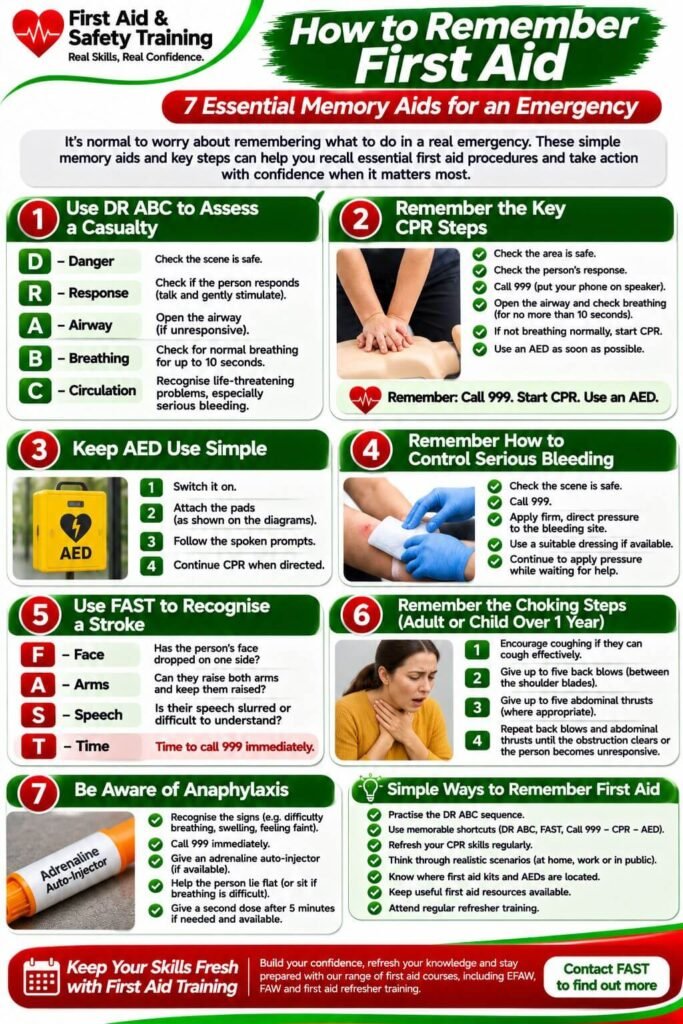
How to Remember First Aid Using DR ABC
One of the most useful ways to remember first aid is through the DR ABC approach.
DR ABC is a simple memory aid used to help first aiders assess a casualty and identify immediate life-threatening problems.
It stands for:
- D – Danger
- R – Response
- A – Airway
- B – Breathing
- C – Circulation
The precise assessment sequence and actions depend on the casualty’s condition, the type of emergency and current first aid guidance.
For an unresponsive casualty, the priority is to call for emergency assistance, assess breathing promptly and begin CPR if they are not breathing normally.
D – Danger: Check the Scene Is Safe
Before approaching a casualty, check for hazards.
These might include:
- Moving vehicles.
- Electrical equipment.
- Machinery.
- Fire or smoke.
- Hazardous substances.
- Falling objects.
Do not put yourself or others at unnecessary risk.
If the area is unsafe, seek assistance and avoid approaching until it is safe to do so.
Memory tip: Before helping someone, ask yourself, “Is it safe to approach?”
R – Response: Check the Casualty
Approach the casualty and check whether they respond.
Speak clearly and ask a simple question, such as:
“Can you hear me?”
If there is no response, gently stimulate the casualty as appropriate.
If they remain unresponsive, shout for help and call 999.
If possible, ask another person to retrieve an AED.
Memory tip: Talk to the casualty and check whether they respond.
A – Airway: Open the Airway
If the casualty is unresponsive, open their airway.
For an adult, this is normally achieved using the head-tilt, chin-lift technique.
Place one hand on the forehead and gently tilt the head back while lifting the chin.
If significant trauma is suspected, follow your training and emergency call-handler instructions, avoiding unnecessary movement.
Memory tip: An unresponsive casualty may have an obstructed airway.
B – Breathing: Check for Normal Breathing
Check whether the casualty is breathing normally.
Look for normal chest movement and assess breathing for no more than 10 seconds.
Occasional gasping or irregular, abnormal breathing should not be mistaken for normal breathing.
If the casualty is unresponsive and not breathing normally, call 999 and begin CPR immediately.
If they are breathing normally, continue monitoring them and follow emergency call-handler instructions.
Use the recovery position where appropriate, taking account of any suspected injuries.
Memory tip: Unresponsive and not breathing normally means CPR is needed.
C – Circulation: Recognise Life-Threatening Problems
The final letter reminds first aiders to consider circulation and other immediate threats, particularly serious bleeding.
Severe bleeding must be controlled promptly.
For an unresponsive person who is not breathing normally, do not delay CPR to search for a pulse.
Lay rescuers are not expected to perform a pulse check before starting CPR.
Memory tip: Recognise and treat life-threatening bleeding, but never delay CPR when cardiac arrest is suspected.
How to Remember First Aid CPR Procedures
CPR is one of the most important skills covered during first aid training.
It is used when someone is unresponsive and not breathing normally.
Remembering a few essential actions can help you respond more effectively.
The Essential Adult CPR Steps
- Check that the area is safe.
- Check the casualty’s response.
- Call 999 and put your phone on speaker.
- Open the airway and check for normal breathing for no more than 10 seconds.
- If the casualty is not breathing normally, begin chest compressions immediately.
- Ask someone to bring an AED and use it as soon as possible.
- Continue CPR and follow emergency call-handler instructions.
Remember the CPR Compression Rate
For adult CPR, aim for:
100 to 120 chest compressions per minute.
Compress the chest approximately 5 to 6 cm, allowing it to recoil fully between compressions.
If trained and willing to provide rescue breaths, use:
30 chest compressions followed by two rescue breaths.
If you cannot provide rescue breaths, continue uninterrupted chest compressions.
For children and infants, age-appropriate paediatric CPR guidance applies.
How to Remember CPR More Easily
A useful way to remember the essentials is:
Call 999. Start CPR. Use an AED.
These three actions are central to responding to a suspected cardiac arrest.
Regular hands-on practice with a training manikin can also help reinforce the correct technique.
For more detailed guidance, see the Resuscitation Council UK Adult Basic Life Support Guidelines.
Remembering How to Use an AED
An automated external defibrillator, commonly called an AED, is designed to help someone experiencing cardiac arrest.
Many people worry about using an AED because they have never used one in a real emergency.
However, AEDs provide clear spoken and visual instructions.
You do not need to memorise every detail of the device.
Four Simple AED Reminders
1. Switch it on.
Turn on the AED and listen to its instructions.
2. Attach the pads.
Expose the casualty’s chest and apply the pads as shown on the diagrams.
3. Follow the prompts.
The AED will analyse the heart’s rhythm and advise whether a shock is required.
Ensure nobody is touching the casualty during rhythm analysis or shock delivery.
4. Continue CPR.
Follow the AED instructions and resume CPR promptly when directed.
Memory tip: Switch on, attach pads, follow prompts and continue CPR.
An AED will only advise a shock when its analysis identifies a shockable rhythm.
How to Remember First Aid for Severe Bleeding
Severe bleeding can become life-threatening quickly.
When dealing with serious external bleeding, the priority is to control blood loss and obtain emergency assistance.
Remember: Pressure and 999
For heavy or uncontrolled bleeding:
- Check the scene is safe.
- Call 999.
- Apply firm, direct pressure to the bleeding site.
- Use a suitable dressing if available.
- Continue bleeding control while waiting for emergency assistance.
- Monitor the casualty for deterioration.
For life-threatening limb bleeding, additional techniques such as a suitable tourniquet may be necessary, depending on the circumstances and your training.
Do not delay essential bleeding control while searching for equipment.
Memory tip: Serious bleeding requires immediate pressure and emergency assistance.
Remembering the Signs of a Stroke: FAST
Another useful first aid memory aid is FAST.
FAST helps people recognise common warning signs of a stroke.
F – Face
Has the person’s face dropped on one side?
Can they smile normally?
A – Arms
Can they raise both arms and keep them raised?
Is one arm weak or drifting down?
S – Speech
Is their speech slurred or difficult to understand?
Are they having difficulty finding words?
T – Time
Time to call 999 immediately.
A stroke is a medical emergency.
Do not wait to see whether symptoms improve.
Even if symptoms disappear, urgent medical assessment is still required.
FAST does not identify every possible stroke, so sudden visual changes, balance problems or other concerning neurological symptoms should also be taken seriously.
Find out more from the NHS stroke guidance.
How to Remember First Aid for Choking
Choking occurs when an object obstructs the airway.
A person who is choking may be unable to speak, cough effectively or breathe normally.
For a conscious adult or child over one year with severe choking, remember the following sequence:
Encourage Coughing
If the casualty can cough effectively, encourage them to keep coughing.
Monitor their condition.
Give Up to Five Back Blows
If the cough is ineffective, give up to five sharp back blows between the shoulder blades.
Check after each blow to see whether the obstruction has cleared.
Give Up to Five Abdominal Thrusts
If back blows are unsuccessful, give up to five abdominal thrusts where appropriate.
Alternate five back blows and five abdominal thrusts until the obstruction clears or the casualty becomes unresponsive.
Call 999 if the obstruction is not relieved.
If the casualty becomes unresponsive, begin CPR following emergency call-handler instructions.
Important: Different techniques apply to infants under one year and to certain other casualties. Infant choking first aid uses back blows and chest thrusts, not abdominal thrusts.
Anyone who has received abdominal thrusts should receive medical assessment.
Memory tip: Cough, back blows, abdominal thrusts, following the appropriate age-specific guidance.
How to Remember First Aid for Anaphylaxis
Anaphylaxis is a severe allergic reaction that can become life-threatening.
It may develop after exposure to allergens such as food, medication or insect stings.
Recognise the Warning Signs
These can include:
- Difficulty breathing.
- Swelling of the tongue or throat.
- Wheezing or persistent coughing.
- Feeling faint or collapsing.
- Sudden confusion.
- Pale, cold or clammy skin.
A visible rash is not always present.
Remember the Emergency Actions
Call 999. Give adrenaline. Position appropriately. Monitor.
If anaphylaxis is suspected, give an adrenaline auto-injector promptly if available, following the device instructions.
Help the casualty lie flat, raising their legs if appropriate. If breathing is difficult, they may need to sit with their legs outstretched.
Do not allow them to stand or walk.
If symptoms are not improving after five minutes, give a second adrenaline auto-injector if one is available.
Continue monitoring the casualty until emergency services arrive.
For more information, explore our Anaphylaxis Training in the North East.
Seven Practical Ways to Remember First Aid Training
Understanding first aid procedures is important, but maintaining your knowledge requires practice.
Here are seven ways to help keep your skills fresh.
1. Practise the Primary Survey
Regularly review the DR ABC approach.
Think through the actions you would take if you found someone unresponsive.
2. Use Simple Memory Aids
Remember short sequences such as:
- DR ABC for casualty assessment.
- FAST for recognising common stroke symptoms.
- Call 999, start CPR and use an AED for suspected cardiac arrest.
Simple reminders are easier to recall under pressure than long lists of instructions.
3. Refresh Your CPR Skills
CPR is a practical skill.
Reading about chest compressions is useful, but it does not replace practising on a training manikin.
Regular refresher sessions can help maintain technique and confidence.
4. Review First Aid Scenarios
Think about emergencies that could happen at home, work or in public.
For example:
- A colleague collapses.
- A child starts choking.
- Someone suffers a serious cut.
- A person experiences breathing difficulties.
Consider what you would do first and when you would call for assistance.
5. Know Where Emergency Equipment Is Located
Make sure you know where to find:
- Workplace first aid kits.
- AEDs.
- Emergency contact information.
- Any specialist equipment provided for identified risks.
Knowing where equipment is located can reduce delays during an emergency.
6. Keep Useful First Aid Resources Available
Reliable first aid guides, course materials and emergency action plans can help reinforce your knowledge.
However, in a life-threatening emergency, call 999 rather than delaying action to search for information.
7. Attend Refresher Training
Practical refresher training provides an opportunity to revisit essential skills and receive updated guidance.
It can also help identify areas where you feel less confident.
How Often Should You Refresh Your First Aid Knowledge?
First aid skills can become less familiar when they are not used regularly.
This is particularly true of practical techniques such as CPR and AED use.
The Health and Safety Executive strongly recommends that workplace first aiders undertake annual refresher training.
Emergency First Aid at Work and First Aid at Work qualifications are normally valid for three years.
Before a qualification expires, the first aider should complete the appropriate requalification training.
Annual refresher training does not replace the requirement to renew an expiring qualification.
Employers should also consider additional training where workplace risks, procedures or equipment change.
You can find more information in the HSE guidance on First Aid at Work.
Can You Forget First Aid After Completing a Course?
Yes. Like many practical skills, first aid knowledge can fade over time if it is not reinforced.
This does not mean that your original training was ineffective.
It means that maintaining confidence requires occasional practice and review.
Someone who completed a first aid course several years ago may remember the general principles but feel uncertain about particular techniques.
This is one reason regular refresher training is valuable.
At First Aid and Safety Training, our approach focuses on helping learners understand why they are performing each action, rather than simply memorising instructions.
Practical exercises allow learners to develop familiarity with the techniques they may need in an emergency.
First Aid Training Helps Build Confidence
One of the most effective ways to remember first aid is to learn through practical experience.
During a first aid course, learners have opportunities to practise essential techniques in a controlled environment.
This can include:
- Assessing casualties.
- Performing CPR.
- Using AED training equipment.
- Managing bleeding.
- Responding to choking.
- Positioning casualties appropriately.
- Working through realistic emergency scenarios.
Repeating these skills helps learners become more familiar with the correct actions.
Although no course can guarantee how someone will respond during a real emergency, practical training can improve preparedness and confidence.
Which First Aid Course Should You Choose?
The most suitable first aid course depends on your responsibilities and the environments in which you may need to provide assistance.
Emergency First Aid at Work
Our Emergency First Aid at Work course provides essential emergency first aid skills.
It is suitable for workplaces where the first aid needs assessment identifies EFAW as the appropriate qualification.
First Aid at Work
Our First Aid at Work course provides more extensive training in workplace injuries and medical emergencies.
It may be appropriate for organisations with more significant first aid requirements.
Paediatric First Aid
Our Paediatric First Aid course focuses on emergencies involving babies and children.
It is particularly relevant to childcare providers and organisations with paediatric first aid responsibilities.
First Aid Refresher Training
Refresher training helps existing first aiders revisit essential skills and maintain their confidence.
It is particularly useful for individuals who have not had an opportunity to practise their skills recently.
Frequently Asked Questions About How to Remember First Aid
What Is the Easiest Way to Remember First Aid?
One of the easiest approaches is to use simple memory aids such as DR ABC for casualty assessment and FAST for recognising common stroke symptoms.
Regular practical training also helps reinforce essential skills.
What Does DR ABC Stand For?
DR ABC stands for Danger, Response, Airway, Breathing and Circulation.
It is a memory aid that helps first aiders follow a structured approach to assessing a casualty.
What Are the Three Most Important Actions in Cardiac Arrest?
Call 999, start CPR and use an AED as soon as possible.
These actions are essential when someone is unresponsive and not breathing normally.
How Do You Remember the CPR Compression Rate?
For adult CPR, remember 100 to 120 chest compressions per minute.
Practical training helps learners develop a more reliable sense of the correct rhythm and compression technique.
What Should You Do if You Forget Your First Aid Training During an Emergency?
Call 999 if the situation is serious.
The emergency call handler can guide you through important actions, including CPR.
Follow their instructions and provide assistance within your abilities.
How Often Should First Aid Skills Be Refreshed?
The HSE strongly recommends annual refresher training for workplace first aiders.
EFAW and FAW qualifications are normally valid for three years and require appropriate requalification before expiry.
Can You Learn First Aid by Reading Online?
Online resources can help reinforce knowledge, but practical training is important for developing skills such as CPR, AED use and casualty assessment.
Regulated workplace first aid qualifications include practical training and assessment requirements.
Remember Your First Aid Skills with FAST
Learning how to remember first aid is about more than memorising instructions.
It involves understanding the priorities of an emergency, practising essential techniques and maintaining the confidence to act when someone needs help.
Simple memory aids such as DR ABC and FAST can make important information easier to recall.
However, practical experience and regular refresher training remain essential.
At First Aid and Safety Training, we provide recognised first aid qualifications and practical refresher training for individuals, businesses and organisations across the North East of England.
We are a Qualsafe Awards Approved Training Centre, delivering regulated qualifications awarded by Qualsafe Awards, an Ofqual-recognised awarding organisation.
Our courses focus on developing practical skills, clear understanding and confidence.
Whether you are learning first aid for the first time or refreshing an existing qualification, we can help you choose suitable training.
Real Skills, Real Confidence.
Contact First Aid and Safety Training to discuss first aid courses, refresher training or onsite group bookings.