Skip to content

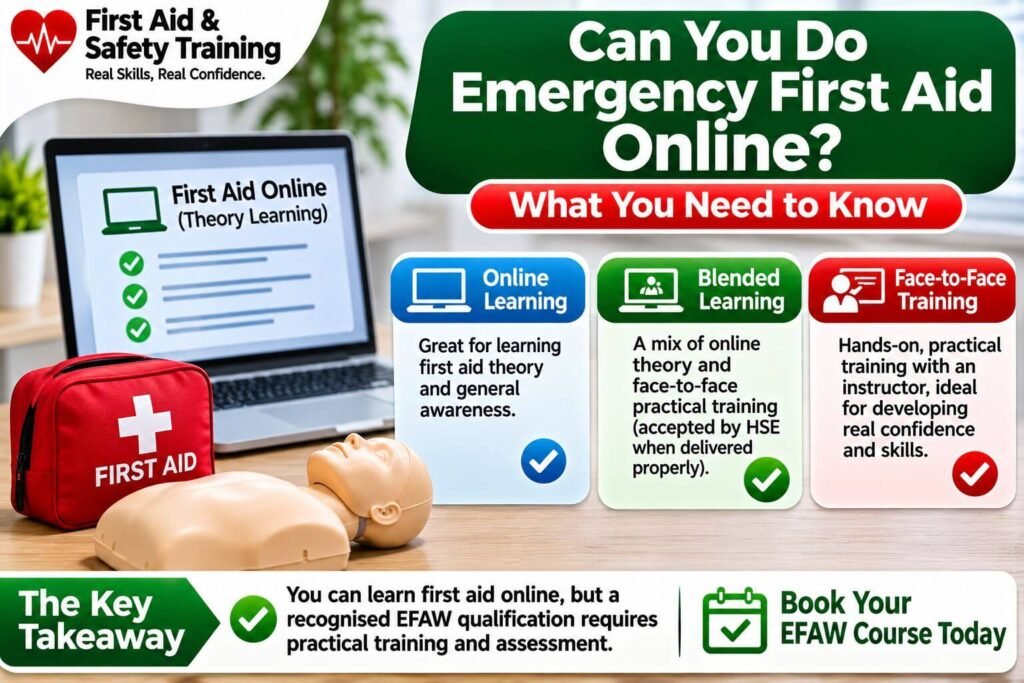
If you need first aid training for work, you may be wondering can you do emergency first aid online instead of spending a full day in a classroom.
You can certainly learn first aid theory online, and online training can be useful for developing or refreshing your knowledge.
However, if you need a recognised Emergency First Aid at Work qualification, you should not assume that a completely online course is equivalent to practical EFAW training.
First aid involves physical skills such as CPR, using an AED and managing a casualty. These skills need to be practised and assessed appropriately.
There is also a third option: blended learning, where appropriate parts of first aid training are completed online and the practical elements are completed face to face.
So, before buying an online course, it is important to understand exactly what qualification or certificate you actually need.
What Is Emergency First Aid at Work?
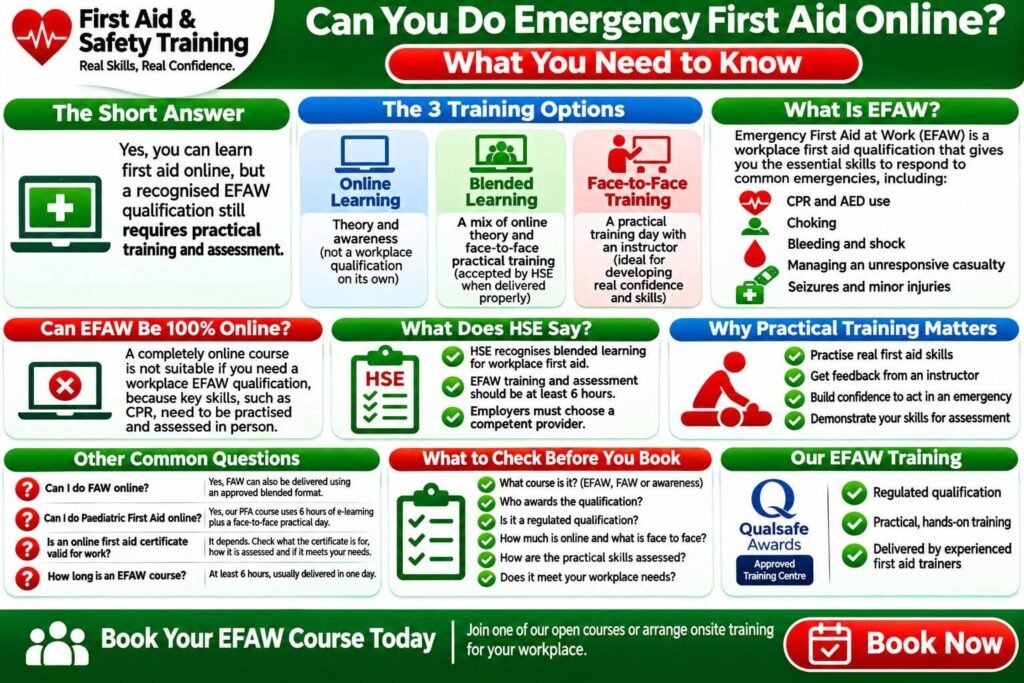
Emergency First Aid at Work, usually shortened to EFAW, is a workplace first aid qualification designed to give learners the skills and knowledge needed to respond to common first aid emergencies.
It is often appropriate for workplaces where the employer’s first aid needs assessment identifies EFAW as the suitable level of training.
A proper EFAW course is much more than watching first aid videos.
Learners need to understand and demonstrate essential first aid skills.
These include areas such as:
- assessing an emergency
- managing an unresponsive casualty
- CPR
- using an AED
- choking
- bleeding
- shock
- seizures
- minor injuries
At First Aid and Safety Training, our Emergency First Aid at Work course leads to a regulated Qualsafe Awards qualification.
Can You Do Emergency First Aid Online?
The answer depends on what you mean by online first aid.
There are three different types of training that can easily become confused.
1. Online First Aid Awareness Training
The whole course is completed online.
This can be useful for:
- learning basic first aid knowledge
- introducing employees to first aid
- refreshing knowledge
- personal development
- supplementary training
However, completing an online awareness course is not automatically the same as becoming a qualified workplace first aider.
2. Blended First Aid Training
Some learning is completed online and the remaining training and assessment are completed face to face.
HSE recognises blended learning as an acceptable way of delivering workplace first aid training, provided appropriate standards are met.
3. Face-to-Face First Aid Training
The learning and practical assessment take place with a trainer.
This remains a straightforward way of completing EFAW because learners can watch demonstrations, practise the techniques, receive feedback and demonstrate their practical competence during the course.
These distinctions are important when comparing courses online.
Can You Complete EFAW Entirely Online?
If you need to act as a workplace first aider, you should be very cautious about a course advertised as a complete EFAW qualification with no practical face-to-face element.
EFAW contains practical skills that need to be demonstrated.
Think about CPR.
You can watch somebody performing chest compressions on a screen.
You can read about:
- hand position
- compression depth
- compression rate
- chest recoil
But watching somebody perform CPR is not the same as physically performing it yourself.
The same applies to other practical first aid skills.
This is why practical training remains such an important part of becoming a competent first aider.
Why Isn’t Watching CPR Online Enough?
CPR is a physical skill.
When you practise on a training manikin, you begin to understand things that are difficult to appreciate from a video.
For example:
- how much pressure chest compressions require
- whether your hands are positioned correctly
- how quickly 100 to 120 compressions per minute feels
- what full chest recoil means
- how tiring CPR can become
- how to move between CPR and AED use
A trainer can also identify mistakes and help you correct them.
Our guide to Basic Life Support explains how CPR and AED use form part of the wider response to cardiac arrest.
What About AED Training Online?
An Automated External Defibrillator is designed to be straightforward to use, and online learning can certainly explain the process.
You can learn about:
- switching the AED on
- exposing the casualty’s chest
- positioning the pads
- following the device prompts
- keeping people clear during rhythm analysis
- delivering a shock when instructed
- continuing CPR
But practical training gives you the opportunity to use an AED training device alongside a CPR manikin.
You can physically practise positioning the pads and coordinating AED use with CPR.
Our guide on how to use an AED provides additional information about the process.
What Is Blended First Aid Training?
Blended learning combines online and face-to-face training.
Instead of trying to teach everything remotely, subjects suitable for distance learning can be completed online before the learner attends practical training.
The face-to-face element can then concentrate on areas that require:
- demonstrations
- hands-on practice
- trainer feedback
- practical assessment
HSE recognises blended learning as an acceptable method of delivering workplace first aid training.
However, the employer still needs to make sure the training is appropriate and that the provider meets the required standards.
Is Blended EFAW Allowed?
Yes, workplace first aid training can use a blended learning approach when it is delivered appropriately.
That does not mean a provider can simply move an entire practical first aid qualification onto the internet.
The training programme still needs to meet the appropriate syllabus, duration, practical training and assessment requirements.
HSE advises employers to carry out additional checks when considering blended learning.
You can read the official HSE guide to selecting a first aid training provider for further information.
How Long Is an EFAW Course?
HSE guidance states that Emergency First Aid at Work training and assessment should be at least six hours, excluding breaks, over a minimum period of one day.
This is why EFAW is commonly described as a one-day first aid course.
At First Aid and Safety Training, our open EFAW course is delivered as a practical training day.
Learners normally register at 8:50am, start at 9:00am and finish at approximately 4:30pm.
The day combines learning, demonstrations, practical exercises and assessment.
What Happens on a Face-to-Face EFAW Course?
Rather than sitting in front of a computer, you are actively involved in the training.
You can expect to:
- listen to explanations
- watch demonstrations
- ask questions
- practise first aid techniques
- work through emergency situations
- use CPR manikins
- practise with AED training equipment
- receive trainer feedback
- complete the required assessments
The practical nature of the course is one of its biggest advantages.
If you have never attended first aid training before, our guide to what happens on a first aid course explains the experience in more detail.
Is Online First Aid Training Useless?
No.
Online first aid learning can be extremely useful.
The problem comes when an online awareness course is presented as though it is automatically equivalent to a practical workplace first aid qualification.
Online learning can be useful for:
Refreshing Existing Knowledge
If you have already completed practical first aid training, online learning can help keep important subjects fresh in your mind.
Introducing First Aid
Someone who is interested in first aid can use an online course to develop basic knowledge before attending practical training.
Staff Awareness
Businesses may use online training to increase general first aid awareness among employees who are not designated workplace first aiders.
Preparing for Practical Training
Online learning can help learners understand theory before attending face-to-face sessions.
Blended Qualifications
Where the qualification and provider allow it, e-learning can form part of an approved blended programme.
The key is understanding what the online training is intended to achieve.
Can Online Training Be Used for Annual First Aid Refresher Training?
Online learning can help refresh knowledge, but employers should understand what HSE recommends.
HSE strongly recommends that workplace first aiders undertake annual refresher training during the three-year certification period.
Refresher training helps first aiders maintain basic skills that they may not regularly use.
For practical skills such as CPR, hands-on practice has obvious advantages.
An online refresher can remind somebody of the sequence, but physically practising CPR provides a different learning experience.
Annual refresher training also does not extend the expiry date of an EFAW or FAW qualification.
What Is the Difference Between EFAW and an Online First Aid Certificate?
This is where buyers need to look carefully at course descriptions.
A website might advertise:
“Online Emergency First Aid Course, Certificate Included”
That does not necessarily mean:
“Emergency First Aid at Work regulated qualification suitable for a workplace first aider.”
A certificate can simply confirm that somebody completed an online course.
Before buying, check:
- the exact title of the course
- whether it is awareness training or a qualification
- who awards the qualification
- whether it is regulated
- whether practical training is included
- how practical skills are assessed
- whether the course meets your employer’s requirements
Do not make a decision based only on the fact that you receive a downloadable certificate.
Is an Online First Aid Certificate Valid for Work?
That depends on what the certificate represents.
If an employer’s first aid needs assessment identifies that an employee needs to be a trained workplace first aider, the employer needs to ensure that appropriate training has been completed through a competent provider.
A general online first aid awareness certificate should not automatically be treated as equivalent to EFAW.
The employer is responsible for making appropriate first aid arrangements.
Our guide Do First Aid Courses Have to Be Accredited? explains the difference between regulated qualifications, independent training and the employer’s responsibility when selecting a provider.
Does EFAW Have to Be a Regulated Qualification?
Not necessarily.
HSE does not require every workplace first aid course to be a regulated qualification.
Employers can select from different competent training routes.
However, a regulated qualification provides a clear external framework covering areas such as:
- learning outcomes
- assessment
- trainer requirements
- quality assurance
- certification
First Aid and Safety Training has chosen this route.
We are a Qualsafe Awards Approved Training Centre, and our EFAW learners complete a regulated qualification awarded through Qualsafe Awards, an Ofqual-recognised awarding organisation.
Can You Do First Aid at Work Online?
First Aid at Work, or FAW, covers considerably more than EFAW.
Again, you should distinguish between 100% online learning and blended learning.
FAW can be delivered using an appropriate blended format, where part of the learning takes place online and practical training and assessment take place face to face.
At First Aid and Safety Training, our current First Aid at Work course is available using an approved blended learning format.
This reduces the amount of classroom time while still retaining the essential practical element.
Can You Do Paediatric First Aid Online?
The same distinction applies to Paediatric First Aid.
You can learn a considerable amount of paediatric first aid theory online.
However, practical skills involving babies and children need appropriate hands-on training and assessment where you are completing the full qualification.
Our current Paediatric First Aid course uses blended learning.
Learners complete 6 hours of e-learning followed by one face-to-face training day.
The practical day includes skills such as:
- infant CPR
- child CPR
- AED use
- infant choking
- child choking
- managing an unresponsive casualty
- bleeding
- anaphylaxis
- fractures
- head, neck and spinal injuries
This is a good example of how online learning and practical training can work together rather than one trying to replace the other.
Is Online First Aid Training Better for Busy Employers?
Online training is attractive because employees can often complete it at a convenient time.
There are potential benefits:
- less travel
- flexible learning
- reduced time away from normal duties
- learners can work through theory at their own pace
But convenience should not be the only consideration.
If somebody is expected to respond when a colleague collapses, chokes or suffers serious bleeding, the quality and suitability of the training matter.
The aim is not simply to get a certificate as quickly as possible.
The aim is to develop someone who can actually help.
What Should Employers Check Before Buying Online or Blended First Aid Training?
If you are arranging first aid training for employees, ask the provider some simple questions.
What Course Is It?
Is it EFAW, FAW, an awareness course or something else?
Is It a Qualification?
If so, who awards it?
Is It Regulated?
If the provider says it is a regulated qualification, ask which recognised awarding organisation is responsible for it.
How Much Is Online?
Find out exactly which elements are completed remotely.
What Is Face to Face?
Ask what practical training learners actually receive.
How Are Learners Assessed?
Make sure the practical skills required by the qualification are assessed appropriately.
How Long Does It Take?
Be cautious if a provider promises a recognised practical qualification in an unrealistically short time.
Does It Meet Your Needs Assessment?
A convenient course is no use if it does not provide the level of first aid your workplace requires.
What Are the Warning Signs of an Online First Aid Course?
Take extra care if you see claims such as:
- “Become a qualified workplace first aider entirely online”
- “Complete EFAW in one hour”
- “No practical training required”
- “Instant workplace first aid qualification”
- “Guaranteed pass”
- “HSE approved online course”
HSE stopped approving ordinary workplace first aid training providers in 2013, so claims about being an HSE-approved provider should also prompt further questions.
A professional provider should be able to explain exactly what course you are buying and what the resulting certificate or qualification means.
What If I Only Want to Learn First Aid for Myself?
Then online learning may be perfectly suitable for what you want to achieve.
Not everybody studying first aid needs a workplace qualification.
Perhaps you want to:
- learn what to do in an emergency at home
- improve your general knowledge
- refresh something you previously learned
- prepare before attending a practical course
In those circumstances, online resources can be valuable.
However, if you want to become more confident physically performing skills such as CPR, choking first aid or bleeding control, practical training offers something a screen cannot reproduce.
What If I Need First Aid Training for an SIA Licence?
Be particularly careful here.
Security Industry Authority requirements are specific.
For relevant SIA licence-linked training, the first aid qualification needs to meet the SIA’s requirements. The SIA states that assessment of competence must include a face-to-face practical assessment.
Therefore, do not buy a cheap online first aid certificate and assume it will automatically satisfy an SIA first aid prerequisite.
We will cover this separately in our guide to first aid requirements for SIA licences.
Should I Choose Online, Blended or Face-to-Face First Aid Training?
It depends on why you need the training.
Choose Online Awareness Training If:
You mainly want knowledge or a refresher and do not need it to replace a practical workplace first aid qualification.
Consider Blended Learning If:
You need an appropriate qualification that allows blended delivery and want to complete suitable theory before attending practical training.
Choose Face-to-Face Training If:
You want the learning, practice, feedback and assessment delivered together with an instructor.
For EFAW, a practical one-day course remains a simple and effective option.
Can You Do Emergency First Aid Online? The Simple Answer
So, can you do emergency first aid online?
You can learn first aid online.
Online training can be useful for knowledge, awareness and refreshing what you have previously learned.
Blended workplace first aid training is also possible.
HSE accepts blended learning where it is delivered appropriately and the necessary standards are met.
But do not assume a completely online certificate is the same as an EFAW qualification.
Workplace first aid includes practical skills that need appropriate training and assessment.
Check what you are buying.
Look at the course title, awarding organisation, assessment, practical element and whether it meets your workplace requirements.
The easiest option is not always the right option.
Practical Emergency First Aid at Work Training in the North East
At First Aid and Safety Training, our approach to EFAW is simple.
We want you to leave able to do first aid, not just answer questions about it.
Our Emergency First Aid at Work course gives learners practical experience in essential workplace first aid skills.
We are a Qualsafe Awards Approved Training Centre, delivering regulated qualifications awarded through Qualsafe Awards.
You can attend one of our scheduled open courses in the North East or arrange onsite first aid training for your organisation.
If you are unsure whether you need EFAW, FAW or another course, read our guide to What First Aid Course Do I Need? or contact First Aid and Safety Training and we can help you choose the appropriate option.
You can also view our South Shields training centre and customer reviews on Google Maps.
For independent workplace guidance, see the Health and Safety Executive’s first aid at work guidance and its guide to selecting a first aid training provider.
Real Skills, Real Confidence.