Skip to content

If you are arranging workplace training, you may be wondering do first aid courses have to be accredited and whether an employer can accept a course that is not described as accredited.
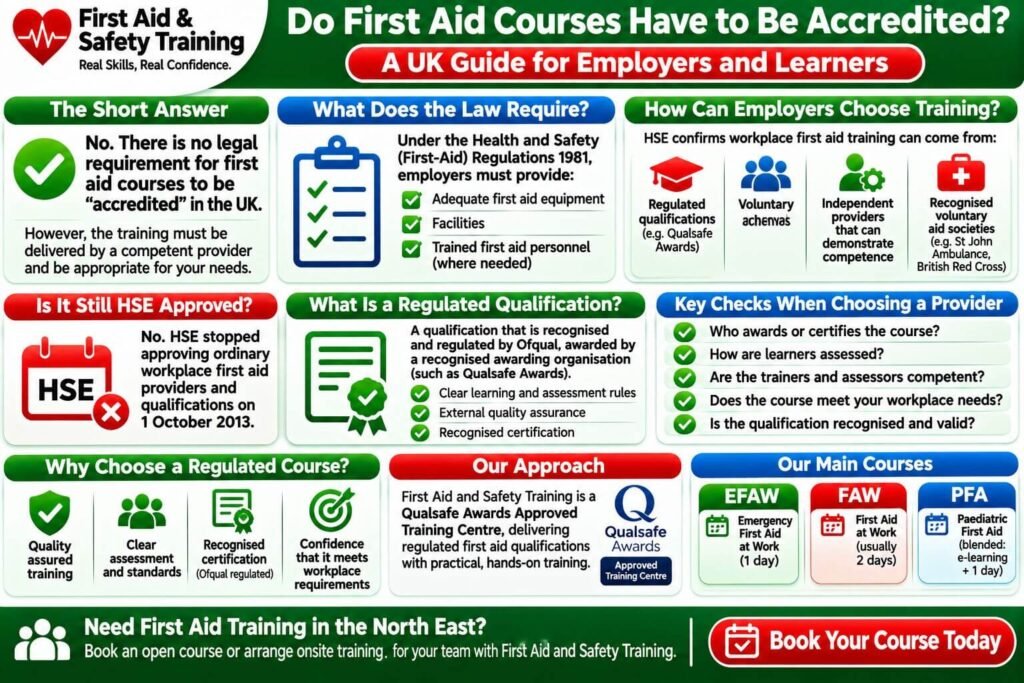
The simple answer is no, there is no general legal requirement for workplace first aid courses to be “accredited” in the way the term is often used online.
In Great Britain, the Health and Safety Executive no longer approves ordinary workplace first aid training providers or First Aid at Work and Emergency First Aid at Work qualifications.
Instead, employers are responsible for choosing a competent first aid training provider and making sure the training is appropriate for their workplace.
One way of doing this is to choose a regulated first aid qualification delivered through an approved training centre and awarded by a recognised awarding organisation.
That is the route we use at First Aid and Safety Training.
We are a Qualsafe Awards Approved Training Centre, delivering regulated first aid qualifications awarded by Qualsafe Awards, an Ofqual-recognised awarding organisation.
But there are other routes that employers can legally consider.
Understanding the difference between them can help you make an informed decision.
What Does Accredited First Aid Training Mean?
The word accredited is widely used in the training industry, but it can mean different things.
A training provider might use it to describe:
- a regulated qualification
- membership of an approval scheme
- approval from a trade organisation
- certification by another organisation
- an internally certified training course
Those are not necessarily the same thing.
For that reason, simply seeing the words “accredited first aid course” does not tell you everything you need to know.
A better question is:
Who awards or certifies the training, how is its quality assured, and does it meet my requirements?
Are First Aid Courses HSE Approved?
For ordinary workplace first aid training in Great Britain, no.
The Health and Safety Executive stopped approving workplace first aid training organisations and qualifications on 1 October 2013.
This changed the way employers select first aid training.
You may still find websites referring to:
- HSE-approved courses
- HSE-approved trainers
- HSE-approved certificates
For normal EFAW and FAW training in Great Britain, that terminology is generally outdated.
HSE’s current guidance makes it clear that employers are responsible for making sure the organisation they choose is competent to provide the required training.
There are separate arrangements in some specialist sectors, including offshore first aid, so context matters.
Why Did HSE Stop Approving First Aid Training Providers?
The change gave employers greater flexibility in how they arrange workplace first aid training.
Rather than HSE maintaining an approval system for ordinary workplace first aid providers, employers now carry out appropriate due diligence when selecting their provider.
This means the employer needs reasonable assurance that the training organisation is competent.
HSE provides specific guidance to help employers make that decision.
You can read the official HSE guidance on selecting a first aid training provider.
What Does the Law Actually Require?
The Health and Safety (First-Aid) Regulations 1981 require employers to provide adequate and appropriate:
- first aid equipment
- facilities
- personnel
This is so employees can receive immediate attention if they are injured or become ill at work.
Employers should carry out a first aid needs assessment to determine what provision is required.
If that assessment identifies a need for trained first aiders, the employer needs to decide:
- the appropriate level of training
- how many people need training
- which competent training provider to use
For many organisations, this will mean choosing between:
- Emergency First Aid at Work, EFAW
- First Aid at Work, FAW
- another appropriate level of training identified through the needs assessment
Our guide to what first aid course you need explains how to make that decision.
What Does HSE Say About Choosing a Training Provider?
HSE gives employers several options.
Workplace first aid training can come from providers offering:
- regulated qualifications from an awarding organisation
- voluntary approval schemes
- independent training where the provider can demonstrate competence
- recognised voluntary aid societies
HSE does not say that every employer must choose one particular route.
Instead, the employer should choose an appropriate provider and carry out the necessary due diligence.
This is an important distinction.
A regulated qualification provides one clear quality-assured route, but it is not correct to claim that every non-regulated first aid course is automatically illegal or invalid.
What Is a Regulated First Aid Qualification?
A regulated qualification is different from a training provider simply creating its own course and certificate.
In England, regulated qualifications can be offered through awarding organisations recognised by Ofqual, the Office of Qualifications and Examinations Regulation.
The awarding organisation is responsible for the qualification and its assessment requirements.
The training centre delivers the qualification in accordance with those requirements.
This provides an external system of quality assurance.
For an employer, that can make it easier to establish that the qualification has defined:
- learning outcomes
- assessment requirements
- trainer requirements
- quality assurance processes
- certification arrangements
You can check regulated qualifications using the Government’s Register of Regulated Qualifications.
Is First Aid and Safety Training Ofqual Regulated?
No, and this is an important distinction.
First Aid and Safety Training is a training provider, not an awarding organisation.
Ofqual regulates recognised awarding organisations and regulated qualifications. It does not regulate ordinary training centres simply because they deliver those qualifications.
First Aid and Safety Training is a Qualsafe Awards Approved Training Centre.
Qualsafe Awards is an Ofqual-recognised awarding organisation.
Therefore, when we deliver one of our regulated first aid qualifications, it is the qualification and awarding organisation framework that provides the regulated route.
It would be misleading for a training company to describe itself simply as “Ofqual regulated” when it is actually an approved centre delivering qualifications from a recognised awarding organisation.
What Is Qualsafe Awards?
Qualsafe Awards is an awarding organisation providing regulated qualifications across areas including first aid.
First Aid and Safety Training operates as an approved training centre for Qualsafe Awards.
This means our regulated qualifications must be delivered and assessed in accordance with the relevant qualification requirements.
For learners and employers, this provides external quality assurance rather than relying solely on a certificate produced internally by the training company.
Does a First Aid Course Have to Be a Regulated Qualification?
Not necessarily.
HSE specifically allows employers to consider different routes when selecting a competent training provider.
A provider may operate independently of a regulated qualification framework and still be able to demonstrate that it meets the required standards.
However, the employer then needs to satisfy itself that the provider is competent.
That due diligence matters.
The question should not simply be:
“Is this course accredited?”
It should be:
“Can I demonstrate that this training provider is competent and that this course meets our first aid needs?”
Why Choose a Regulated First Aid Qualification?
Although it is not the only route available, regulated training has several advantages.
Clear Qualification Requirements
The qualification has defined learning outcomes and assessment requirements.
External Quality Assurance
The training centre operates within the quality assurance requirements of the awarding organisation.
Defined Assessment
Learners need to demonstrate the required knowledge and practical skills.
Recognised Certification
The certificate relates to a defined regulated qualification rather than simply confirming attendance at an internally created course.
Employer Confidence
For many employers, choosing a regulated qualification provides a straightforward way to demonstrate that they selected a recognised quality-assured route.
This is why First Aid and Safety Training has chosen to deliver regulated workplace first aid qualifications through Qualsafe Awards.
Does a Regulated Qualification Mean Everyone Automatically Passes?
No.
A regulated qualification is not simply an attendance certificate.
Learners need to meet the required assessment criteria.
Depending on the qualification, this can involve:
- practical assessment
- trainer observation
- scenarios
- questioning
- theory assessment
For example, if CPR is an assessed practical skill, the learner needs to demonstrate CPR to the required standard.
Our guide Can You Fail a First Aid Course? explains how first aid assessments work and what happens if somebody struggles.
What Should Employers Check When Choosing a First Aid Provider?
Whether you choose regulated or independent training, you need confidence in the organisation delivering it.
HSE’s guidance identifies important areas employers should consider when carrying out due diligence.
These include the provider’s:
- trainers and assessors
- teaching and first aid standards
- syllabus
- assessment processes
- quality assurance
- certification
The level of checking required can depend on the type of provider you select.
A provider should be prepared to explain how its training meets the required standards.
What Qualifications Should the Trainer Have?
A competent provider should use appropriately qualified trainers and assessors.
This means considering both:
- first aid competence
- training and assessing competence
Simply having attended a first aid course does not automatically make somebody competent to teach regulated first aid qualifications.
Approved training centres also need to work within the trainer, assessor and quality assurance requirements set by their awarding organisation.
Does the Course Need Practical Training?
For qualifications such as EFAW and FAW, first aid is fundamentally practical.
Learners need to develop and demonstrate practical skills.
These include areas such as:
- casualty assessment
- CPR
- AED use
- management of an unresponsive casualty
- choking
- bleeding control
Depending on the qualification, additional practical skills may also be included.
A certificate obtained by simply clicking through online slides should not automatically be assumed to be equivalent to a properly delivered practical workplace first aid qualification.
Can First Aid Training Be Completed Online?
Some first aid qualifications can use blended learning.
Blended learning combines appropriate online learning with face-to-face practical training and assessment.
This is different from an entirely online first aid course.
For example, our current blended Paediatric First Aid programme combines 6 hours of e-learning with a face-to-face practical training and assessment day.
Some of our First Aid at Work training can also use an approved blended learning format.
The important question is not simply whether part of the course is online.
It is whether the complete training programme meets the requirements of the qualification and provides the necessary practical training and assessment.
Are Online First Aid Certificates Accredited?
Some online training providers may describe their courses as accredited.
Again, you need to look beyond the word.
Ask:
- Who has accredited it?
- Is it a regulated qualification?
- What practical training is included?
- How are practical skills assessed?
- What qualification will I actually receive?
- Does it meet my employer’s requirements?
An online awareness course may be perfectly useful for learning.
That does not automatically make it suitable for somebody who needs to act as a qualified workplace first aider.
Does Emergency First Aid at Work Need to Be Accredited?
An employer needs to ensure that the person acting as a workplace first aider has been trained appropriately by a competent provider.
A regulated Emergency First Aid at Work course provides one clear route.
EFAW normally involves a minimum of one day’s training and develops the essential skills needed to provide emergency first aid to someone who becomes injured or ill at work.
At First Aid and Safety Training, our EFAW learners complete a regulated Qualsafe Awards qualification.
Does First Aid at Work Need to Be Accredited?
The same principle applies to FAW.
There is no general rule saying that every FAW course must carry something specifically called “accreditation”.
The employer needs to select a competent training provider and appropriate training.
Our First Aid at Work course leads to a regulated Qualsafe Awards qualification.
FAW provides a broader level of workplace first aid training than EFAW and is particularly relevant where the first aid needs assessment identifies a wider range of foreseeable injuries and illnesses.
What About Paediatric First Aid?
Paediatric First Aid is slightly different because people may be completing it for specific childcare or Early Years Foundation Stage requirements.
If you need Paediatric First Aid for an early years role, you should make sure the course satisfies the relevant EYFS requirements rather than relying on an advertisement simply saying the course is accredited.
Our Paediatric First Aid course leads to a regulated Qualsafe Awards qualification and is designed to meet the relevant requirements for people working with babies and children.
Does My Employer Have to Accept Any Accredited First Aid Certificate?
Not necessarily.
An employer is responsible for its first aid arrangements.
If you arrive with an existing certificate, the employer may need to establish whether your training:
- is still valid
- is appropriate for your role
- covers the level of first aid identified in its needs assessment
- came from an appropriate training provider
- satisfies any additional industry requirements
The word “accredited” on a certificate does not remove the employer’s responsibility to make appropriate first aid arrangements.
What If My First Aid Certificate Is from Another Provider?
You do not normally have to repeat training simply because you change employer or because your new employer uses a different training company.
The important questions include:
- Is your certificate still valid?
- What qualification did you complete?
- Is that level of training appropriate for your new workplace?
- Is the employer satisfied with the training and certification?
A valid EFAW or FAW qualification does not belong to your previous employer.
However, a new workplace may have different risks and may require additional or higher-level training.
How Long Is an Accredited First Aid Certificate Valid?
For workplace first aid purposes, EFAW and FAW certificates are normally valid for three years.
Before the certificate expires, the first aider needs to undertake appropriate requalification training if they are going to continue acting as a workplace first aider.
HSE also strongly recommends annual refresher training to help first aiders maintain their basic skills.
An annual refresher does not extend the expiry date of the original qualification.
Does Accreditation Guarantee Good Training?
Not by itself.
Quality assurance is valuable, but the actual training experience still matters.
A good first aid course should include:
- clear explanations
- correct current first aid guidance
- demonstrations
- sufficient practical equipment
- plenty of hands-on practice
- appropriate learner-to-equipment ratios
- realistic scenarios
- fair assessment
- constructive feedback
The aim should be more than obtaining a certificate.
Learners should leave able to use what they have learned.
Our guide to what happens on a first aid course explains what you should expect from a practical training day.
What Are Warning Signs When Choosing a First Aid Course?
Be cautious if a provider:
- cannot clearly explain who awards or certifies the course
- makes vague claims about “accreditation”
- still claims ordinary workplace courses are HSE approved
- cannot explain how learners are assessed
- offers a practical qualification entirely through videos with no appropriate practical assessment
- cannot explain its quality assurance arrangements
- provides no clear information about trainer competence
- guarantees that everyone passes regardless of performance
Price is important, but it should not be the only factor.
If the course is being used to fulfil a workplace responsibility, make sure you understand what you are actually buying.
How Can I Check a Regulated Qualification?
If a provider says a qualification is regulated in England, you can check the Government’s official Register of Regulated Qualifications.
The register allows you to search for:
- regulated qualifications
- recognised awarding organisations
- qualification details
Use the Government’s regulated qualification search rather than relying solely on marketing claims.
You can also use the regulated awarding organisation search to check whether an awarding organisation is officially recognised.
What Is the Difference Between a Training Provider and an Awarding Organisation?
This is one of the most useful distinctions to understand.
Training Provider
The training provider teaches and assesses learners.
For example:
First Aid and Safety Training Ltd
Awarding Organisation
The awarding organisation develops and awards regulated qualifications and oversees the quality assurance framework.
For our regulated courses:
Qualsafe Awards
Regulator
In England, Ofqual regulates recognised awarding organisations and regulated qualifications.
So the relationship is broadly:
Ofqual → recognised awarding organisation → approved training centre → learner
This is much more accurate than saying:
“Our training company is Ofqual accredited.”
Is Qualsafe Training HSE Approved?
It is better not to describe ordinary Qualsafe workplace first aid qualifications as HSE approved.
HSE no longer operates the old approval system for ordinary workplace first aid training.
The more accurate description is that Qualsafe Awards is an Ofqual-recognised awarding organisation and First Aid and Safety Training is an Approved Training Centre delivering its regulated qualifications.
Employers should still ensure that the qualification and level of training are appropriate for their workplace needs.
So, Do First Aid Courses Have to Be Accredited?
If you are still asking do first aid courses have to be accredited, the answer is:
No, not necessarily.
There is no general requirement that ordinary workplace first aid training in Great Britain must carry something specifically described as “accreditation”.
Instead:
THE EMPLOYER MUST ASSESS THEIR NEEDS
Your first aid provision should be based on your workplace and its risks.
THE TRAINING MUST BE APPROPRIATE
EFAW, FAW or another level of training should match the findings of the first aid needs assessment.
THE PROVIDER MUST BE COMPETENT
Employers need to satisfy themselves that the training provider can deliver appropriate first aid training.
REGULATED QUALIFICATIONS ARE ONE CLEAR ROUTE
Choosing a qualification from a recognised awarding organisation provides an externally quality-assured option.
CHECK WHAT “ACCREDITED” ACTUALLY MEANS
Do not rely on the word alone.
Find out who awards the qualification, how it is assessed and whether it meets your requirements.
Why We Use Regulated First Aid Qualifications
At First Aid and Safety Training, we have chosen the regulated qualification route because it provides a clear framework for learners and employers.
We are a Qualsafe Awards Approved Training Centre.
Our regulated qualifications are delivered and assessed according to the relevant Qualsafe Awards requirements.
That gives our customers confidence that there is an awarding organisation and external quality assurance framework behind the qualification.
Just as importantly, we keep our training practical.
Our aim is not simply for somebody to collect another certificate.
We want learners to leave with real skills and real confidence to respond when somebody needs help.
Regulated First Aid Training in the North East
First Aid and Safety Training provides practical first aid qualifications for individuals and organisations across the North East.
Our main courses include:
We provide scheduled open courses as well as onsite first aid training for organisations.
If you are responsible for arranging workplace training and are unsure what qualification you need, contact First Aid and Safety Training and we can help you understand the available options.
For independent guidance, you can also read the Health and Safety Executive’s advice on first aiders and training and its guide to selecting a competent first aid training provider.
You can view our South Shields training centre and customer reviews on Google Maps.
Real Skills, Real Confidence.