
Benedict's Law, Allergy and Anaphylaxis Training
Helping Schools Understand the New Allergy Safety Requirements
Benedict’s Law introduces new statutory allergy safety requirements for schools in England, including greater emphasis on staff training, allergy awareness and emergency response. First Aid and Safety Training can help your school understand the changes and prepare your staff with dedicated Allergy and Anaphylaxis Awareness training.
- Valuable Life Skills
- Increased Confidence
- Workplace Compliance
- Valuable Life Skills
- Increased Confidence
- Workplace Compliance
Understanding Benedict's Law
Schools across England are facing important new responsibilities around allergy safety, staff awareness and emergency response.
Often referred to as Benedict’s Law, the new requirements are designed to create a more consistent approach to protecting children with allergies and ensuring schools are prepared to recognise and respond to an anaphylactic emergency.
For schools, this goes beyond simply having qualified first aiders.
It means developing a whole-school approach to allergy safety, where policies, staff training, individual care arrangements and access to emergency medication work together.
First Aid and Safety Training provides practical, confidence-focused training to help schools understand these responsibilities and prepare their staff to respond effectively in an emergency.
A realistic UK primary or secondary school setting with a teacher/support member of staff and pupils. Ideally there should be a subtle indication of first aid/emergency readiness without making a child appear ill or distressed.

Important – New Guidance
The information on this page is currently under review and will continue to be updated as further guidance and qualification information becomes available.
Benedict’s Law and the associated statutory allergy safety requirements are very new. We are actively reviewing updates from the Department for Education, Qualsafe Awards and specialist allergy organisations to ensure the information and training we provide remains current.
What Is Benedict’s Law?
Benedict’s Law is the name widely associated with the campaign for stronger allergy protections in schools following the death of five-year-old Benedict Blythe after an anaphylactic reaction at his primary school.
His family campaigned for changes that would help prevent other families experiencing a similar tragedy.
The resulting changes place a much greater emphasis on allergy safety within schools and on creating consistent standards for preventing, recognising and responding to allergic emergencies.
Schools need to consider areas including
A clear whole-school Allergy Policy
Allergy awareness throughout the school
Appropriate staff training
Recognising allergic reactions and anaphylaxis
Individual healthcare and allergy action plans
Access to emergency adrenaline auto-injectors (AAIs)
Clear emergency procedures
Defined responsibilities for staff
Communication with pupils and families
Regular review of allergy arrangements
The aim is not simply to respond better when an emergency happens.
It is to create a school environment that is better prepared to prevent allergic reactions where possible, recognise them quickly and respond appropriately when they occur.
When Do Schools Need to Comply?
New statutory guidance on allergy safety in schools was published in 2026, creating new responsibilities for schools across England.
Schools should now be reviewing their current allergy arrangements, policies, staff awareness and emergency procedures and making the necessary changes.
For many schools, this will involve considerably more than updating a first aid policy.
It requires allergy safety to be considered across the whole school.
Is Your School Ready?
Consider
Policy → People → Plans → Medication → Training → Emergency Response
Benedict’s Law should be approached as a whole-school responsibility rather than simply another first aid requirement.
Which Schools Are Affected by Benedict’s Law?
The new statutory allergy safety requirements apply to schools in England covered by the legislation and associated statutory guidance.
This includes a wide range of education settings such as maintained schools, academies, free schools, special schools and alternative provision.
There are differences in how and when requirements apply to some settings, including independent schools.
Early years providers, nurseries and other education settings should continue to follow the legislation and statutory guidance applicable to their particular setting.
Because the requirements are new, schools should establish exactly which provisions apply to them rather than assuming that existing first aid arrangements automatically provide compliance.
Who Needs Allergy and Anaphylaxis Training in a School?
One of the most important principles behind the new approach is that allergy safety cannot be left solely to designated first aiders.
An allergic reaction could happen almost anywhere.
It could happen in a classroom, dining hall, playground, sports field, school office, corridor, during an activity or while away from school.
The first adult present may not be one of the school’s qualified first aiders.
A whole-school approach therefore means ensuring staff and relevant volunteers understand the school’s allergy arrangements and know how to respond if a child experiences a serious allergic reaction.
This can include
Teachers
Teaching Assistants
Learning Support Staff
Office and Administrative Staff
Lunchtime Supervisors
Kitchen and Catering Staff
Caretakers and Site Staff
Sports and Activity Staff
Governors
Volunteers
Transport Support and Drivers
The objective is straightforward
People need to recognise what may be happening, know what they should do and have the confidence to act.
Is Paediatric First Aid, EFAW or FAW Enough for Benedict's Law?
This is likely to be one of the biggest questions schools have.
Existing first aid qualifications remain extremely important.
Schools will continue to need appropriate first aid provision, which may include Paediatric First Aid, Emergency First Aid at Work (EFAW) and First Aid at Work (FAW) depending upon their setting, staff responsibilities and first aid needs assessment.
These qualifications include important emergency first aid knowledge, and anaphylaxis is covered within first aid training.
However, schools should not assume that existing first aid qualifications alone satisfy all of their new allergy safety responsibilities.
Benedict’s Law introduces a much wider whole-school approach.
Dedicated Allergy and Anaphylaxis Awareness training complements existing first aid qualifications by helping a wider group of staff understand allergies, prevention, recognition, emergency arrangements and the school’s responsibilities.
Think of the two as complementary
First Aid Training
Develops broader first aid knowledge and practical emergency response skills.
Allergy and Anaphylaxis Awareness Training
Develops specific knowledge and awareness around allergies, anaphylaxis, prevention, emergency procedures and allergy safety within the school environment.
A school may therefore have excellent qualified first aiders while still needing to review its wider allergy training and procedures.
Benedict's Law & Allergy and Anaphylaxis Training
First Aid and Safety Training will be delivering the new Qualsafe Level 3 Award in Allergy and Anaphylaxis Awareness (RQF) following its formal launch by Qualsafe Awards.
The qualification is being developed specifically to support the new allergy safety requirements.
It provides schools with a structured way of providing Benedict’s Law & Allergy and Anaphylaxis Training to staff and volunteers.
With a Total Qualification Time of approximately two hours, the qualification is particularly well suited to:
School INSET days
Whole-school training
Staff development sessions
Groups of teaching and support staff
School volunteers
Academy and multi-academy trust training
The awareness qualification does not require practical assessment, making it possible to provide consistent training to larger groups of staff.
Annual requalification is expected in line with the new requirements.
What Does Allergy and Anaphylaxis Awareness Training Cover?
The new qualification will help learners develop a greater understanding of allergies, allergic reactions and anaphylaxis within the school environment.
Training is expected to cover areas including:
Understanding allergies
Common allergens and triggers
Allergic reactions
Signs and symptoms of an allergic reaction
Recognising anaphylaxis
Understanding how quickly anaphylaxis can develop
Reducing the risk of accidental exposure
Individual allergy and healthcare plans
Emergency procedures
Adrenaline auto-injectors
Accessing emergency medication
Responding when anaphylaxis is suspected
Contacting the emergency services
Responsibilities within the school
Supporting a whole-school approach to allergy safety
The aim is not to turn every member of school staff into a medical professional.
It is to give people the understanding and confidence to recognise when something may be seriously wrong and know what they need to do next.
Recognising Anaphylaxis
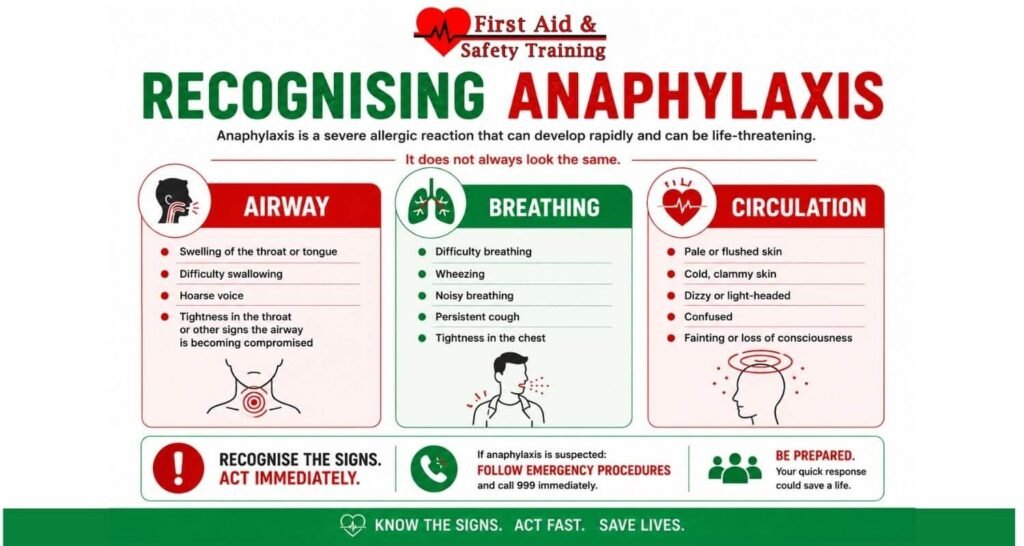
Anaphylaxis is a severe allergic reaction that can develop rapidly and can be life-threatening.
Staff need to understand that anaphylaxis does not always look the same.
A serious reaction can affect a person’s:
Airway
There may be swelling involving the throat or tongue, difficulty swallowing, a hoarse voice or other signs that the airway is becoming compromised.
Breathing
The person may experience difficulty breathing, wheezing or noisy breathing.
Circulation
They may become pale, clammy, dizzy, confused, faint or lose consciousness.
Recognising these changes and responding quickly is extremely important.
Where anaphylaxis is suspected, emergency procedures should be followed immediately.
Understanding Adrenaline Auto-Injectors
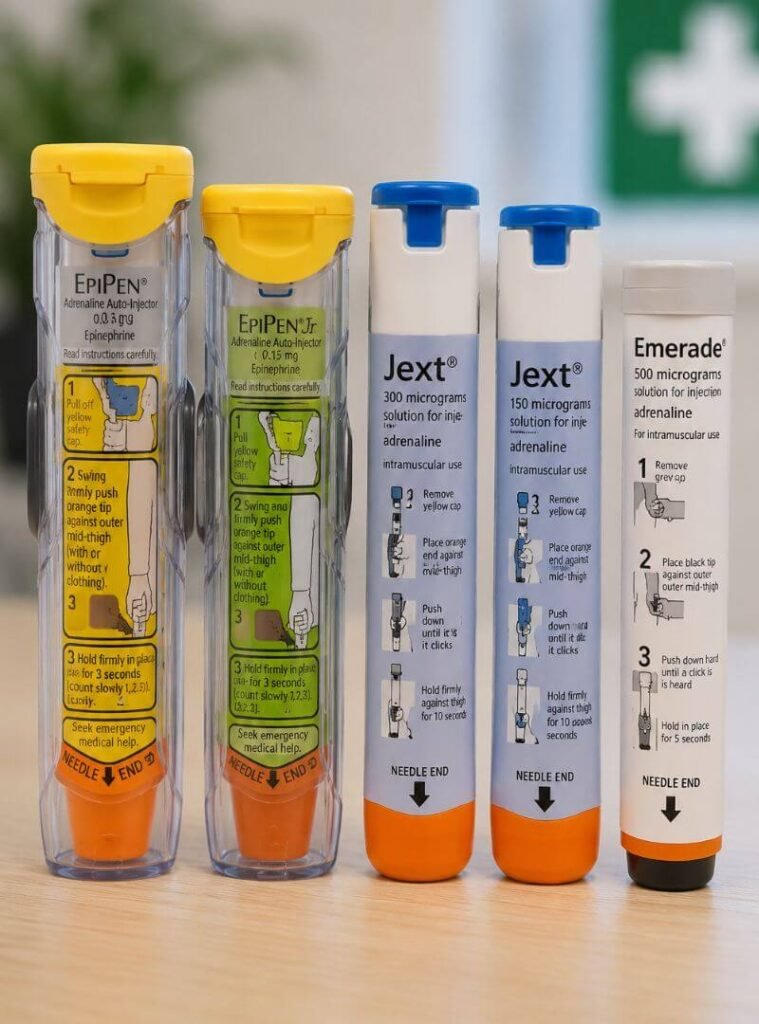
Adrenaline is the first-line emergency treatment for anaphylaxis.
An important part of allergy awareness is therefore understanding the role of adrenaline auto-injectors (AAIs) and how emergency medication can be accessed when it is needed.
Different AAI devices exist, and staff may encounter different brands.
During our training we use adrenaline auto-injector training devices, including EpiPen and other AAI trainers, so learners can see and become familiar with the type of equipment that could be used during an emergency.
Although the Qualsafe awareness qualification does not require a practical assessment, our approach to training has always been based around making learning relevant and understandable.
Seeing the equipment and understanding how it works can help remove some of the fear and uncertainty surrounding an anaphylactic emergency.
Benedict’s Law Is About More Than an Adrenaline Pen
Emergency medication is extremely important, but effective allergy safety requires much more than simply purchasing an adrenaline auto-injector.
Several elements need to work together.
Policy
The school should have a clear Allergy Policy which reflects its responsibilities and is understood by staff.
Prevention
Staff need awareness of allergies and allergens and should understand the measures used within the school to reduce avoidable exposure.
Individual Planning
Children with known allergies need appropriate individual arrangements so relevant staff understand their needs and emergency procedures.
Emergency Medication
Medication needs to be appropriate, accessible and managed correctly.
Training
Staff need suitable allergy and anaphylaxis awareness training and should understand the school’s procedures.
Emergency Response
People throughout the school need to know what to do when an allergic reaction or suspected anaphylactic emergency occurs.
Together these create a much stronger approach to allergy safety.
Allergy Training and Your Wider School First Aid Provision
Benedict’s Law, Allergy and Anaphylaxis Training should form part of your school’s wider approach to first aid and emergency readiness.
First Aid and Safety Training can support schools with a range of regulated qualifications and specialist training.
Allergy and Anaphylaxis Awareness
Supporting whole-school allergy awareness and the new allergy safety requirements.
More About The Allergy and Anaphylaxis Awareness Course
Emergency First Aid at Work
Essential emergency first aid knowledge and practical skills for staff.
About Our Emergency First Aid at Work Course
First Aid at Work
More comprehensive first aid training for staff with greater workplace first aid responsibilities.
More About Our First Aid at Work Course
Paediatric First Aid
Specialist first aid training for people responsible for babies and children and for settings where paediatric first aid requirements apply.
Learn More About Our Paediatric First Aid Courses
Rather than viewing each course in isolation, schools can review their first aid and allergy training together and build an appropriate training programme around their people, responsibilities and needs.
Training That Builds Confidence to Act
Knowing what anaphylaxis is and feeling confident enough to respond to it are two different things.
This is something we see throughout first aid training.
Someone may have been told what to do, but when faced with a real emergency they can still hesitate because they are frightened of making a mistake.
Our training is designed to reduce that uncertainty.
We use simple explanations, realistic examples, training equipment and an open learning environment where people are encouraged to ask questions.
We want staff to understand
What am I looking for?
What do I need to do?
What equipment is available?
What happens next?
Because knowledge matters.
But in an emergency, people also need the confidence to act on that knowledge and that is why physical training is vital.
Preparing Your School for Benedict’s Law
If you are responsible for first aid, health and safety, safeguarding, staff development or allergy provision within a school, now is the time to review your arrangements.
Consider
Does your school have an up-to-date Allergy Policy?
Do staff know where to find it?
Have individual allergy arrangements been reviewed?
Do staff understand the signs of anaphylaxis?
Is emergency medication accessible?
Do staff know where it is?
Do staff understand what to do in an emergency?
Has appropriate allergy and anaphylaxis training been completed?
Is training recorded?
Is there a process for keeping knowledge and training current?
The objective isn’t simply to tick another compliance box.
It is to make sure that when a child needs help, the people around them are prepared to respond.
Talk to Us About Benedict’s Law & Allergy and Anaphylaxis Training
First Aid and Safety Training can help schools across the North East understand their training requirements and develop an appropriate programme for their staff.
Whether you need dedicated Benedict’s Law & Allergy and Anaphylaxis Training, Emergency First Aid at Work, First Aid at Work, Paediatric First Aid or a combination of training across your school, we can help you identify the most appropriate approach.
The new Qualsafe Allergy and Anaphylaxis Awareness qualification will also make whole-school delivery particularly suitable for INSET days and larger staff groups.
Get Your School Ready
If you would like to discuss allergy and anaphylaxis training for your school, contact First Aid and Safety Training.
We can discuss your staff numbers, existing first aid provision and training requirements and help you plan the next steps.
Contact us today to discuss Benedict’s Law & Allergy and Anaphylaxis Training for your school.
Further Information About Benedict’s Law
As this is a developing area, schools should also refer to current official and specialist guidance.
Department for Education – Allergy Safety in Schools statutory guidance.
Kitt Medical – Information about Anaphylaxis Kitts and emergency adrenaline provision for schools.
Frequently Asked Questions About Benedict's Law, Allergy and Anaphylaxis Training
Benedict's Law is the name associated with new statutory allergy safety requirements for schools in England, introduced following the death of five-year-old Benedict Blythe after an anaphylactic reaction at school.
The changes are designed to create stronger and more consistent allergy protection within schools, including allergy policies, staff training, emergency procedures and appropriate arrangements for pupils with allergies.
The new statutory allergy safety guidance applies from the beginning of the 2026/27 academic year, with schools expected to take action to implement the new requirements.
Because the guidance and associated requirements are new, schools should continue to monitor Department for Education guidance as implementation develops.
The statutory requirements apply to schools in England covered by the legislation and associated Department for Education guidance, including maintained schools, academies and pupil referral units.
There are differences in the requirements and implementation timescales for some education settings, so schools should check the current statutory guidance applicable to their organisation.
The new approach is based around whole-school allergy awareness rather than limiting knowledge to designated first aiders.
Staff throughout the school should have appropriate allergy awareness training because an allergic reaction could occur anywhere, including classrooms, playgrounds, dining areas, corridors or during school activities.
This can include teaching staff, teaching assistants, administrative staff, catering teams, lunchtime supervisors, site staff and other people working within the school.
The new requirements include annual allergy awareness training.
Schools should therefore consider how allergy training will be incorporated into their ongoing staff training programme rather than treating it as a one-off exercise.
No. Paediatric First Aid remains extremely important and includes the recognition and emergency treatment of conditions including anaphylaxis, but schools should not assume that holding Paediatric First Aid qualifications alone fulfils their wider allergy safety responsibilities.
Dedicated allergy and anaphylaxis awareness training supports the whole-school approach required by the new guidance and can be provided to a much wider group of staff.
Emergency First Aid at Work (EFAW) and First Aid at Work (FAW) remain important qualifications for appropriate members of school staff.
However, Benedict's Law introduces wider requirements around allergy awareness, policies, individual arrangements, prevention and emergency response. Schools should therefore consider their dedicated allergy and anaphylaxis training alongside their existing first aid provision.
Anaphylaxis is a severe and potentially life-threatening allergic reaction that can develop rapidly.
It can affect a person's airway, breathing and circulation and requires immediate emergency action. School staff therefore need to be able to recognise the warning signs and understand what they should do next.
An adrenaline auto-injector, often referred to as an AAI, is a device designed to deliver a measured dose of adrenaline during an anaphylactic emergency.
Different devices are available. During our training we use AAI training devices so learners can become familiar with the equipment they may encounter without using live medication.
The new allergy safety arrangements strengthen the expectations around schools having appropriate emergency adrenaline provision.
Schools should review the current statutory guidance when deciding how spare AAIs are obtained, stored, managed and made accessible during an emergency.
Is the new allergy and anaphylaxis course a regulated qualification?
First Aid and Safety Training will be delivering the new Qualsafe Level 3 Award in Allergy and Anaphylaxis Awareness (RQF) following its formal launch by Qualsafe Awards.
The qualification is being developed to support schools with the new allergy safety requirements. We will update this page with the complete qualification specification as soon as it is formally released.
The forthcoming Qualsafe qualification has a Total Qualification Time of approximately two hours, making it particularly suitable for school staff development and INSET days.
This provides schools with a practical way of delivering consistent allergy and anaphylaxis awareness training to larger groups of staff.
The forthcoming Qualsafe qualification is an awareness qualification and is not expected to include a formal practical assessment.
However, at First Aid and Safety Training we believe that seeing and understanding emergency equipment helps build confidence. Our delivery will therefore include demonstrations using adrenaline auto-injector training devices and relevant training equipment.
Yes. The short duration of the Allergy and Anaphylaxis Awareness qualification makes it particularly suitable for INSET days and whole-school staff training.
We can discuss your number of staff and existing first aid provision and help determine the most appropriate way to deliver the training.
The new qualification is specifically suited to allergy awareness training for larger groups because there is no formal practical assessment requirement.
Please contact us with your approximate staff numbers and we can discuss the most appropriate delivery arrangements for your school.
No. Allergy and anaphylaxis awareness training should complement rather than replace appropriate first aid qualifications.
Schools will still need to consider their wider first aid requirements, which may include Emergency First Aid at Work, First Aid at Work and Paediatric First Aid, depending upon their setting and first aid needs assessment.
Yes. We can discuss your existing first aid qualifications, staff numbers and allergy awareness provision and help you identify appropriate training options.
This can include Benedict's Law & Allergy and Anaphylaxis Training, Emergency First Aid at Work, First Aid at Work and Paediatric First Aid.
If you're unsure where to start, contact us and we can talk through your current training arrangements and the options available.
This page is under active review. Information will be updated as further guidance, qualification specifications and training information become available.