Skip to content

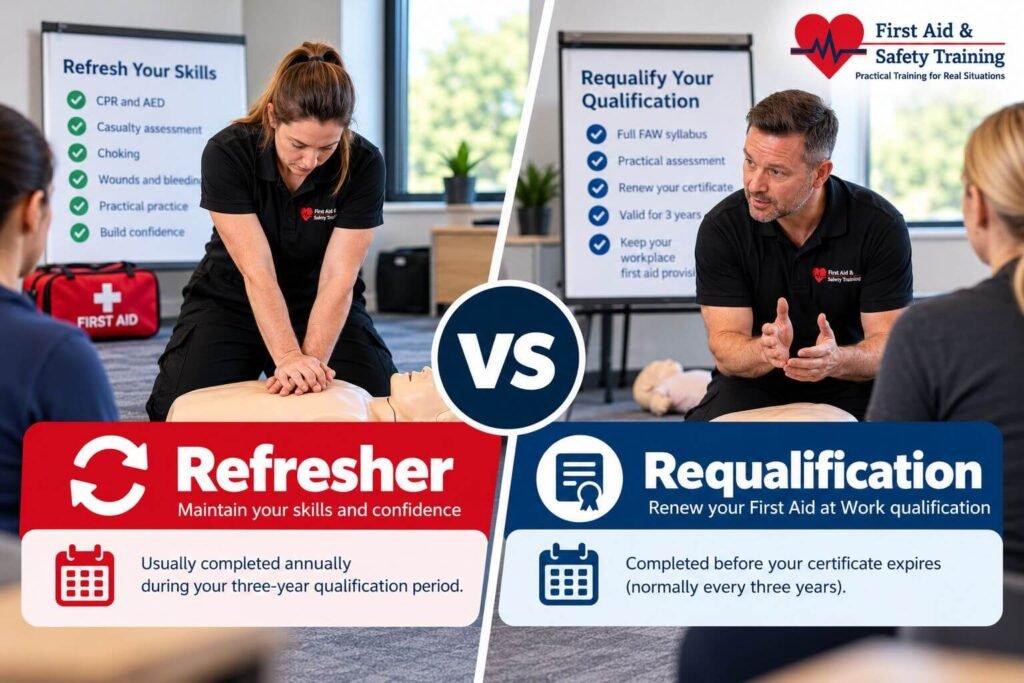
If you are responsible for first aid training in a workplace, the terms first aid refresher and first aid requalification can easily cause confusion.
They are not the same thing.
Annual refresher training helps qualified first aiders maintain their knowledge, practical skills and confidence during the life of their existing qualification.
Requalification training has a different purpose. It allows a first aider to renew their First Aid at Work qualification as it approaches expiry.
Understanding the difference matters because completing an annual refresher does not renew a First Aid at Work certificate or restart its three-year validity period.
In this guide, we explain the difference between first aid refresher and requalification training, when each is used and why the Health and Safety Executive strongly recommends annual refresher training for workplace first aiders.
What Is Annual First Aid Refresher Training?
Annual first aid refresher training is designed to help qualified workplace first aiders maintain their practical skills and knowledge.
A First Aid at Work qualification is valid for three years, but this does not mean somebody’s practical skills will automatically remain at the same level throughout that period.
First aid is different from a skill that somebody uses every day.
A workplace first aider could complete their qualification and then go months, or even years, without having to perform CPR, use an AED or deal with serious bleeding.
The Health and Safety Executive therefore strongly recommends that first aiders undertake annual refresher training during the three-year certification period.
The purpose is to keep essential first aid skills fresh and give first aiders regular opportunities to practise.
Importantly, annual refresher training does not renew the underlying qualification.
If your organisation is looking to arrange practical refresher training for existing first aiders, you can find further information on our First Aid at Work Refresher Course page.
What Is First Aid at Work Requalification Training?
First Aid at Work requalification training is for people who already hold an FAW qualification and need to renew it.
A First Aid at Work certificate is valid for three years. Employers should arrange appropriate requalification training before the certificate expires so that they can maintain the first aid provision identified by their first aid needs assessment.
Unlike an annual refresher, the FAW requalification course leads to the first aider renewing their qualification for a further certification period.
The initial First Aid at Work qualification normally involves at least 18 contact hours of training over three days.
The FAW requalification course involves at least 12 contact hours over two days.
It revisits the wider FAW syllabus and includes the assessment required to renew the qualification.
First Aid Refresher vs Requalification
The easiest way to understand the difference is to look at what each course is trying to achieve.
| Annual Refresher | FAW Requalification | |
|---|---|---|
| Purpose | Maintain skills and confidence | Renew the FAW qualification |
| When? | During the three-year certification period | Before the FAW qualification expires |
| HSE position | Strongly recommended annually | Needed to remain appropriately qualified as an FAW first aider |
| Renews FAW certificate? | No | Yes |
| Replaces requalification? | No | N/A |
| Main emphasis | Maintaining essential practical skills | Revisiting, assessing and renewing the qualification |
| FAW duration | Short refresher training | At least 12 contact hours over 2 days |
The important distinction is:
Refresher = maintain your skills.
Requalification = renew your qualification.
Completing refresher training every year does not mean you can avoid the FAW requalification course when your qualification approaches expiry.
Is Annual First Aid Refresher Training Mandatory?
No.
HSE strongly recommends annual refresher training for workplace first aiders, but it is not a mandatory requirement under the Health and Safety (First-Aid) Regulations 1981.
That distinction is important.
Employers should not be told that the law requires their first aiders to complete an annual refresher when it does not.
However, the fact that something is not legally mandatory does not mean it has no value.
The more useful question for an employer is:
Could our first aiders confidently perform the skills we are relying on them to provide if an emergency happened today?
If somebody last practised CPR two years ago, their certificate may still be valid.
But would they immediately recognise that somebody was not breathing normally?
Would they confidently begin CPR?
Would they remember how to use the AED on the wall?
Would they know how to respond to serious bleeding?
Regular practical refresher training helps address that problem.
Why Does HSE Recommend Annual Refresher Training?
First aid skills can deteriorate when they are not regularly practised.
This is particularly relevant to procedures such as CPR because a first aider may rarely, if ever, need to perform them during the three years that their qualification remains valid.
HSE strongly recommends annual refresher training to help qualified first aiders maintain their basic skills and keep up to date with changes to first aid procedures.
HSE also recommends that employers encourage first aiders to regularly review their course manuals and other instructional material and allow them time to do this.
Refresher training provides another opportunity to practise rather than simply read about those skills.
What Does Annual First Aid Refresher Training Cover?
Annual refresher training does not need to repeat the complete First Aid at Work qualification.
Instead, it should concentrate on maintaining important emergency first aid skills.
Training can include practical work covering areas such as:
- Assessing an incident
- Assessing a casualty
- Managing an unresponsive casualty
- CPR
- Using an Automated External Defibrillator, AED
- Choking
- Wounds and bleeding
- Shock
The emphasis should be on practical skills and confidence.
A first aider who has not performed CPR since their original course benefits much more from getting back onto a manikin and practising than simply being shown another presentation about CPR.
Which Businesses Should Consider Annual First Aid Refresher Training?
HSE’s recommendation for annual refresher training is not restricted to a particular industry.
If your organisation relies on qualified workplace first aiders, annual refresher training is something worth considering as part of your overall first aid arrangements.
For some businesses, however, there may be particularly strong reasons for keeping first aid skills regularly practised.
Higher-Risk Workplaces
Construction, manufacturing, engineering, warehousing, utilities and similar workplaces may expose employees to significant hazards.
The potential for serious injuries can make effective first aid provision particularly important.
Employers in higher-risk environments should consider the nature of the injuries that could occur as part of their first aid needs assessment.
Annual refresher training can then be used to keep core emergency skills familiar between full qualification courses.
Businesses Using Machinery, Tools or Vehicles
Workplaces involving machinery, powered equipment, tools or workplace vehicles may have the potential for significant injuries.
First aiders may need to respond to serious bleeding, crush injuries, fractures or other trauma while professional medical help is on its way.
Where an employer is relying on first aiders to respond to these incidents, maintaining practical competence should form part of the organisation’s wider first aid planning.
Remote and Lone Working Environments
Location can influence first aid requirements.
Some employees work in areas where professional medical assistance may take longer to arrive.
Others work alone or across multiple sites.
Employers should consider factors such as remoteness from emergency medical services and the needs of travelling, remote or lone workers when completing their first aid needs assessment.
Where immediate professional help may not be readily available, keeping first aid skills current can become particularly valuable.
Sports, Fitness and Leisure Businesses
Gyms, sports clubs, leisure centres and activity providers can encounter both injuries and sudden medical emergencies.
A person suffering a cardiac arrest needs immediate action.
First aiders need to recognise what has happened, call 999, start CPR and use an AED as soon as one is available.
Regular refresher training gives staff another opportunity to practise these skills rather than relying entirely on something they learned several years earlier.
Schools, Colleges and Educational Settings
Schools and colleges can have large numbers of staff, pupils, students and visitors on site.
They may also include sports facilities, workshops, science laboratories and other environments with different risks.
Annual refresher training can help workplace first aiders maintain their skills between qualification courses.
Schools and early years settings should also consider whether staff require specific paediatric first aid training, as separate requirements can apply to people caring for babies and young children.
Care and Community Organisations
Care providers, charities, community organisations and services supporting potentially vulnerable people should also consider how frequently staff may encounter illness or injury.
Their first aid needs assessment should reflect the people they support, the activities being undertaken and the availability of professional medical assistance.
Regular refresher training may be particularly useful where staff are expected to respond confidently to medical emergencies.
What About Offices and Other Low-Risk Businesses?
Being a low-risk workplace does not mean that medical emergencies cannot happen.
Someone can suffer a cardiac arrest, choke or become seriously ill in an office just as they can in a factory or construction environment.
There is also another reason refresher training can be valuable in lower-risk workplaces.
First aiders may use their skills less often.
An employee in an environment with very few accidents could potentially go through the entire three-year qualification period without providing significant first aid.
That makes regular practice particularly useful.
HSE’s recommendation for annual refresher training is not limited to high-risk industries.
Should Emergency First Aid at Work First Aiders Complete Refreshers?
HSE also strongly recommends annual refresher training for people holding the Emergency First Aid at Work, EFAW qualification.
The same principle applies.
The qualification may remain valid for three years, but practical skills can deteriorate during that period.
There is an important difference when the qualification needs renewing.
EFAW does not have the same shortened two-day requalification route as FAW. To renew an EFAW qualification, the learner completes the EFAW course again.
This is another reason employers need to understand exactly which qualification their employees hold rather than simply referring to every subsequent course as a “refresher”.
How Long Does a First Aid at Work Certificate Last?
A First Aid at Work qualification is valid for three years.
Employers should keep accurate records showing which employees hold first aid qualifications and when those qualifications expire.
Training should then be arranged early enough to avoid gaps in first aid provision.
Waiting until the final few days of a certificate can create unnecessary problems if the employee cannot attend the planned course, becomes ill or the course is cancelled.
Building qualification expiry dates into the organisation’s training records makes the process much easier to manage.
What Happens If an FAW Certificate Expires?
Employers should aim to arrange FAW requalification before the existing certificate expires.
If it expires, that employee should not simply continue being counted as a qualified FAW first aider while the business waits for a convenient training date.
HSE guidance recognises that a person may still be able to undertake the shorter FAW requalification course after their certificate has expired.
However, where a considerable period has elapsed since expiry, HSE indicates that it may be more appropriate to complete the full First Aid at Work course again.
This is another good reason to manage expiry dates proactively rather than relying on a last-minute booking.
Should Refresher Training Be Part of Your First Aid Needs Assessment?
Your first aid needs assessment should consider much more than the number of first aiders in the building.
Think about:
- The hazards within your workplace
- The types of accidents that could occur
- The number of employees
- Working patterns and shift work
- Lone and remote workers
- Previous accidents and incidents
- Distance from emergency medical services
- Employees working across several locations
- First aider holidays and absences
- Members of the public visiting your premises
- Specialist first aid equipment
- Additional training that may be required because of particular hazards
You should also consider how frequently your first aiders actually use their skills.
If they rarely deal with emergencies, regular refresher training can provide valuable opportunities to practise.
You can find further information about workplace first aid requirements through the Health and Safety Executive’s first aid guidance.
Refresher Training Should Not Be a Tick-Box Exercise
The purpose of refresher training should not simply be to put another certificate in a training file.
It should help answer a much more important question:
Can our first aiders still confidently perform the skills we expect them to use?
Practical refresher training allows first aiders to perform CPR again, use an AED trainer, assess casualties and revisit other important emergency procedures.
It also provides an opportunity to ask questions and correct mistakes in a safe training environment.
Making a mistake while practising on a manikin gives an instructor an opportunity to correct it.
Discovering during a real cardiac arrest that somebody cannot remember what to do is very different.
A Simple Three-Year First Aid Training Cycle
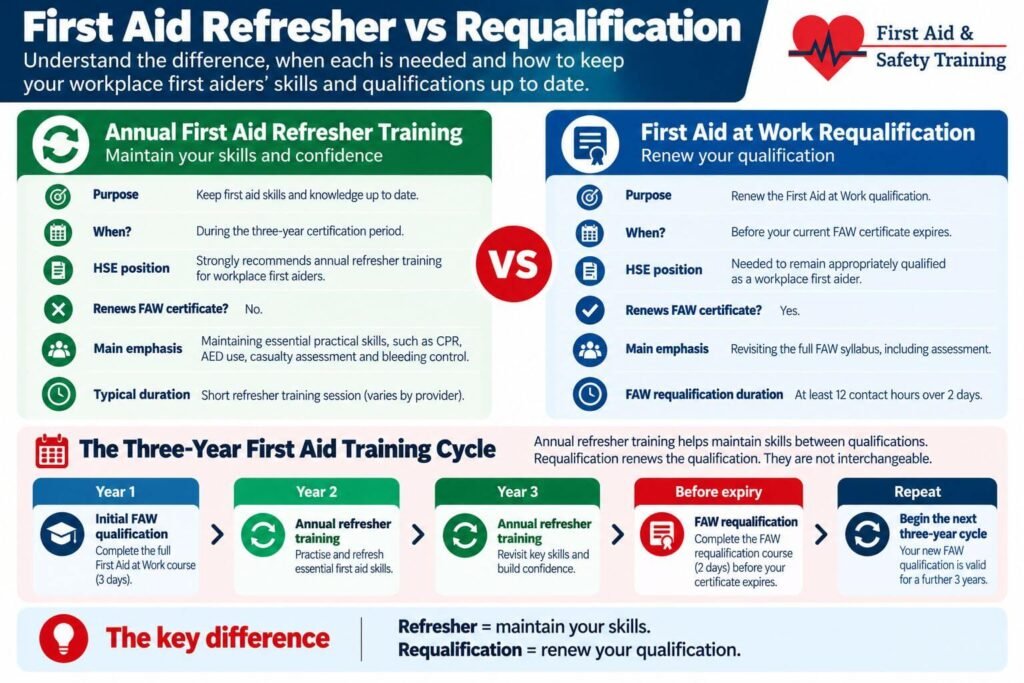
For somebody holding a First Aid at Work qualification, the training cycle could look like this:
Initial FAW qualification
Complete the full First Aid at Work course and assessment.
↓
Annual refresher
Practise essential skills during the qualification period.
↓
Annual refresher
Revisit those skills again during the following year.
↓
FAW requalification
Complete the appropriate requalification course before the existing qualification expires.
↓
Begin the next three-year cycle
The annual refresher training helps maintain skills between qualifications.
The requalification course renews the qualification.
They are not interchangeable.
Does Every Business Need the Same First Aid Training?
No.
A small office does not necessarily have the same first aid requirements as a construction company, manufacturing business or organisation operating in remote locations.
Employers should determine their requirements through an appropriate first aid needs assessment.
That assessment may identify a need for EFAW or FAW qualified staff, additional specialist training or other arrangements appropriate to the risks within the organisation.
You can explore our first aid training courses if you are unsure about the different qualifications available.
Keep Your First Aiders’ Skills Current
If your organisation has invested in qualified first aiders, it makes sense to help them maintain the skills you are relying on them to use.
Annual refresher training provides an opportunity to revisit essential practical skills during the three-year certification period.
FAW requalification has a different purpose: renewing the First Aid at Work qualification.
First Aid and Safety Training provides workplace first aid training for organisations across the North East. If you are unsure whether your employees need annual refresher training, FAW requalification or another qualification, we can help you identify the appropriate option.
You can view our first aid training courses, book a first aid course or contact First Aid and Safety Training to discuss your organisation’s training requirements.
You can also find First Aid and Safety Training on Google and see our business information and customer reviews.