Skip to content
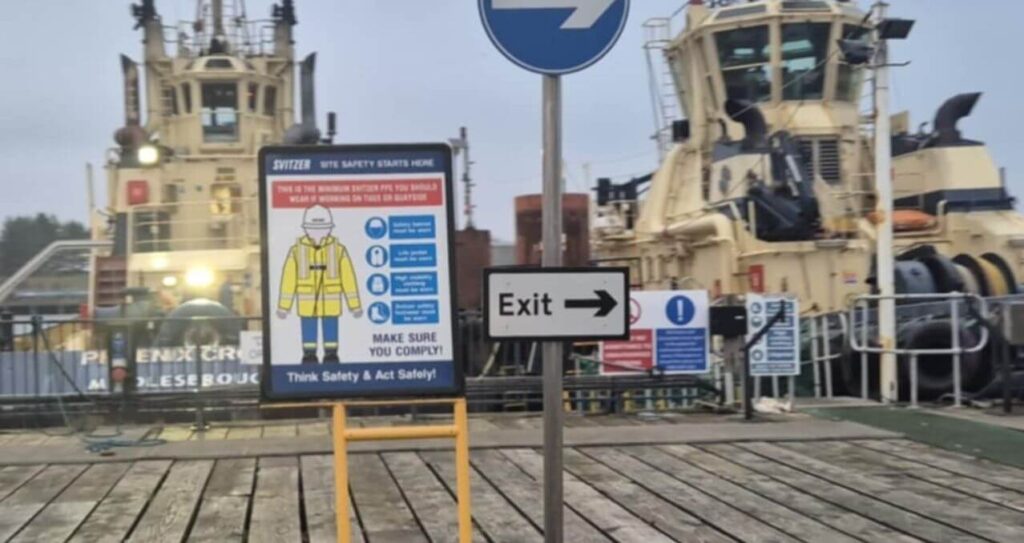
Maritime first aid training needs to reflect the environment in which a crew may actually have to respond. Limited space, small crews, heavy equipment and the possibility of delayed external assistance can all influence how an emergency is managed.
As part of its ongoing first aid provision, Svitzer asked First Aid and Safety Training to return and train additional skippers and boat crew operating on the Rivers Tyne and Tees.
The training combined the regulated Level 3 Emergency First Aid at Work (EFAW) qualification with additional catastrophic bleeding training.
It also gave us an opportunity to work with the medical equipment crews actually carry onboard their vessels.
Maritime First Aid Training for Skippers and Boat Crews
Working on a vessel creates first aid considerations that are very different from those found in a conventional workplace.
Crew members may be working with relatively few people around them. Space can be restricted and maintaining the safety of the vessel remains important while an incident is being managed.
Depending on the vessel’s location, professional medical help may not be immediately beside the casualty.
Throughout the course, learners discussed issues including:
- responding with a small crew and limited manpower
- managing an incident while maintaining vessel safety
- reaching and treating casualties in confined spaces
- communicating effectively between crew members
- making decisions when additional help is not immediately available
These discussions allowed the core first aid skills to be considered within the environment in which the learners could actually need them.
Emergency First Aid and Catastrophic Bleeding
Alongside the Emergency First Aid at Work qualification, additional training concentrated on catastrophic bleeding.
For maritime crews working around machinery, equipment and lines, serious trauma is an important subject to consider.
Learners practised recognising and responding to life-threatening external bleeding, including the use of appropriate bleeding-control techniques and equipment.
The wider practical training included:
- casualty and incident assessment
- adult CPR
- use of an Automated External Defibrillator (AED)
- managing an unconscious casualty
- responding to choking
- recognising and managing shock
- controlling serious external bleeding
- responding to catastrophic blood loss
Practical sessions gave learners repeated opportunities to perform the skills and receive feedback.
You can learn more about the Emergency First Aid at Work qualification and its practical requirements.
Using the Medical Equipment Carried Onboard
One of the most useful parts of this maritime first aid training was being able to relate the course to the medical equipment available to the crews themselves.
We worked with the Category C medical kit carried onboard Svitzer vessels.
This allowed learners to consider:
- what equipment is available onboard
- how the kit differs from a standard workplace first aid kit
- what additional equipment and medicines may be carried
- where equipment is stored
- the importance of knowing what is available before an emergency happens
- the limitations of the equipment available to the crew
Rather than discussing first aid equipment in the abstract, the crew could relate their training to the resources they would actually have available on their vessel.
First Aid in Confined and Operational Environments
Performing a first aid skill in a training room is one thing.
Applying the same principles within a vessel can present additional challenges.
A casualty may not be lying conveniently in an open space. Crew members may need to work around restricted access, vessel equipment and other operational considerations.
That makes preparation and teamwork particularly important.
The training therefore encouraged learners to think beyond simply remembering a first aid technique and consider how they would organise the response as a crew.
Who takes control?
Who contacts additional help?
Who retrieves the AED or medical equipment?
How can other crew members support the response while maintaining safety?
Working through questions like these helps connect individual first aid skills with a wider emergency response.
Learning from Experienced Crews
The skippers and boat staff brought considerable operational experience into the training room.
Rather than relying solely on predetermined scenarios, discussions developed around incidents, near misses and situations learners had encountered during their careers.
That allowed the group to explore issues including:
- how incidents can escalate
- recognising when rapid intervention is required
- clear communication between crew members
- leadership during an emergency
- remaining methodical under pressure
This type of discussion is particularly valuable during specialist training because the trainer brings first aid knowledge while the learners bring detailed knowledge of their own working environment.
Combining the two makes the training more relevant.
Building First Aid Capability Across Different Crews
This was not the first training First Aid and Safety Training had delivered for Svitzer.
An earlier group had already completed Emergency First Aid at Work and catastrophic bleeding training with Svitzer Tees.
Returning to train additional skippers and crew helped extend first aid capability across the workforce.
Training different crews can help an organisation avoid concentrating first aid knowledge within one particular team or shift.
It also gives people who routinely work together an opportunity to practise and discuss how they would respond together.
The Outcome of the Training
Learners successfully completed the regulated Level 3 Emergency First Aid at Work qualification, awarded through Qualsafe Awards, alongside the additional catastrophic bleeding training.
By the end of the course, the crew had practised core emergency first aid skills, considered serious bleeding and trauma, examined their onboard medical equipment and discussed how they would respond within their own operational environment.
The objective was therefore broader than simply completing a qualification.
It was about giving the crew practical first aid skills they could relate directly to working on the river.
Specialist Onsite First Aid Training
The Svitzer programme demonstrates one of the major advantages of onsite training.
The qualification requirements remain consistent, but examples, discussions and additional training can reflect the actual hazards and working environment of the organisation.
For maritime, engineering, construction and other specialist operations, that can make training considerably more relevant to the workforce.
First Aid and Safety Training provides onsite first aid training for organisations across the North East, including Emergency First Aid at Work, First Aid at Work and additional catastrophic bleeding training where appropriate.
If your organisation has specialist operational risks, multiple teams or employees working in unusual environments, contact First Aid and Safety Training to discuss your requirements.
You can also view our South Shields training centre and customer reviews on Google or call 0191 7166601.