Skip to content

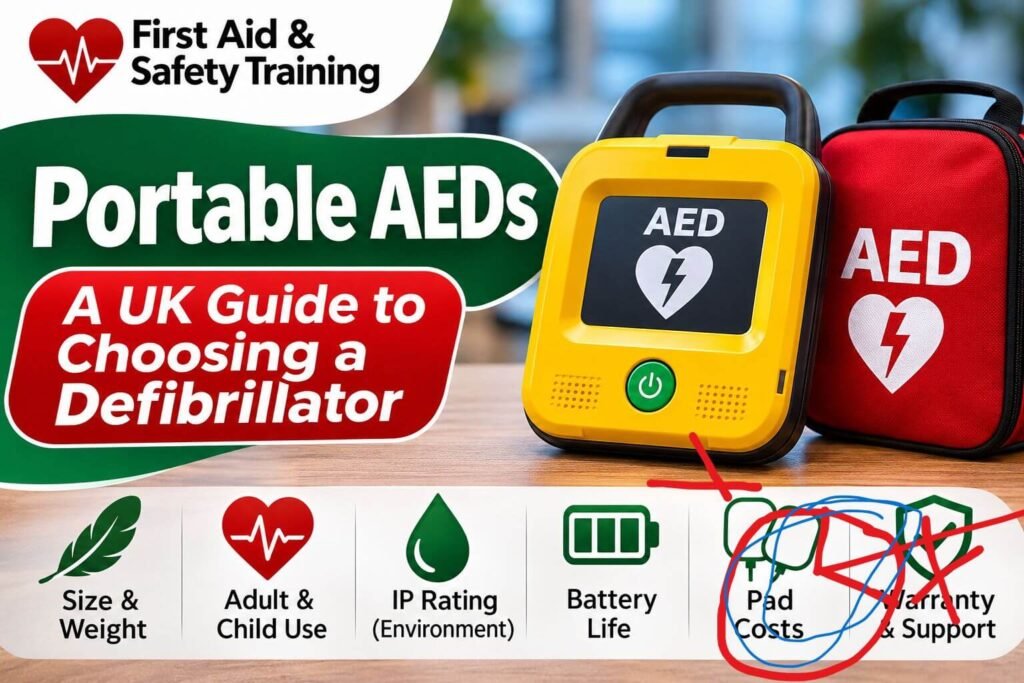
Portable AEDs make it possible to bring potentially life-saving defibrillation to someone experiencing a sudden cardiac arrest rather than waiting for the equipment to come to them.
Modern Automated External Defibrillators are compact, relatively lightweight and designed so that members of the public can use them.
That makes them suitable for far more than hospitals and ambulances.
AEDs can now be found in workplaces, schools, sports clubs, community buildings, gyms, public spaces and many other locations.
Some organisations also need an AED that can be moved between sites or taken to activities away from their normal premises.
But if you are considering buying one, how do you choose the right portable AED?
Price matters, but it should not be the only consideration.
Battery life, replacement pad costs, environmental protection, size, weight, child capability, CPR feedback, warranty and ongoing maintenance can all affect which defibrillator is right for you.
This guide explains what to look for before buying.
What Is a Portable AED?
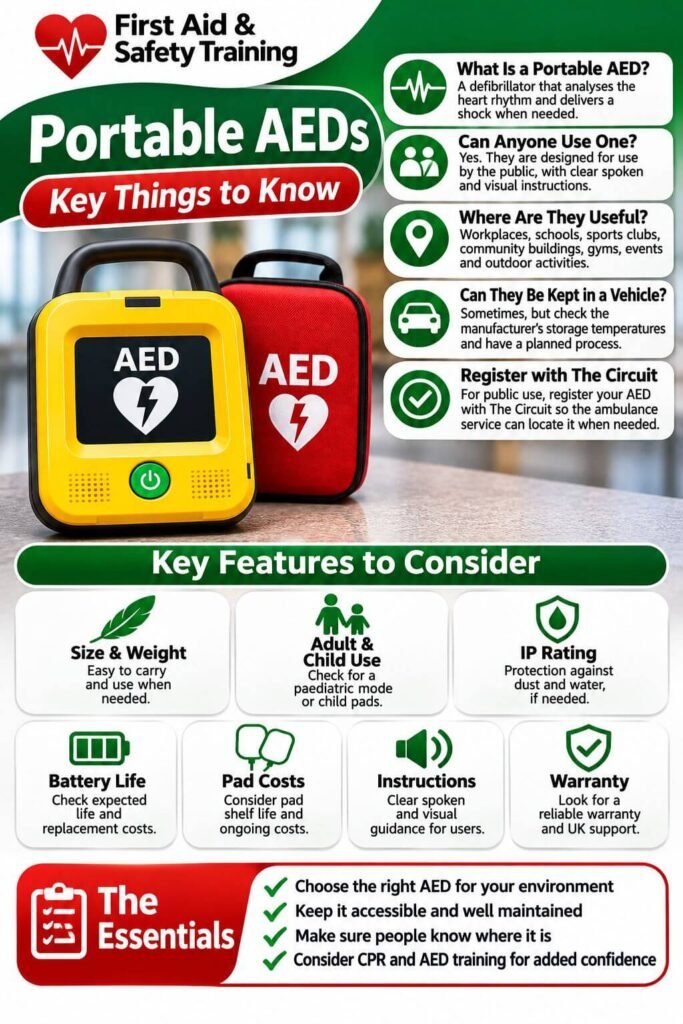
An AED, or Automated External Defibrillator, is a device designed to analyse the heart rhythm of someone in cardiac arrest and deliver an electrical shock when one is required.
The word portable can be slightly misleading because the vast majority of modern public-access AEDs are portable.
They are designed to be carried to the casualty.
You may also hear them described as:
- AEDs
- defibrillators
- portable defibrillators
- public access defibrillators
- PADs
- community defibrillators
Although the terminology varies, the basic purpose is the same.
When someone is unresponsive and not breathing normally, rescuers should call 999, start CPR and use an AED as soon as one is available.
If you want to understand the emergency sequence itself, our step-by-step guide to using an AED explains what to do.
Can Anyone Use a Portable AED?
Yes.
Resuscitation Council UK states that anyone can use an Automated External Defibrillator.
You do not need to be a doctor, paramedic or qualified first aider.
Modern AEDs provide spoken and visual instructions to guide the rescuer through the process.
Once the electrode pads have been attached, the AED analyses the casualty’s heart rhythm.
It determines whether a shock is appropriate.
The person using the AED does not have to diagnose the heart rhythm or decide whether the casualty needs to be shocked.
This is one of the most important things to understand when considering AED provision.
The purpose of having an AED available is for it to be used quickly when somebody is in cardiac arrest, not kept untouched until somebody with a particular certificate arrives.
Practical CPR and AED training can considerably improve people’s confidence, but lack of previous training should never prevent someone from using an AED during an emergency.
Where Are Portable AEDs Useful?
Portable AEDs can be useful anywhere a cardiac arrest could occur and where having rapid access to defibrillation could improve emergency preparedness.
Examples include:
- workplaces
- offices
- factories
- warehouses
- construction environments
- schools and colleges
- nurseries
- gyms
- leisure centres
- sports clubs
- community centres
- churches
- hotels
- hospitality venues
- event venues
- remote workplaces
- farms
- outdoor organisations
Some AEDs are installed permanently at a particular location.
Others may need to travel.
For example, a sports organisation might take its AED from its clubhouse to training sessions and matches.
An organisation operating across several sites may need a portable device that can be transported with staff.
However, portability needs careful thought.
An AED that regularly moves location can be more difficult for other people to find.
For public-access provision in particular, a fixed, known and accessible location can often be preferable.
Portable Does Not Always Mean It Should Live in a Vehicle
It can seem logical to keep a portable AED in a car or van.
Sometimes that may be appropriate.
For example, community responders, organisations working in remote locations or people with specific reasons for carrying an AED may choose to transport one.
However, Resuscitation Council UK currently prioritises widespread availability of public access defibrillators in fixed, known locations registered with The Circuit.
Vehicles also introduce practical issues including:
- temperature extremes
- accessibility
- security
- battery and pad storage conditions
- uncertainty over the AED’s current location
- maintenance
- registration and availability information
If you are considering keeping an AED permanently in a vehicle, check the manufacturer’s permitted storage temperatures and environmental requirements.
Simply putting an AED in the boot and forgetting about it is not good emergency planning.
What Should You Look for When Buying a Portable AED?
There is no single AED that is automatically the best choice for everybody.
Instead, think about how and where you intend to use it.
Here are some of the main factors we would consider.
1. Size and Weight
If an AED will remain in a wall cabinet for most of its life, a small difference in weight may have little practical importance.
If staff need to carry it regularly, weight and size become more significant.
Consider:
- who will carry it
- how far it might need to be carried
- whether it travels with other emergency equipment
- whether it fits into a suitable protective case
- whether it will be taken outdoors
- whether staff move between locations
Don’t automatically assume that the lightest AED is the best AED.
Reliability, environmental protection, usability and ongoing costs may be much more important.
2. Semi-Automatic or Fully Automatic AED?
Portable AEDs are commonly available as either semi-automatic or fully automatic models.
Both analyse the casualty’s heart rhythm and determine whether a shock is appropriate.
The difference is how the shock is delivered.
Semi-automatic AED
If a shock is required, the AED tells the rescuer to stand clear and instructs them to press a shock button.
The rescuer presses the button to deliver the shock.
Fully automatic AED
The AED warns rescuers to stand clear and then delivers the shock automatically without requiring someone to press a shock button.
Neither system requires the rescuer to decide whether the casualty needs defibrillation.
The AED makes that decision.
When comparing the two, think about the likely users and environment rather than assuming one type is automatically superior.
3. Adult and Paediatric Capability
If your AED may need to be used on a child, find out how the particular model provides paediatric defibrillation.
Depending on the AED, this may involve:
- separate paediatric electrode pads
- a child mode
- a child button or switch
- a special key
- another manufacturer-specific system
This can be particularly important for:
- schools
- nurseries
- leisure facilities
- family attractions
- sports organisations
- community venues
Check exactly what is supplied when you purchase the AED.
A defibrillator may support paediatric use while the equipment required to activate its child mode is sold separately.
We will cover this subject in more detail in our dedicated guide to using an AED on a child or baby.
4. Electrode Pad Life
AED electrode pads do not last forever.
They normally have a manufacturer-specified expiry date and must be replaced when required.
They also need replacing after use.
Before buying an AED, check:
- expected pad shelf life
- replacement pad price
- availability of replacement pads
- whether adult and paediatric pads are separate
- whether replacement pads are readily available in the UK
This is where looking only at the initial AED price can be misleading.
A cheaper machine may not necessarily be cheaper to own over several years.
5. Battery Life and Replacement Cost
The battery is another ongoing cost.
AED battery arrangements vary considerably between manufacturers and models.
Before buying, establish:
- expected standby battery life
- battery warranty
- replacement cost
- replacement procedure
- whether the AED performs automatic battery checks
- how the device indicates low battery status
Avoid relying on a generic statement such as “AED batteries last five years”.
The correct replacement schedule is the one specified for the AED you actually own.
6. Automatic Self-Checks
Modern AEDs commonly perform automatic self-tests.
Depending on the model, these may check elements of:
- battery condition
- electronics
- internal circuitry
- electrode connection
- general device readiness
The AED normally has a visual status indicator showing whether it is rescue ready.
This does not remove the need for somebody to look after the AED.
An organisation should still have a system for checking its equipment and responding if the device indicates a fault.
7. CPR Feedback
Some AEDs provide additional feedback to the rescuer while CPR is being performed.
Depending on the device, this may include information about:
- compression rate
- compression depth
- CPR quality
- timing
This can be useful, particularly in environments where trained responders may use the equipment.
However, CPR feedback is only one feature.
It should be considered alongside usability, reliability, consumable costs, environmental protection and the needs of the organisation.
8. Audio and Visual Instructions
AEDs generally provide spoken instructions.
Many also provide visual guidance through:
- diagrams
- indicator lights
- screens
- animations
- illuminated steps
Consider who may use the AED.
Visual prompts can be particularly useful in noisy environments where spoken instructions may be harder to hear.
Some organisations may also need to consider language requirements.
The most technically advanced device is not necessarily the easiest device for your intended users to operate.
9. Environmental Protection and IP Rating
If the AED is going to be used outdoors, in an industrial environment or somewhere exposed to dust or moisture, look at its IP rating.
IP stands for Ingress Protection.
The rating indicates the level of protection the equipment enclosure provides against solid particles and water.
This can matter for:
- construction
- manufacturing
- outdoor sport
- agriculture
- marine environments
- remote work
- outdoor events
Do not assume that putting an AED in a carry case makes it suitable for every environment.
Check the manufacturer’s specifications.
10. Operating and Storage Temperatures
Temperature matters.
An AED kept inside a temperature-controlled office has very different storage conditions from one installed outdoors or left in a vehicle.
Check the manufacturer’s:
- operating temperature
- storage temperature
- humidity requirements
- environmental limitations
Outdoor public access AEDs may require an appropriate cabinet to protect the device and maintain suitable conditions.
This is another reason why buying the AED itself is only part of the planning process.
11. Warranty
AED warranties can vary between manufacturers.
A longer warranty can be useful because an AED may remain in service for many years.
Check:
- length of warranty
- what the warranty covers
- exclusions
- registration requirements
- whether the warranty is transferable
- what happens if the device develops a fault
Keep purchase and warranty records somewhere accessible.
12. Carry Case
If the AED will genuinely be portable, a suitable carry case is worth considering.
A good case can help keep together:
- AED
- electrode pads
- spare pads where appropriate
- scissors
- razor
- gloves
- face shield
- towel or drying material
However, avoid filling the case with unnecessary equipment that makes the AED difficult to locate or deploy.
The priority is rapid access to the defibrillator.
What Accessories Should Be Kept with a Portable AED?
A basic AED rescue kit may include:
- trauma scissors
- disposable gloves
- razor
- towel or absorbent material
- CPR face shield
These support preparation of the casualty for AED use.
For example, scissors may be needed to expose the chest, a towel can help dry wet skin and a razor may be needed if excessive chest hair prevents the electrode pads from sticking.
Do not routinely shave the casualty’s chest.
Only remove enough hair if it prevents effective pad adhesion.
Do Portable AEDs Need Maintenance?
Yes, although modern AED maintenance is generally straightforward.
AEDs spend most of their lives waiting to be used, which makes routine readiness checks important.
Someone should be responsible for checking the device.
Typical checks include:
- rescue-ready status indicator
- electrode pad expiry date
- battery condition
- physical damage
- accessories
- cabinet or carry case
- signs and access arrangements
Always follow the manufacturer’s instructions for the specific AED.
After an AED has been used, it should be checked and returned to a rescue-ready condition as soon as possible.
That will normally involve replacing the electrode pads and checking the battery and other consumables.
We will cover this fully in our dedicated AED maintenance guide.
Where Should a Portable AED Be Kept?
Buying a portable AED achieves very little if nobody can find it.
The AED should be:
- easy to locate
- clearly signposted
- quickly accessible
- protected appropriately for its environment
Current Resuscitation Council UK guidance recommends that public access AEDs should be placed in clear sight and readily accessible.
For public access devices, RCUK recommends unlocked cabinets with 24-hour access wherever possible.
The objective is straightforward:
Reduce the time between cardiac arrest and defibrillation.
A defibrillator locked in an inaccessible office after the building closes may provide little benefit to somebody experiencing a cardiac arrest outside at night.
Our separate AED placement guide will look at accessibility, retrieval times, cabinets, signs and workplace locations in much greater detail.
Register Public Access AEDs with The Circuit
If an AED is available for public use, it should be registered with The Circuit, the UK’s national defibrillator network.
The Circuit connects defibrillator information with ambulance services.
During a 999 call involving a suspected cardiac arrest, the ambulance service may therefore be able to identify a nearby registered AED and direct someone to it.
This is particularly important because simply installing an AED does not automatically mean the ambulance service knows it exists.
You can learn more through The Circuit, the national defibrillator network.
If your AED changes location or availability, keep its registration information updated.
Are Portable AEDs a Legal Requirement at Work?
There is not a general UK law requiring every workplace to have an AED.
Workplace first aid provision should be considered as part of the employer’s wider first aid needs assessment.
HSE guidance states that where an employer identifies through its needs assessment that it wishes to provide an AED, the Provision and Use of Workplace Equipment Regulations 1998 apply.
The employer should therefore provide appropriate information and written instructions, such as those supplied by the AED manufacturer.
HSE also notes that fuller training is likely to increase user confidence and that AED training forms part of FAW and EFAW courses.
We will deal with the legal position separately in our dedicated guide to AED laws and regulations in the UK, rather than turning this buying guide into a legal article.
How Much Does a Portable AED Cost?
AED prices vary according to the manufacturer, model and features.
The purchase price is only part of the cost.
When comparing portable AEDs, consider:
Purchase price
plus
replacement pads + replacement battery + cabinet or carry case + accessories + ongoing consumables.
For an outdoor public access installation, the cabinet and installation arrangements can add further costs.
Rather than putting prices into this article that will quickly become outdated, we will maintain a separate guide covering AED costs in the UK and the longer-term cost of ownership.
Examples of Portable AEDs Available in the UK
There are numerous reputable AED manufacturers and models available.
At the time this guide was reviewed, examples available through UK first aid suppliers included models from manufacturers such as:
- Mediana
- iPAD
- Cardiac Science
The important thing is not choosing a particular brand because you recognise the name.
Compare the specific model against your requirements.
Ask:
Does it suit the environment?
Can it be used on children if required?
What are the pad and battery costs?
How long do the consumables last?
What warranty is provided?
How well protected is it against water and dust?
Can the likely users understand its instructions easily?
Is there good UK support and access to replacement consumables?
Those questions are more useful than simply asking which AED is “best”.
Buying a Portable AED
If you are ready to compare AEDs, Jax First Aid currently supplies a range of defibrillators for workplaces, schools, sports clubs, public buildings and community locations.
Their current range includes semi-automatic and fully automatic devices from several manufacturers.
View the current range of AED defibrillators from Jax First Aid.
Check the individual product specification carefully before ordering to make sure the device is appropriate for your intended environment and users.
Affiliate disclosure: The link above is an affiliate link. If you make a purchase after following it, First Aid and Safety Training may receive a small commission at no additional cost to you. We only include affiliate links where the supplier or product is relevant to the subject being discussed.
Should You Buy the Cheapest Portable AED?
Not automatically.
Budget matters, but consider the whole life of the equipment.
Imagine AED A costs less initially but has more expensive pads with a shorter shelf life.
AED B costs slightly more but has longer-life consumables and a longer warranty.
Over several years, the apparently more expensive AED could potentially cost less to own.
Equally, a cheaper AED may be perfectly suitable if it provides the features, protection and support you actually require.
The answer is not:
“Buy the most expensive AED.”
It is:
“Buy an appropriate, reliable AED and make sure it remains accessible and rescue ready.”
Do You Need a Cabinet?
That depends on where the AED will be located.
An AED stored inside an occupied workplace may simply require a clearly identified and easily accessible location.
A public access AED installed outdoors will normally need an appropriate protective cabinet.
Consider:
- weather protection
- temperature
- visibility
- accessibility
- security
- signage
- power requirements for heated cabinets
- manufacturer storage requirements
Current Resuscitation Council UK guidance favours unlocked public access AED cabinets because locked cabinets can introduce delays.
The best cabinet is not simply the strongest box.
It needs to help keep the AED protected without unnecessarily delaying access during a cardiac arrest.
Portable AEDs for Sports Clubs
AED provision is particularly relevant to sports environments because people may be exercising across a large site or away from the clubhouse.
Consider:
- distance to playing areas
- training pitches
- away activities
- who transports the AED
- accessibility during matches
- environmental conditions
- who checks it
- whether everyone knows where it is
If an AED travels with a team, make its location part of the pre-activity emergency arrangements.
Don’t assume everyone knows who has it.
Portable AEDs for Schools
Schools have additional considerations because an AED may potentially need to be used on an adult or a child.
Consider:
- adult and paediatric capability
- accessibility during the school day
- access outside normal hours
- sports facilities
- detached buildings
- staff awareness
- community use of school premises
- registration
- maintenance responsibility
We will cover these issues properly in our separate guide to AEDs in schools.
Portable AEDs for Community Locations
A community AED should be treated as emergency infrastructure rather than simply equipment somebody has purchased.
Before installation, think about:
- where people can see it
- 24-hour accessibility
- cabinet requirements
- signage
- registration with The Circuit
- who will check it
- replacement pads and batteries
- what happens after it is used
Someone needs to take responsibility for keeping the device rescue ready.
A community AED that nobody checks can create false reassurance.
Should You Buy an AED for Home Use?
Some people consider purchasing a personal AED for their home.
That raises different questions from buying one for a workplace or public location.
Personal medical risk, household circumstances, accessibility, training, maintenance and cost all need consideration.
For that reason, we will cover personal ownership separately in our dedicated AED for home use guide rather than treating a workplace or community buying guide as medical advice for an individual household.
Portable AED Buying Checklist
Before purchasing a portable AED, ask:
Where will it be used?
Who might need to use it?
Will it stay in one location or genuinely travel?
Could it need to be used on a child?
Is it semi-automatic or fully automatic?
What is its IP rating?
What are its operating and storage temperatures?
How long do the pads last?
How much do replacement pads cost?
What is the expected battery life?
How much does a replacement battery cost?
Does it provide CPR feedback?
What visual and spoken prompts does it provide?
What warranty is included?
Does it require a cabinet?
Who will check it?
Will it be registered with The Circuit?
Can replacement consumables be obtained easily in the UK?
If you can answer those questions, you are in a much better position to compare different AEDs intelligently.
The Best Portable AED Is One That Is Ready When Needed
It is easy to become absorbed in comparing specifications.
But the purpose of every AED is ultimately the same.
When somebody experiences a cardiac arrest, the defibrillator needs to be:
available, accessible, working and used quickly.
A sophisticated AED is of little value if nobody can find it.
An inexpensive AED is not good value if its battery has failed.
A community AED cannot help if it is locked away and inaccessible.
A portable AED is not genuinely useful if nobody knows where it has been taken.
Choosing the equipment matters.
Planning what happens after you buy it matters just as much.
Build Confidence to Use an AED
Anyone can use an AED in an emergency by following its instructions.
Training is still valuable because it gives people an opportunity to practise recognising cardiac arrest, performing CPR and operating an AED before they face the pressure of a real emergency.
First Aid and Safety Training includes practical CPR and AED skills within our regulated workplace first aid courses.
Our Emergency First Aid at Work course covers CPR, AED use and other essential emergency first aid skills.
For organisations requiring more comprehensive training, our First Aid at Work course develops a wider range of workplace first aid knowledge and practical skills.
Businesses and organisations can also arrange onsite first aid training across the North East.
If you are unsure which course is suitable for your organisation, contact First Aid and Safety Training and we can help you choose the right option.
You can also view our South Shields training location and customer reviews on Google.
Real Skills, Real Confidence.