Skip to content
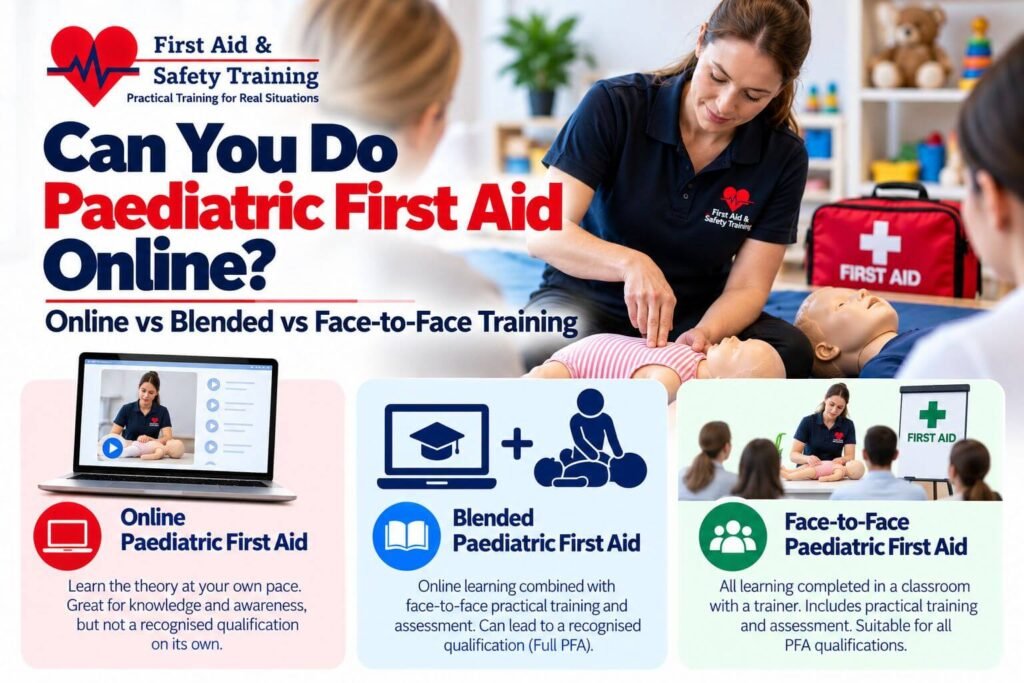
Yes, you can complete part of some Paediatric First Aid training online, but an online-only course is not the same as completing a practical Paediatric First Aid qualification.
This distinction is particularly important if you need Paediatric First Aid for work, a nursery, childminding or to meet Early Years Foundation Stage requirements.
Full Paediatric First Aid can be delivered through an appropriate blended course, combining online learning with face-to-face practical training and assessment.
Emergency Paediatric First Aid, however, must be completed face-to-face if it is being used to meet the EYFS criteria.
So, before booking a course advertised as “online Paediatric First Aid”, it is important to understand exactly what training and certification you will receive.
Can Paediatric First Aid Be Completed Entirely Online?
You can learn a great deal about Paediatric First Aid online.
Online learning can explain how to recognise an emergency, what action to take and the principles behind subjects such as CPR, choking, seizures, bleeding, burns and childhood illnesses.
What it cannot provide on its own is the same practical experience as physically performing first aid skills.
Watching someone perform CPR on a screen is very different from kneeling beside an infant or child manikin, positioning your hands correctly, performing chest compressions and demonstrating the technique to an instructor.
The same applies to choking procedures, casualty assessment and other practical first aid skills.
For this reason, someone who needs a recognised practical Paediatric First Aid qualification should not assume that an online-only course will meet their requirements.
What Is Online Paediatric First Aid Training?
Online Paediatric First Aid training normally involves completing learning through a computer, tablet or other device.
Depending on the course, learners may work through:
- videos
- written information
- interactive activities
- scenario-based questions
- quizzes
- knowledge assessments
This can be a useful way of learning or refreshing first aid knowledge.
For parents, carers or someone who simply wants a better understanding of first aid, an online course can provide valuable awareness.
Online learning can also form part of a recognised qualification when it is combined correctly with practical training.
That is where blended Paediatric First Aid comes in.
What Is Blended Paediatric First Aid?
Blended Paediatric First Aid combines online learning with face-to-face practical training.
Rather than spending the whole course in a classroom, learners complete an appropriate part of the theory in their own time before attending a trainer-led practical session.
A Full Paediatric First Aid course meeting the EYFS Paediatric First Aid criteria must provide at least 12 hours of training, excluding breaks.
A common blended format is:
Approximately 6 hours online learning
followed by
Approximately 6 hours face-to-face practical training and assessment
The exact structure depends on the qualification and training provider, but the important point is that blended learning still includes substantial face-to-face training.
It is not simply an online course with a certificate at the end.
You can also read more about how this type of training works in our guide to blended Paediatric First Aid training.
Is Blended Paediatric First Aid Accepted for EYFS?
Yes, Full Paediatric First Aid can be delivered using an appropriate blended learning model.
The current EYFS statutory framework requires a Full Paediatric First Aid course to last for a minimum of 12 hours, excluding breaks.
The emergency elements within that full course must be delivered face-to-face.
This allows some of the wider knowledge-based learning to be completed online while preserving face-to-face practical training for the emergency skills learners need to demonstrate.
For nurseries, childminders and other Early Years providers, blended training can therefore provide a practical alternative to completing the whole 12 hours in a classroom.
Can Emergency Paediatric First Aid Be Completed Online?
Not if the qualification needs to meet the EYFS criteria.
Emergency Paediatric First Aid must be undertaken face-to-face and last for a minimum of six hours, excluding breaks.
The course covers essential emergency skills including how to:
- assess an emergency situation
- help an unresponsive baby or child who is breathing normally
- help an unresponsive baby or child who is not breathing normally
- respond to a seizure
- deal with choking
- control bleeding
- recognise and respond to shock caused by severe blood loss
These are practical skills, which is why physical face-to-face training forms such an important part of the qualification.
If you see an “Emergency Paediatric First Aid” course being advertised as entirely online, check carefully what certification it actually provides before booking.
Online vs Blended vs Face-to-Face Paediatric First Aid
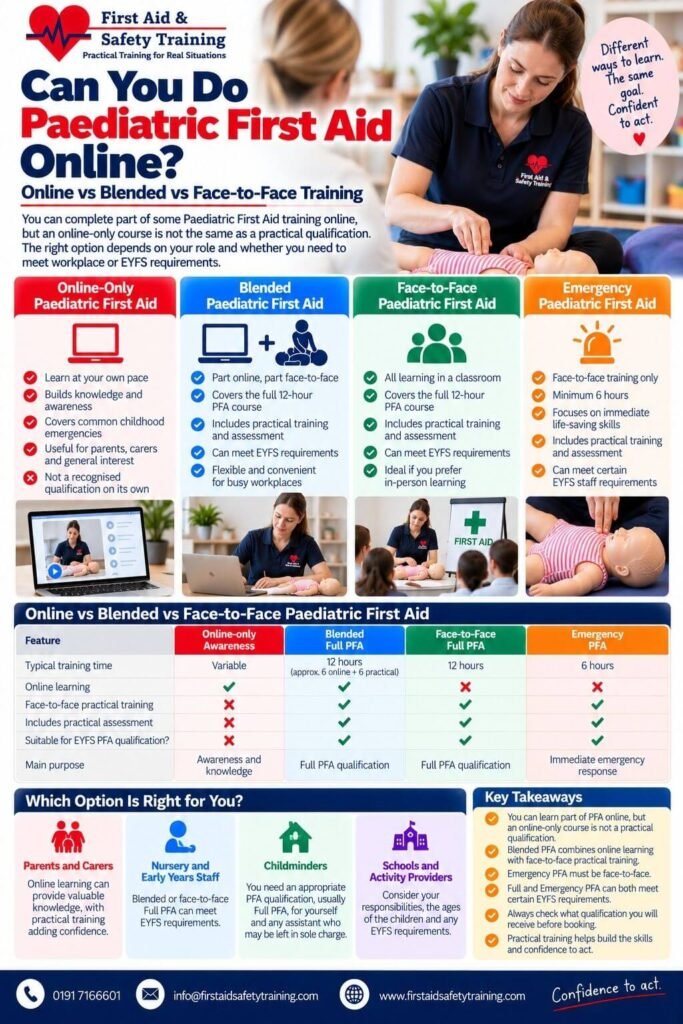
The three methods can sound similar when looking at course advertisements, but there are important differences.
| Training method | Online learning | Face-to-face practical training | Can include practical assessment | Suitable for an EYFS PFA qualification? |
|---|---|---|---|---|
| Online-only awareness course | Yes | No | No | No, not on its own |
| Blended Full Paediatric First Aid | Yes | Yes | Yes | Yes, when delivered in accordance with the requirements |
| Face-to-face Full Paediatric First Aid | No or minimal online learning | Yes | Yes | Yes |
| Emergency Paediatric First Aid | No as a substitute for the course | Yes | Yes | Yes, when the required course is completed face-to-face |
The key question therefore isn’t simply:
“Can I do Paediatric First Aid online?”
It is:
“What do I need the training for?”
If you are unsure which qualification applies to you, our guide to the different types of Paediatric First Aid training explains the main options and who they are designed for.
When Is Online-Only Paediatric First Aid Useful?
Online-only training still has a useful role.
For example, it may be suitable for:
- parents wanting to improve their first aid knowledge
- grandparents and family members
- babysitters
- people considering further practical training
- existing first aiders refreshing their knowledge between courses
- organisations providing additional first aid awareness
- people who want to learn more about common childhood emergencies
It can be convenient, accessible and useful for building knowledge.
The problem arises when an awareness course is presented as though it provides the same outcome as a practical qualification.
They serve different purposes.
Why Does Practical Paediatric First Aid Training Matter?
First aid is a practical skill.
During a good Paediatric First Aid course, learners should have opportunities to physically practise the techniques they may need during an emergency.
That includes skills such as:
- baby CPR
- child CPR
- recovery position
- choking procedures
- casualty assessment
- controlling bleeding
- using appropriate first aid equipment
Practical training also gives the instructor an opportunity to observe the learner.
Small corrections can make a significant difference.
A learner might understand CPR perfectly when answering an online question but position their hands incorrectly, compress too slowly or struggle with the physical technique when using a manikin.
Practical sessions allow those issues to be identified and corrected.
They also allow learners to ask questions and work through realistic scenarios.
That is an important part of developing the confidence to act, rather than simply remembering information.
Is Blended Training Easier for Nurseries?
For many nurseries, schools and childcare organisations, blended learning can make staff training easier to manage.
Releasing several employees for two full classroom days can create problems with staffing and ratios.
A blended course allows staff to complete part of their learning independently before attending the practical training day.
This can reduce the amount of time employees need to be away from the workplace without reducing the overall training requirement.
However, employers should still give staff sufficient time and opportunity to complete the online element properly.
Blended learning should not mean asking someone to rush through several hours of training in their own time the night before the practical course.
Do You Still Get a Paediatric First Aid Certificate With Blended Training?
Yes, when you successfully complete an appropriate blended Paediatric First Aid qualification.
The online element and practical element form parts of the same overall programme.
Learners must complete the required learning and successfully meet the assessment requirements before the qualification is awarded.
The certificate is therefore for the Paediatric First Aid qualification, not simply for attending an online course.
Where the qualification is being used to meet EYFS requirements, the certificate must be renewed every three years.
You can read more in our guide to Paediatric First Aid certificate validity and renewal.
What Paediatric First Aid Training Do I Need?
That depends on your role.
Nursery and Early Years staff
Your training needs should be considered against the current EYFS statutory framework.
At least one person with a current Full Paediatric First Aid certificate must be on the premises and available whenever children are present, and an appropriately qualified person must accompany children on outings.
Settings also need to consider staffing levels and practical first aid coverage.
Childminders
Childminders and assistants who may be left in sole charge of children need to ensure they meet the relevant EYFS Paediatric First Aid requirements.
An online-only awareness course should not be used as a substitute where a qualifying PFA certificate is required.
Schools
Schools may need different types of first aid provision depending on the ages of the children and the activities taking place.
Early Years provision must meet the relevant Paediatric First Aid requirements, while the school also needs to consider its wider workplace first aid responsibilities.
Parents and carers
Parents and carers are not normally trying to satisfy workplace or EYFS qualification requirements.
For them, online learning can be a useful starting point.
However, practical training provides the opportunity to physically practise CPR, choking procedures and other emergency skills, which can make a considerable difference to confidence.
Is Face-to-Face Paediatric First Aid Better Than Blended Training?
Not necessarily.
A properly delivered blended Full Paediatric First Aid qualification and an appropriate fully face-to-face course can both provide effective training.
The better option often depends on the learner and organisation.
Some people prefer completing all their learning with an instructor.
Others prefer working through theory at their own pace and then attending a practical training day.
For an employer, blended learning can make releasing staff easier.
What matters is that the course provides the required learning, practical training and assessment rather than simply whether some of the learning takes place online.
What Should You Check Before Booking Online Paediatric First Aid?
Before paying for a course, find out exactly what you are buying.
Check:
- whether the course is online-only or blended
- whether practical face-to-face training is included
- how many hours of training are provided
- which qualification you will receive
- who awards the qualification
- whether practical skills are assessed
- whether the course is appropriate for your job or childcare setting
- how long the certificate is valid
- whether it meets any EYFS requirements that apply to you
Be particularly careful with very short courses promising instant Paediatric First Aid certification entirely online.
If you require a qualification for your job, ask the provider exactly what qualification will appear on your certificate.
What Is the Difference Between Full and Emergency Paediatric First Aid?
Full Paediatric First Aid and Emergency Paediatric First Aid are separate training options.
Full PFA provides broader training and has a minimum duration of 12 hours.
Emergency PFA is a minimum six-hour face-to-face course concentrating on immediate life-saving emergencies.
We explain the differences, along with the other available options, in our guide to Types of Paediatric First Aid Training and Which Course You Need.
If you want to know how long the different training options take, see our guide to Paediatric First Aid course duration.
Paediatric First Aid Training With FAST
First Aid and Safety Training provides practical Paediatric First Aid training for individuals and organisations across the North East.
We are an approved Qualsafe Awards Centre, and our relevant Paediatric First Aid courses lead to regulated qualifications awarded by Qualsafe Awards, an Ofqual-recognised awarding organisation.
Training is available for individual learners attending open courses and for organisations that want Paediatric First Aid delivered for their staff.
Where blended training is appropriate, learners can complete the online element before attending their practical face-to-face training and assessment.
Our aim is not simply to get learners through a course.
We want people to understand what they are doing, practise the skills properly and leave with the confidence to act when a baby or child needs help.
View our Paediatric First Aid training courses to find the appropriate option for you.
If you are booking for a nursery, school or childcare organisation and are unsure whether you need Full Paediatric First Aid, Emergency Paediatric First Aid or another course, contact First Aid and Safety Training and we can help you identify the appropriate training.
You can also find First Aid and Safety Training on Google Maps.