Skip to content
You don’t need to be sent by an employer to learn first aid. In December 2025, a small group attended First Aid and Safety Training in South Shields to learn first aid for personal reasons, simply because they wanted to be better prepared if somebody needed their help.
The Emergency First Aid at Work (EFAW) course took place on 18 December 2025 at One Trinity Green in South Shields.
Unlike many of our open courses, where learners attend because they require a qualification for work, everyone in this group had chosen to attend for personal reasons.
One learner’s reason for being there was particularly significant.
Witnessing an Emergency Led to First Aid Training
One learner had previously witnessed a serious medical emergency at a Metro station.
CPR was being performed and an Automated External Defibrillator (AED) was used.
Watching an emergency unfold while not knowing how to help had stayed with them.
They decided that if they ever encountered something similar again, they wanted to understand what was happening and have the skills and confidence to offer appropriate help.
That’s what brought them to the course.
It’s also an important reminder that first aid isn’t only a workplace skill.
Cardiac arrests, choking, serious bleeding and other medical emergencies can happen at home, in shops, on public transport, during sport or simply while walking down the street.
Can You Learn First Aid for Personal Reasons?
Yes.
Although Emergency First Aid at Work is primarily designed as a workplace first aid qualification, individuals can book places on our open courses themselves.
People choose to learn first aid for personal reasons for many different reasons.
They may want to feel better prepared to help:
- a partner or family member
- their children or grandchildren
- somebody at a sports or community activity
- a member of the public
- a friend or colleague
- a stranger during an unexpected emergency
Others have witnessed or experienced an emergency previously and don’t want to feel helpless if something similar happens again.
Whatever brings someone into the training room, the practical skills they learn aren’t restricted to their workplace.
A Small Group With Plenty of Practical Training
This particular course had a small number of learners.
That created plenty of opportunities for individual practice, questions and feedback.
Rather than rushing from one subject to another, learners could repeat techniques and ask questions about areas they weren’t sure about.
This was particularly useful during CPR practice.
Using CPR Feedback to Improve Technique
During the course, learners practised adult CPR using training equipment capable of providing feedback on their performance.
This allowed them to see information about aspects of their CPR technique, including compression depth and rate.
Feedback equipment can be particularly useful because CPR can initially feel unfamiliar.
Instead of simply being told that something needs adjusting, learners can make a change and see the effect it has on their performance.
The equipment doesn’t replace trainer observation and instruction, but it provides another useful way of helping learners develop their technique.
You can read our seven steps of CPR guide for more information about responding to a cardiac arrest.
Practising With an AED
Learners also practised using an Automated External Defibrillator.
This was particularly relevant given the emergency witnessed by one member of the group.
AEDs are designed to provide spoken and visual instructions to the person using them, but physically practising with an AED trainer can remove some of the uncertainty people may feel about using one for the first time.
During training, learners could practise retrieving the device, following its prompts, applying the pads and integrating AED use with CPR.
The experience helped turn something they may previously only have seen during an emergency into a piece of equipment they understood how to use.
What Else Did the EFAW Course Cover?
The Emergency First Aid at Work qualification develops essential emergency first aid skills.
During the course, learners covered areas including:
- assessing an incident safely
- recognising an unresponsive casualty
- adult CPR
- using an AED
- managing an unconscious casualty
- responding to choking
- controlling external bleeding
- recognising and managing shock
The emphasis throughout the day was on understanding what to do and then practising the appropriate actions.
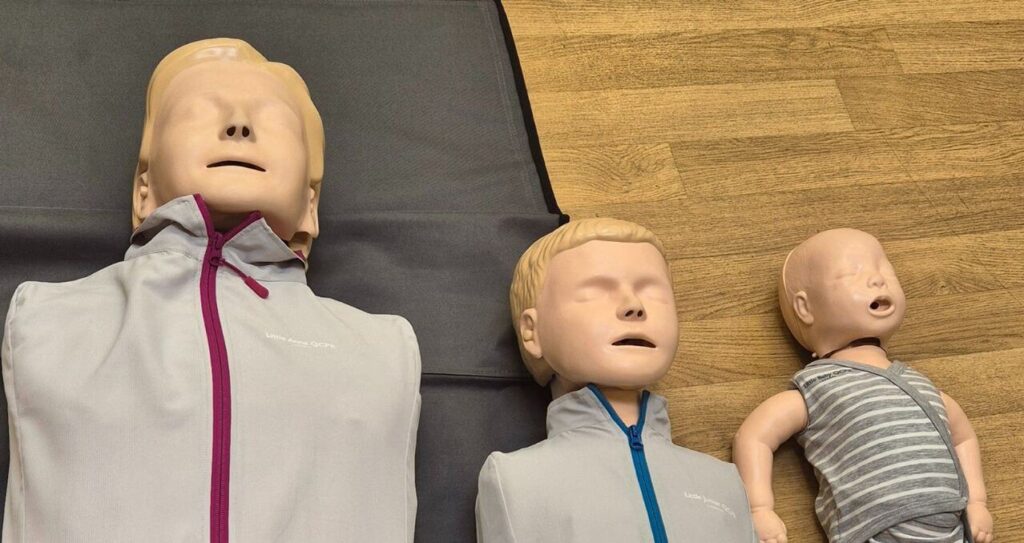
Additional Child and Baby CPR Practice
Because these learners were attending first aid for personal reasons, there was also considerable interest in what they might do if an emergency involved a child or baby.
Additional time was therefore used to practise child and infant CPR.
This was supplementary training rather than part of the EFAW qualification.
It is important to make that distinction.
Someone who requires a recognised Paediatric First Aid qualification for an early years or childcare role should complete the appropriate Paediatric First Aid course.
However, providing additional child and infant CPR practice was useful for this particular group because their motivation extended beyond workplace first aid.
Creating Confidence Without Creating Pressure
Several learners were there because they wanted to feel better prepared for a real emergency.
That can also create some nervousness.
Nobody wants to imagine having to perform CPR on a family member or witnessing another serious incident.
The training environment therefore remained relaxed and supportive while still treating the subject seriously.
Learners could ask questions, practise repeatedly and discuss situations that concerned them.
The aim wasn’t to make people believe every emergency would be easy.
It was to give them practical skills and a better understanding of what they could do while professional help was being arranged.
What Did the Learners Think?
Feedback from the group reflected the practical and supportive nature of the course:
“Really enjoyed the course and learnt a lot of very useful information and skills. Great trainers with plenty of knowledge to pass on.” – Corrine
“The trainer was very friendly and always answered clearly.” – Charlie
“Good pace to the session. Effective discussions and demonstrations. Excellent knowledge.” – Gary
First Aid Skills Aren’t Only for Work
This course demonstrates something that can easily be overlooked when discussing workplace first aid qualifications.
The certificate may have a workplace purpose, but the skills belong to the person who learned them.
Someone who learns CPR because their employer sent them on a course may ultimately use it at home.
Someone who learns how to respond to choking for work may later help a family member in a restaurant.
And someone who chooses to learn first aid after witnessing an emergency may one day find themselves in a position to help somebody else.
That’s why learning first aid for personal reasons can be worthwhile even when you don’t need a qualification for your job.
Book a First Aid Course in South Shields
Individuals can book places on our open first aid courses in South Shields at One Trinity Green.
You don’t need to be booked by an employer. If you simply want to learn practical first aid skills and would also like to complete a recognised qualification, you can book as an individual.
Businesses and organisations requiring several employees to be trained together can instead arrange onsite first aid training in South Shields.
If you’re unsure which course would be most appropriate, contact First Aid and Safety Training and tell us what you want to get from the training.
You can also view our South Shields training centre and customer reviews on Google.