Skip to content
First aid training for large teams requires more than simply repeating the same course several times. The training needs to remain practical, engaging and consistent while still being relevant to people working in very different roles.
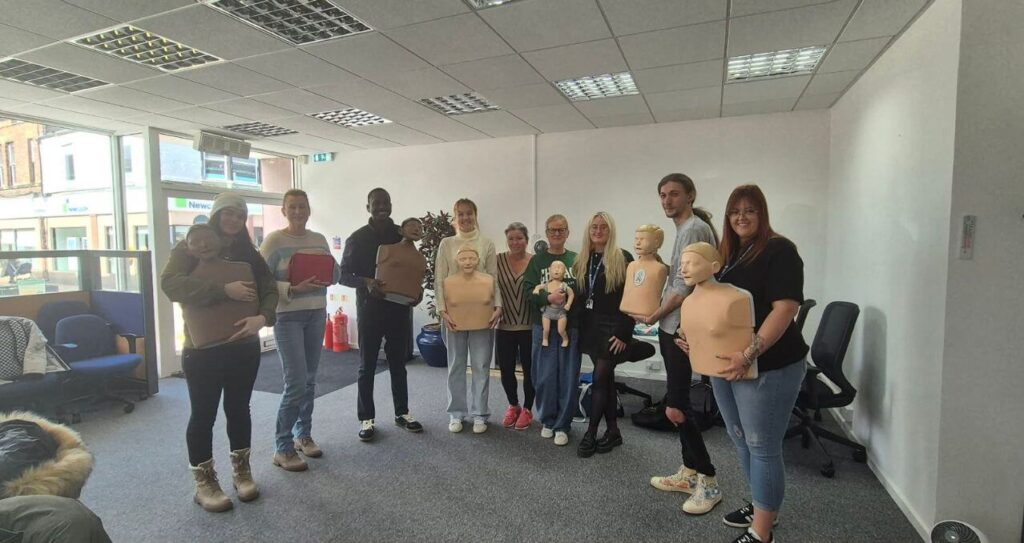
At the end of March and beginning of April 2026, First Aid and Safety Training delivered a Level 3 Emergency First Aid at Work (EFAW) programme for Citizens Advice Sunderland.
Across three full training days on 31 March, 1 April and 2 April, 31 members of staff completed the qualification.
The learners represented a wide range of roles, including reception and front-of-house staff, finance team members, interview advisers, call centre staff and people carrying out home visits.
That variety gave us plenty to discuss about how first aid might actually be needed within their organisation.
First Aid Training for Large Teams with Different Roles
A front-facing organisation such as Citizens Advice can encounter situations very different from those experienced in an office where there is little public interaction.
Staff regularly support people dealing with difficult and sometimes stressful circumstances.
For reception and face-to-face staff, an emergency could happen directly in front of them.
Home-visiting staff may need to respond away from the main workplace.
Telephone-based staff face a different challenge altogether.
During the training, we discussed what someone should do if a caller appears to be describing a medical emergency and the importance of remaining calm, gathering useful information and directing them towards the appropriate emergency response.
Relating first aid principles to the different roles within the organisation helped make the training relevant rather than simply working through a generic list of subjects.
Real Emergency Experience in the Training Room
Another strength of the programme was the amount of real-life experience learners brought with them.
Across the three days, staff discussed previous experiences that included:
- performing CPR during a genuine emergency
- dealing with serious choking incidents
- treating wounds and significant bleeding
- supporting vulnerable people in distress
These experiences generated useful discussion.
Learners who have already faced an emergency often have very different questions from someone learning first aid for the first time. They may want reassurance about what they did, clarification about a particular technique or a better understanding of what happened.
It also gives other learners an opportunity to hear how quickly an ordinary situation can become an emergency.
Catastrophic Bleeding and the Local Connection
Several learners had been to school with Connor Brown, which led to particularly meaningful discussion around catastrophic bleeding.
We incorporated catastrophic bleeding awareness and practical training into the programme, helping learners consider what they would do when faced with severe, life-threatening blood loss.
This gave the subject a very real local context for some of the people in the room.
Catastrophic bleeding is not something most people will encounter regularly, but when it does happen, rapid and effective action can be critical.
Practical Emergency First Aid at Work Training
The core Emergency First Aid at Work training covered essential workplace first aid skills including:
- assessing an incident safely
- recognising an unresponsive casualty
- adult CPR
- using an Automated External Defibrillator (AED)
- managing an unconscious casualty
- responding to choking
- controlling external bleeding
- recognising and managing shock
Learners didn’t simply watch these skills being demonstrated.
They practised them.
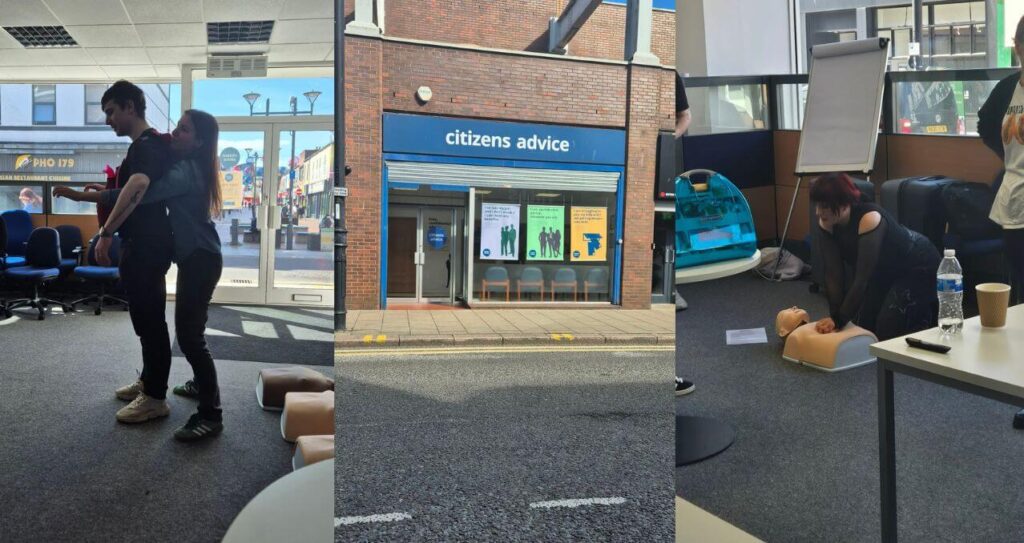
Repeated hands-on practice gave learners opportunities to develop their technique, ask questions and receive feedback throughout each training day.
You can find out more about the Emergency First Aid at Work qualification and the skills learners develop.
Taking AED Training into the Real Environment
One particularly useful part of the training involved the public access defibrillator located directly opposite the Citizens Advice building.
The defibrillator had been provided by Red Sky Foundation.
Rather than only discussing public access AEDs in the classroom, the group went outside to look at the actual device available near their workplace.
We discussed how they would locate and access it during a real emergency before returning to practical training using AED training devices.
That simple exercise connected the training directly with their working environment.
Instead of learners leaving knowing only how to use a training AED, they also knew where a real defibrillator was located close to their workplace.
Supporting People in Distress
Because of the work undertaken by Citizens Advice, discussion also naturally included situations involving people experiencing significant distress.
Emergency First Aid at Work is not a mental health qualification, so this was not presented as one.
However, remaining calm, communicating clearly, considering immediate safety and knowing when further help is required are valuable principles when staff are faced with someone in distress.
Being able to relate discussions to situations learners may actually encounter helped make the wider training more relevant to their roles.
What Did the Learners Think?
With 31 people completing first aid training across three days, learner feedback gave us a useful indication of whether the programme remained engaging and practical throughout.
Day One
“Brilliant and informative session.” – Cherelle
“I learnt things I did not know otherwise, and I have worked in care settings. Very informative.” – Heidi
“I loved the practice sessions and loved that it was so interactive.” – Isaac
“Good interactive sections of the course and clear explanations of the subject.” – Julie
Day Two
“Excellent content, informed, entertaining and nice trainers, would 100% recommend.” – Elle
“Very insightful and easy to understand.” – Rhiannon
“Training was very involving and gave individuals a chance to try the technique.” – Joanne
“Best course I have had, very interesting.” – Kelly
“Good attitude and atmosphere for training.” – Luke
Day Three
“Enjoyed the training, thank you.” – Billie Jo
“The training was very interactive and engaging. I feel a lot more confident in my first aid skills.” – Phillipa
“Really useful training, will feel confident using the techniques learnt.” – Joanne
“Had a fab day and really enjoyed it.” – Gemma
“Very useful course with good practical exercises.” – Luke
“It was brilliant. Thank you so much.” – Anne
All 31 learners successfully completed the qualification. Read more reviews from Sunderland First Aid Training.
The comments also demonstrate something we aim for on every course: learners should be involved in the training rather than spending the day simply listening to someone talk.
First Aid Training for Large Teams and Organisations
The Citizens Advice Sunderland programme demonstrated how first aid training for large teams can be organised across several days without losing the practical and interactive nature of the course.
Splitting 31 learners across three training days allowed staff to complete the qualification while keeping group sizes suitable for practical learning, assessment and individual feedback.
For organisations with larger workforces, training can be planned across multiple sessions rather than trying to fit everyone onto one course.
First Aid and Safety Training provides onsite first aid training for organisations in Sunderland and across the wider North East.
We can work with businesses, charities and other organisations to plan training around staff numbers, operational requirements and the findings of their first aid needs assessment.
If you need to train a larger team across several sessions, contact First Aid and Safety Training to discuss your requirements.