Skip to content
Real CPR experience brought a very different perspective to one of our Emergency First Aid at Work courses in South Shields, when two learners arrived having recently performed CPR in genuine emergencies.
The Level 3 Emergency First Aid at Work (EFAW) course took place on Monday 13 April 2026 and included both new and returning learners.
For those who had recently needed their first aid skills for real, the course provided an opportunity to practise, reflect and ask questions about what had happened.
How Real CPR Experience Changed the Training
For several learners, this course had particular significance.
One learner had recently performed CPR on a family member.
Understandably, she wanted reassurance about what she had done. Had her technique been correct? Had she responded appropriately? Was there anything she could have done differently?
The practical CPR session allowed her to work through the current techniques again, practise on the manikins and discuss her experience in a supportive training environment.
Importantly, she was able to leave with reassurance about the actions she had taken.
Another learner had experienced a cardiac arrest situation only the previous day.
Someone had collapsed in the street and he had performed CPR before the paramedics arrived. He came onto the course wanting to develop his technique further after experiencing just how quickly a real emergency can unfold.
Having real CPR experience within the group created valuable discussions throughout the course. It also demonstrated something we regularly emphasise during our training: you never know when you may need to use first aid.
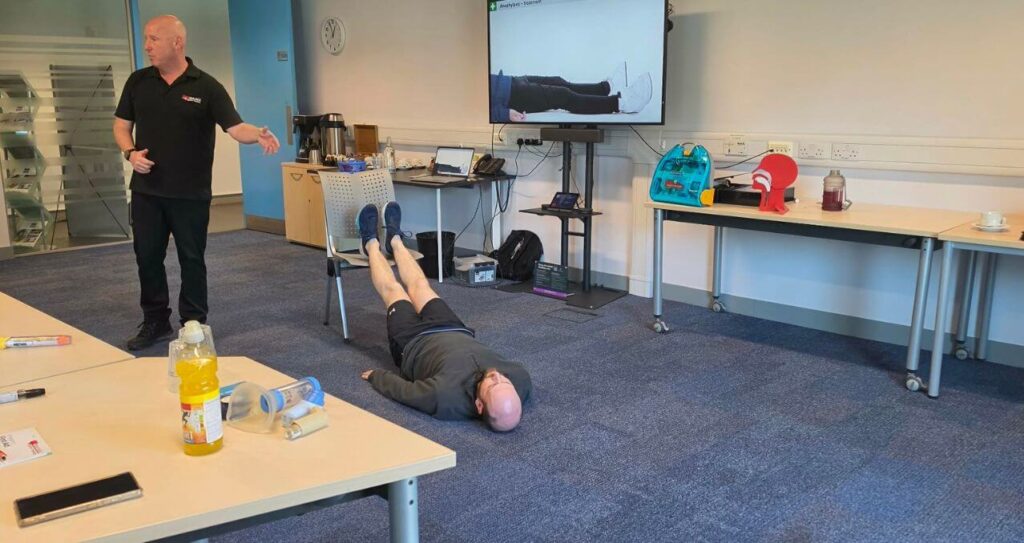
Practical Emergency First Aid Training
Emergency First Aid at Work is a practical qualification.
Learners therefore spent a significant part of the course practising the skills they may need to use during a workplace or everyday emergency.
Training included:
- assessing an incident safely
- recognising an unresponsive casualty
- adult CPR
- using an Automated External Defibrillator (AED)
- managing an unconscious casualty
- responding to choking
- controlling external bleeding
- recognising and managing shock
The course included practical demonstrations, learner practice, discussion and assessment.
Rather than simply showing a technique once and moving on, learners had opportunities to repeat practical skills and receive feedback.
This becomes particularly important with skills such as CPR and AED use, where confidence often develops through actually performing the skill rather than simply hearing it explained.
Current First Aid and Resuscitation Guidance
First aid trainers need to keep their own knowledge and course delivery current.
The training therefore reflected current first aid and resuscitation guidance applicable to the qualification at the time of delivery.
Learners could discuss why techniques are performed in a particular way as well as practise how to perform them.
For learners reflecting on a real CPR experience, understanding the reasoning behind those actions can be particularly reassuring.
Supporting Different Learners
Not everyone learns in exactly the same way.
We aim to create a training environment that is structured, supportive and practical while still allowing people to ask questions and learn at their own pace.
Clear demonstrations, practical repetition, discussion and individual feedback all played a part during this course.
Every learner completed the required elements of the qualification successfully.
Serious Training Doesn’t Have to Feel Intimidating
The subjects covered during first aid training can be serious.
That doesn’t mean the training room has to feel uncomfortable or overly formal.
We want learners to feel confident enough to ask questions, make mistakes during practice and try a skill again.
This course combined:
- clear explanations
- practical demonstrations
- repeated hands-on practice
- open discussion
- individual feedback
- a relaxed and positive training environment
The objective isn’t simply to get someone through an assessment.
We want people to leave feeling more confident about what they would actually do if somebody needed their help.
What Did the Learners Think?
Feedback from the course reflected the balance between practical learning, clear explanations and an enjoyable training environment.
“It was a really informative and interesting course delivered with energy and enthusiasm. I felt like I learnt a lot. Thank you.” – Alix
“The pace was very good and I felt that through a combination of practical and theoretical training I was able to retain a lot.” – Mia
“Very informative and easy to understand.” – Harry
“Great course, good laugh and great tutoring.” – Ben
“I would definitely recommend First Aid and Safety Training. Adam is really good at delivering presentations. The staff are lovely and helpful.” – Phil
All learners successfully completed the qualification.
More importantly, they left with additional practical experience and greater confidence about responding when somebody needs help.
For the two learners who had recently performed CPR for real, the course also provided an opportunity to reflect on their experiences, reinforce their skills and ask questions that only become apparent after dealing with a genuine emergency.
Looking for Emergency First Aid at Work Training?
This course was delivered at our South Shields training centre, where we run regular open first aid courses for individuals and organisations.
If you need to train one or two members of staff, you can view our upcoming first aid courses in South Shields.
For organisations requiring training for a group of employees, we can also deliver first aid training at your workplace in South Shields and across South Tyneside.
You can learn more about the Emergency First Aid at Work qualification and what the course covers, or contact First Aid and Safety Training to discuss the right training option for your organisation.
You can also view our South Shields training centre and reviews on Google.