Skip to content

Paediatric first aid for school staff needs to prepare people for the situations they could genuinely face when caring for babies and children.
We recently delivered a Level 3 Paediatric First Aid blended learning course at Bowburn Primary School in Durham, bringing together six members of staff from across the school and nursery setting.
The group included a reception first aider, teachers, a nursery nurse, a baby room nursery nurse and an apprentice nursery nurse completing her first first aid qualification.
Having learners with different roles and levels of experience created a brilliant day of practical learning, discussion and skill development.
Paediatric First Aid for School Staff and Nursery Teams
Schools and nurseries present their own first aid challenges.
Children explore, climb, run and test boundaries. Babies and younger children may also be unable to clearly explain what is wrong, while illness or an emergency can develop quickly.
For staff, therefore, paediatric first aid is about more than completing a qualification.
They need to understand what to look for, know what action to take and have enough confidence to put their training into practice.
The full Paediatric First Aid qualification is particularly important within early years settings because the EYFS framework sets specific requirements for paediatric first aid provision.
You can read more about what the Paediatric First Aid qualification covers and the practical skills learners develop.
How Blended Paediatric First Aid Training Works
The blended format combines online learning with face-to-face practical training and assessment.
Learners complete six hours of e-learning before attending the practical training day.
The online element introduces and develops knowledge across subjects including casualty assessment, shock and hypoxia, asthma, diabetes, seizures, meningitis and sepsis, burns, fractures, head injuries and allergic reactions including anaphylaxis.
This means the face-to-face session can concentrate heavily on practical skills, scenarios, discussion and assessment.
Rather than spending the day simply working through presentation slides, learners get much more opportunity to practise.
For schools and nurseries trying to organise training around staffing requirements, this can also make the blended Paediatric First Aid format particularly useful.
Hands-On Training at Bowburn Primary School
Practical training was at the heart of the Bowburn session.
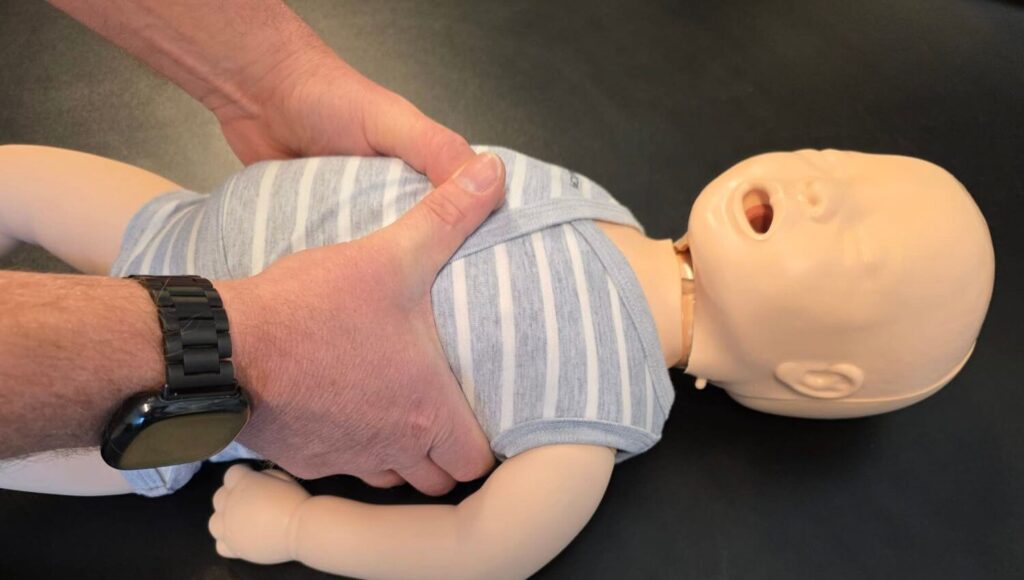
Learners practised infant and child CPR, including chest compressions and rescue breaths, alongside the safe use of an Automated External Defibrillator (AED).
They also worked through managing an unconscious infant or child and responding to choking emergencies.
Skills were demonstrated before learners practised them themselves, with opportunities for repetition and individual feedback.
That practical repetition is important.
Knowing what CPR looks like is very different from physically performing it on a manikin and receiving feedback on your technique.
Anaphylaxis Training for School and Nursery Staff
Anaphylaxis was another important part of the practical training.
Schools and nurseries need staff who can recognise the signs of a serious allergic reaction and respond appropriately when a child needs help.
During the session, we worked through recognising anaphylaxis, responding to the emergency and using an adrenaline auto-injector.
Training devices allowed learners to physically practise the administration technique without using a live device.
We could then apply those skills to realistic nursery and classroom situations.
For staff responsible for children with known allergies, physically practising with training devices can help turn theoretical knowledge into something they feel much more confident doing.
Applying First Aid to the School Environment
One advantage of delivering paediatric first aid for school staff at their own premises is that discussions naturally relate to situations they recognise.
The Bowburn group considered incidents that could occur within classrooms, nursery rooms and playgrounds.
Alongside CPR, choking and anaphylaxis, practical training included areas such as:
- external bleeding and shock
- head injuries
- neck and spinal injuries
- fractures and other injuries
Rather than treating these as abstract examples, learners could discuss how incidents might present within their own working environment.
A Relaxed but Focused Training Environment
We encourage questions, shared experiences and discussion throughout our courses.
First aid involves serious subjects, but people don’t necessarily learn better because the training itself feels overly formal.
Our aim is to create an environment where learners are comfortable asking questions, trying practical skills and repeating them when necessary.
The feedback from Bowburn reflected that approach.
“Adam was knowledgeable and approachable. I felt at ease and comfortable to ask questions and share experiences. Would 100% recommend to others.” – Sarah
“Engaging course and good real life examples. Encouraged to think through the scenarios.” – Deborah
“Brilliant trainer, Adam was very friendly and helpful. I really enjoyed the course.” – Steph
“Very knowledgeable, friendly trainer. Unlike previous courses, it really kept my attention. I came out feeling confident in giving first aid.” – Rachael
“I felt very engaged and very comfortable in this course. Very much enjoyed the humour in the room.” – Ellie
“Great and interesting training delivered with fun, not boring or draining.” – Larraine
All six learners successfully completed the qualification, including the apprentice completing first aid training for the first time.
Paediatric First Aid Training for Schools and Nurseries
The Bowburn course demonstrated the difference between simply knowing about first aid and having the opportunity to practise it.
By the end of the training, staff had worked through practical scenarios, practised essential skills and had opportunities to ask questions relevant to the children they work with.
First Aid and Safety Training can deliver Paediatric First Aid training for schools and nurseries as blended or face-to-face training, depending on the course and requirements.
For organisations in County Durham, we can provide onsite first aid training at your school, nursery or workplace.
Individuals and smaller groups can also view our open first aid courses in Durham.
If you’re responsible for arranging first aid training for a school or nursery, contact First Aid and Safety Training to discuss your requirements.
You can also view our Durham training location and reviews on Google.