Skip to content

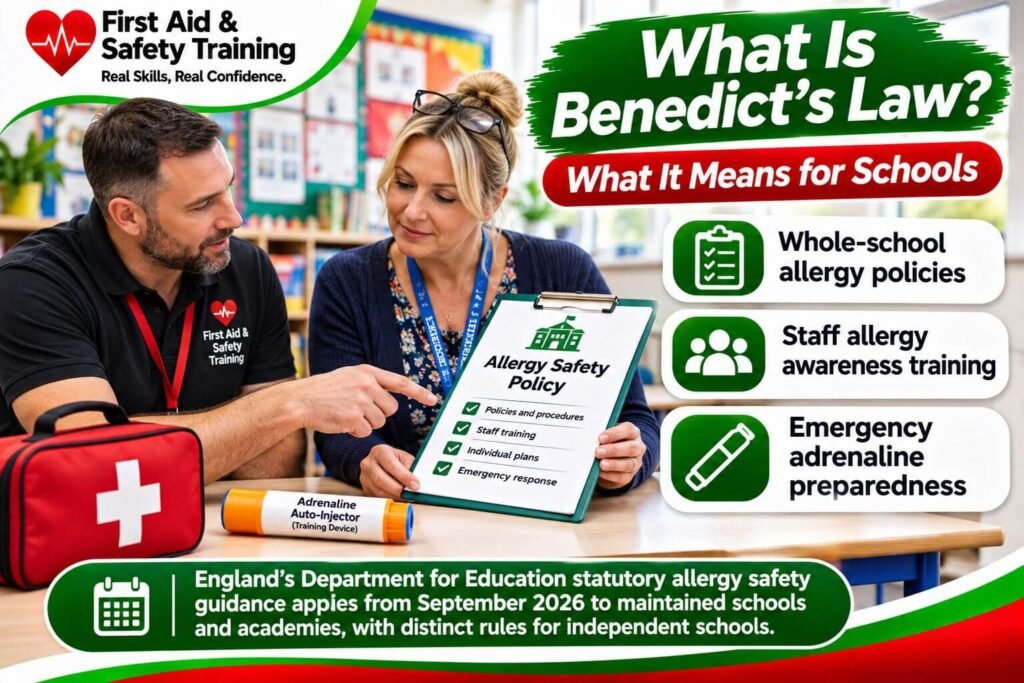
If you work in a school, you may have heard about Benedict’s Law and the changes to allergy safety requirements in England.
But what is Benedict’s Law, which schools are affected, and what should your school be doing to protect pupils with allergies?
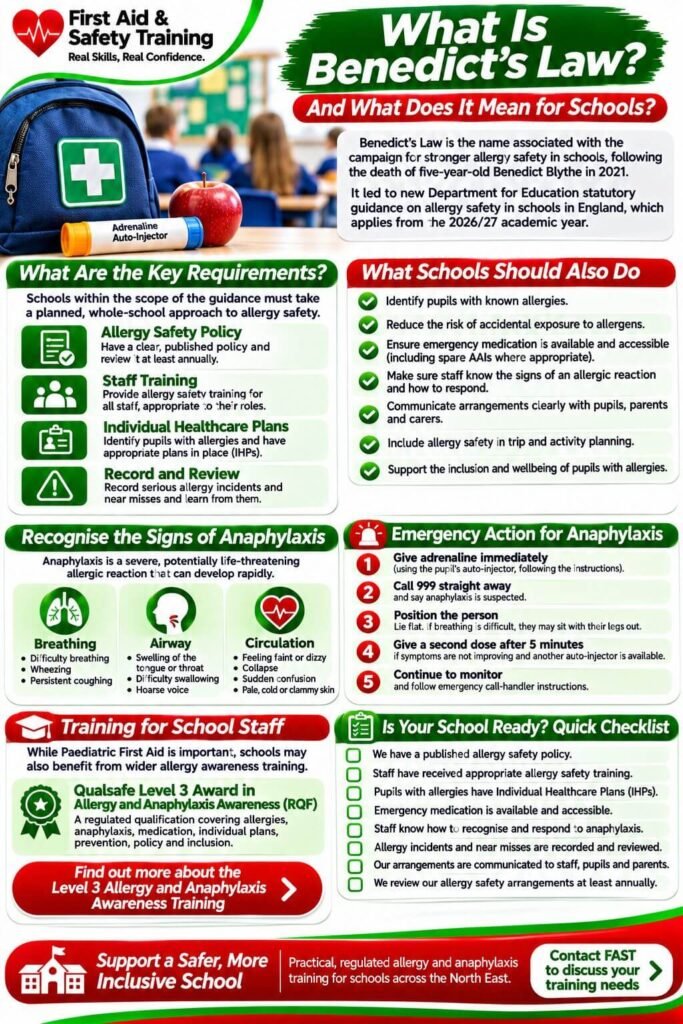
Benedict’s Law is the name associated with a campaign to improve allergy safety in schools following the tragic death of five-year-old Benedict Blythe in 2021.
The campaign helped bring greater attention to the need for consistent allergy policies, staff awareness, individual healthcare arrangements and effective emergency procedures.
In July 2026, the Department for Education published new statutory guidance on allergy safety in schools, applying from the 2026/27 academic year.
For schools covered by this guidance, allergy safety is no longer something that can be left entirely to designated first aiders or individual members of staff.
It requires a coordinated, whole-school approach.
At First Aid and Safety Training, we help schools and education providers across the North East develop the knowledge and confidence to recognise and respond to allergic emergencies.
This guide explains the changes associated with Benedict’s Law, what the new guidance means for schools and how appropriate allergy and anaphylaxis training can support safer learning environments.
What Is Benedict’s Law?
Benedict’s Law is the name given to the campaign for stronger allergy safety protections in schools, established following the death of Benedict Blythe.
Benedict died in December 2021 after experiencing an anaphylactic reaction at his primary school. He was just five years old.
His family subsequently campaigned for changes to improve how schools understand, manage and respond to allergies.
The campaign highlighted concerns about inconsistent approaches to allergy management, including staff awareness, emergency medication, individual arrangements and the procedures followed when an allergic reaction occurs.
The aim was to ensure that children with allergies could attend school safely and participate in school life without unnecessary exclusion.
Is Benedict’s Law Now Legislation?
It is important to distinguish between the name of the campaign and the legal requirements schools must follow.
Benedict’s Law is the commonly used name associated with the campaign for improved school allergy safety.
The Department for Education’s Allergy Safety in Schools statutory guidance, published in July 2026, sets out requirements for the schools within its scope.
The guidance applies from the 2026/27 academic year.
It explains schools’ responsibilities concerning allergy safety policies, staff training, Individual Healthcare Plans and learning from incidents and near misses.
Schools should follow the statutory guidance and the legislation applicable to their particular setting.
Official resource: Department for Education: Allergy Safety in Schools
Why Was Benedict’s Law Introduced?
Allergies can affect children throughout their school day.
A child with a serious allergy may encounter potential risks in classrooms, dining halls, playgrounds, sports activities, school trips and other school environments.
An allergic reaction may happen unexpectedly, and a severe reaction can develop rapidly.
Before the new guidance, approaches to allergy management were not always consistent between schools.
Some schools had well-developed allergy policies, individual plans and staff training arrangements, while others relied more heavily on designated first aiders or informal procedures.
The campaign for Benedict’s Law highlighted the need for greater consistency and accountability.
Its central message is that allergy safety should be part of everyday school practice, not simply something considered when an emergency occurs.
What Does Benedict’s Law Mean for Schools in 2026?
The Department for Education’s statutory guidance strengthens the expectations placed on schools within its scope.
It requires a structured approach to identifying, managing and responding to allergies.
Schools need to consider how their arrangements work throughout the school day and across different activities.
Four particularly important areas are:
- Having an appropriate allergy safety policy.
- Providing allergy safety training for all staff.
- Identifying pupils who require Individual Healthcare Plans and preparing those plans.
- Recording serious allergy incidents and near misses, and learning from them.
Schools must also consider how emergency medication, communication and practical arrangements support these responsibilities.
1. Develop and Publish an Allergy Safety Policy
Schools covered by the statutory guidance must have an allergy safety policy.
The policy should explain how the school manages allergies and supports pupils who may be at risk.
It should address relevant arrangements such as:
- Identifying pupils with allergies.
- Communicating allergy information appropriately.
- Reducing avoidable exposure to allergens.
- Managing individual healthcare needs.
- Providing staff training.
- Accessing emergency medication.
- Responding to allergic emergencies.
- Recording and reviewing incidents.
- Supporting pupils’ participation and inclusion.
The policy should be published, reviewed at least annually and updated when necessary.
A policy should also be practical.
It is not enough for a document to exist if the people responsible for implementing it do not understand what it says.
The Department for Education provides an Allergy Safety Policy template to help schools develop their arrangements.
2. Provide Allergy Safety Training for All Staff
One of the most significant changes is the emphasis on allergy awareness across the school workforce.
Allergy safety should not depend entirely on a small number of qualified first aiders.
Consider how many different adults a pupil might encounter during a normal school day.
These could include:
- Classroom teachers.
- Teaching assistants.
- Lunchtime supervisors.
- Catering staff.
- PE teachers and sports coaches.
- Pastoral and support staff.
- School administrators.
- Senior leadership teams.
- Staff supervising trips or extracurricular activities.
An allergic reaction may begin when the designated first aider is somewhere else.
The person who first notices something is wrong needs to recognise the potential seriousness of the situation and know how to obtain appropriate help.
The statutory guidance requires allergy safety training for staff, with arrangements appropriate to their responsibilities.
This includes understanding the school’s procedures and how to respond when an allergic emergency is suspected.
For schools wanting to develop broader staff knowledge, FAST provides the Qualsafe Level 3 Award in Allergy and Anaphylaxis Awareness (RQF).
This qualification explores allergies, anaphylaxis, emergency medication, individual planning and wider allergy management.
It can complement a school’s statutory training arrangements and existing first aid provision.
3. Identify Pupils Who Need Individual Healthcare Plans
Schools need to identify children and young people who require an Individual Healthcare Plan (IHP) to manage their allergies.
An IHP helps explain the support a pupil needs and the arrangements that should be followed.
Depending on the individual, it may include:
- Known allergies and relevant triggers.
- Information about the pupil’s medical needs.
- Arrangements for avoiding or managing exposure.
- Emergency medication requirements.
- How and where medication is stored.
- Responsibilities of relevant staff.
- Procedures for responding to an allergic reaction.
- Arrangements for school trips and activities.
- Communication with parents, carers and healthcare professionals.
An Individual Healthcare Plan should be developed with appropriate input and kept under review.
It is also important that relevant staff understand the arrangements applying to the pupils they support.
The Department for Education provides an Individual Healthcare Plan template.
4. Record and Learn from Allergy Incidents and Near Misses
Allergy safety does not end when an incident has been dealt with.
Schools need arrangements for recording serious allergy incidents and near misses and considering what can be learned.
A near miss might involve a pupil almost being exposed to a known allergen, a breakdown in communication or a problem accessing medication.
Reviewing incidents can help identify weaknesses in existing procedures.
For example:
- Was the pupil’s allergy information available?
- Did the relevant staff understand the arrangements?
- Was emergency medication accessible?
- Were communication procedures followed?
- Were any changes needed to the policy or individual plan?
The purpose should be to improve safety and reduce the likelihood of similar incidents happening again.
Which Schools Does the New Allergy Safety Guidance Apply To?
The Department for Education’s statutory guidance applies to specified state-funded schools in England.
These include:
- Local authority maintained schools, including maintained special schools, but excluding maintained nursery schools.
- Academies and free schools, including alternative provision academies, but excluding 16-to-19 academies.
- Pupil referral units.
The guidance does not currently impose the same statutory requirements on every education setting.
For example, independent schools, including independent special schools, and non-local-authority-maintained special schools are not currently subject to these specific statutory requirements. The Department for Education has stated its intention to introduce relevant requirements through the regulatory standards applying to those schools.
The guidance may also be useful to early years settings, further education colleges and other education providers.
Schools should check the latest official guidance to confirm which requirements apply to their setting.
Is Benedict’s Law Only About Pupils With Known Allergies?
No.
Schools need appropriate arrangements for pupils with identified allergies, but a serious allergic reaction can also happen when an allergy has not previously been diagnosed.
A child may experience their first episode of anaphylaxis at school.
This is one reason wider staff awareness is so important.
Staff should be able to recognise concerning symptoms even when a pupil does not have a known allergy or an existing Allergy Action Plan.
Good allergy awareness involves understanding both individual arrangements and the warning signs that indicate someone may be experiencing a medical emergency.
What Is Anaphylaxis?
Anaphylaxis is a severe, potentially life-threatening allergic reaction.
It can develop rapidly and may affect a person’s airway, breathing or circulation.
Potential triggers include certain foods, medications and insect stings.
Symptoms can vary between individuals, and a person may not experience the same symptoms during every reaction.
Recognising the Signs of Anaphylaxis
Warning signs can include:
Airway problems
- Swelling of the tongue or throat.
- Difficulty swallowing.
- A hoarse voice.
- A feeling that the throat is closing.
Breathing problems
- Difficulty breathing.
- Wheezing.
- Persistent coughing.
- Noisy breathing.
Circulation problems
- Feeling faint or dizzy.
- Collapse.
- Sudden confusion.
- Pale, cold or clammy skin.
A skin rash or hives may occur, but anaphylaxis can happen without visible skin symptoms.
School staff need to recognise these warning signs and understand that anaphylaxis requires immediate emergency action.
What Should School Staff Do if Anaphylaxis Is Suspected?
If a pupil is showing signs of anaphylaxis, immediate action is essential.
The response should follow the pupil’s emergency arrangements where available and current emergency guidance.
Key actions include:
- Give adrenaline promptly using an appropriate adrenaline auto-injector if available, following the device instructions.
- Call 999 immediately and state that anaphylaxis is suspected.
- Position the pupil appropriately. They should normally lie flat. If breathing is difficult, they may need to sit with their legs outstretched. They must not stand or walk.
- Give a second adrenaline dose after five minutes if symptoms are not improving and another suitable auto-injector is available.
- Continue monitoring and follow emergency call-handler instructions until help arrives.
- If the pupil becomes unresponsive and is not breathing normally, begin CPR.
Adrenaline is the first-line emergency treatment for anaphylaxis.
Antihistamines must not be used instead of adrenaline when anaphylaxis is suspected.
Schools should ensure relevant staff understand their emergency procedures and know where medication is kept.
What Are Adrenaline Auto-Injectors?
Adrenaline auto-injectors, commonly called AAIs, are devices designed to deliver adrenaline during an anaphylactic emergency.
Different devices are available, including EpiPen and other prescribed brands.
The correct technique depends on the particular device.
Schools need appropriate arrangements for prescribed emergency medication, including:
- Identifying pupils who have been prescribed AAIs.
- Understanding individual emergency plans.
- Ensuring medication is stored appropriately.
- Making medication accessible when required.
- Checking relevant expiry dates.
- Ensuring staff know how to respond.
- Considering the availability and management of spare AAIs in accordance with current guidance.
Schools in England may obtain and hold spare AAIs for emergency use under the relevant legal arrangements and guidance.
The new statutory allergy safety guidance should be read alongside the specific guidance on emergency medication.
Having an adrenaline device available is important, but it must be supported by clear procedures and staff awareness.
Does Every Member of School Staff Need Allergy Awareness Training?
Allergy awareness is a whole-school responsibility.
Although staff roles differ, the statutory guidance requires schools within its scope to provide allergy safety training for all staff.
The training and additional responsibilities should be appropriate to the roles people perform.
A classroom teacher may need to understand a pupil’s Individual Healthcare Plan and recognise an allergic reaction.
A lunchtime supervisor may need to understand food allergy precautions and how to raise the alarm.
A senior leader may have responsibility for policies, staff training arrangements and reviewing incidents.
A designated first aider may have additional practical emergency response responsibilities.
The important point is that everyone understands the procedures relevant to their role.
Why Whole-School Training Matters
Consider a pupil moving between a classroom, dining hall, playground and after-school activity.
The adults responsible for that pupil change throughout the day.
If allergy awareness is limited to one or two first aiders, other staff may be uncertain about what to do.
A wider approach helps create more consistent awareness across the school.
It can also help staff understand that allergy safety includes prevention, communication, inclusion and emergency preparedness.
Does Paediatric First Aid Cover Benedict’s Law?
Paediatric First Aid remains an important qualification for staff who are required to provide first aid to babies and children.
It includes relevant knowledge and practical skills for responding to emergencies, including allergic reactions and anaphylaxis.
However, Paediatric First Aid alone should not be assumed to fulfil all of a school’s wider allergy safety responsibilities.
The new guidance extends beyond emergency first aid.
It includes policies, staff awareness, individual healthcare arrangements, medication procedures, communication and learning from incidents.
This is where dedicated allergy awareness training can provide additional value.
Our Paediatric First Aid courses and Level 3 Allergy and Anaphylaxis Awareness Training have different purposes.
They complement each other rather than replace each other.
What About Emergency First Aid at Work and First Aid at Work?
Emergency First Aid at Work (EFAW) and First Aid at Work (FAW) remain relevant to a school’s overall first aid arrangements.
Schools should continue to assess their first aid needs and provide suitable first aid personnel and qualifications.
However, having qualified workplace first aiders does not automatically mean the wider school workforce has received the allergy safety training required by the statutory guidance.
The distinction is important.
First aid qualifications prepare people to respond to emergencies. Wider allergy awareness training also addresses prevention, planning, individual needs and everyday allergy management.
Schools may therefore need a combination of qualifications and training arrangements.
What Is the Level 3 Allergy and Anaphylaxis Awareness Qualification?
The Qualsafe Level 3 Award in Allergy and Anaphylaxis Awareness (RQF) is a regulated qualification designed to develop a broader understanding of allergies, allergy management and anaphylaxis.
It goes beyond learning how to recognise a severe allergic reaction.
The qualification covers subjects including:
- Understanding allergies and common allergens.
- Recognising allergic reactions.
- Recognising and responding to anaphylaxis.
- Emergency allergy medication and adrenaline devices.
- Allergy management and planning.
- Individual Healthcare Plans and Allergy Action Plans.
- Asthma and allergy emergencies.
- Supporting the wellbeing and inclusion of people living with allergies.
- Recording and learning from incidents and near misses.
This makes it particularly relevant to schools, nurseries and organisations responsible for children with allergies.
How Can This Training Support Schools?
The qualification can help staff develop a better understanding of how allergy safety works before, during and after an emergency.
It supports wider awareness of individual arrangements, risk management and appropriate responses.
For schools, this may be particularly useful when developing a consistent approach across different staff groups.
Training can be arranged for teaching staff, support teams, lunchtime supervisors and other employees according to the school’s needs.
Explore the course: Level 3 Allergy and Anaphylaxis Awareness Training.
Does Completing the Level 3 Qualification Make a School Compliant?
No single qualification makes a school automatically compliant with all allergy safety requirements.
Training is one important part of a wider system.
Schools must also ensure their policies, individual arrangements, medication procedures, records and emergency plans meet the requirements applicable to their setting.
The Level 3 qualification can support staff knowledge and preparedness, but it does not replace the school’s responsibility to implement and maintain appropriate arrangements.
Benedict’s Law Is About More Than Emergency Treatment
Anaphylaxis is a medical emergency, but effective allergy safety begins long before an allergic reaction occurs.
A whole-school approach should consider six connected areas.
Policy
Does the school have a current, published allergy safety policy that staff understand?
Prevention
Are reasonable measures in place to reduce avoidable exposure to known allergens?
Individual Plans
Have pupils requiring Individual Healthcare Plans been identified, and are appropriate arrangements in place?
Medication
Is emergency medication appropriately managed, available and accessible when required?
Training
Do staff understand allergies, the school’s procedures and the actions appropriate to their responsibilities?
Emergency Response
If anaphylaxis occurred today, would the staff present recognise the warning signs and know what to do?
These areas should work together.
A school may have an excellent policy, but if staff do not know how to implement it, the arrangements may not work effectively in practice.
Similarly, providing emergency medication is important, but staff must understand how to access it and what actions are required.
Allergy Safety Should Also Support Inclusion
An important part of effective allergy management is ensuring pupils with allergies can participate in school life as fully and safely as possible.
Children with serious allergies may experience anxiety about food, school trips, social activities or situations where they are unsure whether others understand their needs.
Some may also experience misunderstanding or allergy-related bullying.
Schools should aim to reduce unnecessary restrictions while managing risks appropriately.
This can involve:
- Communicating with pupils and families.
- Planning for school trips and activities.
- Supporting safe participation in school meals and events.
- Helping staff understand individual needs.
- Encouraging an inclusive school culture.
- Addressing inappropriate behaviour and bullying.
Good allergy safety is not simply about avoiding emergencies.
It is also about helping children feel safe, supported and included throughout their education.
Is Your School Ready for Benedict’s Law? A Practical Checklist
Schools can use the following questions as a starting point when reviewing their arrangements.
Allergy Policies and Procedures
- Do we have a published allergy safety policy?
- Is it reviewed at least annually and when circumstances change?
- Do staff understand the procedures relevant to their roles?
Individual Pupil Arrangements
- Have we identified pupils with known allergies?
- Have we identified pupils who require Individual Healthcare Plans?
- Are plans developed with appropriate input and reviewed?
- Are relevant staff aware of the arrangements for pupils they support?
Emergency Medication
- Do we know which pupils have prescribed adrenaline auto-injectors?
- Are medication storage and access arrangements appropriate?
- Do staff know how to access emergency medication quickly?
- Have we considered spare AAIs in accordance with current guidance?
Staff Training
- Have all staff received appropriate allergy safety training?
- Do relevant staff recognise the warning signs of anaphylaxis?
- Do staff understand how to respond and call for emergency assistance?
- Are training records maintained and reviewed?
Incidents and Review
- Are serious allergy incidents and near misses recorded?
- Are lessons identified and improvements implemented?
- Are relevant policies and procedures updated when needed?
Wider First Aid Arrangements
- Have we reviewed our first aid needs assessment?
- Do we have suitable first aid qualifications and personnel?
- Do our first aid and allergy safety arrangements work together?
This checklist is intended as a practical starting point, not a substitute for the Department for Education’s full statutory guidance.
Frequently Asked Questions About Benedict’s Law
Is Benedict’s Law Now in Force?
The Department for Education’s statutory allergy safety guidance applies from the 2026/27 academic year to the schools within its scope.
Benedict’s Law is the name associated with the campaign that helped bring about these changes.
Does Benedict’s Law Apply to All Schools in England?
The statutory guidance applies to specified maintained schools, academies and pupil referral units.
It does not currently impose identical statutory requirements on every independent school, early years provider or post-16 institution.
Schools should check the latest Department for Education guidance for their setting.
Do Schools Need a Written Allergy Policy?
Schools covered by the statutory guidance must create and publish an allergy safety policy and review it at least annually.
The Department for Education provides a template to help schools.
Does Every Teacher Need Allergy Training?
Schools within the scope of the guidance must put allergy safety training in place for all staff.
The content and additional responsibilities should reflect staff roles and the school’s arrangements.
Do Schools Need Spare Adrenaline Auto-Injectors?
Schools should consider spare AAIs as part of their emergency medication arrangements and follow the relevant legal and Department for Education guidance.
The availability of spare devices does not replace a pupil’s prescribed medication or individual emergency arrangements.
Is Paediatric First Aid Enough for Benedict’s Law?
Paediatric First Aid remains important, but schools should not assume it covers every aspect of the statutory allergy safety guidance.
Dedicated allergy awareness training can complement existing first aid qualifications.
What Is the Difference Between Anaphylaxis Training and Level 3 Allergy Awareness Training?
Dedicated anaphylaxis training focuses primarily on recognising and responding to a severe allergic reaction.
The Qualsafe Level 3 Award in Allergy and Anaphylaxis Awareness covers a wider range of subjects, including allergies, individual planning, medication, asthma, wellbeing, inclusion and incident review.
Can FAST Deliver Allergy and Anaphylaxis Training at Our School?
Yes. First Aid and Safety Training offers onsite allergy and anaphylaxis training for schools and organisations across the North East.
Schools can discuss their staff numbers, existing training and the most appropriate qualification for their needs.
Will the Level 3 Qualification Make Our School Fully Compliant?
Not automatically.
The qualification can support staff awareness and preparedness, but schools must also implement the policies, individual plans, medication arrangements and other procedures required by the relevant guidance.
Benedict’s Law and Allergy Training for Schools in the North East
The changes associated with Benedict’s Law represent an important development in school allergy safety.
They reinforce the need for schools to take a coordinated approach to policies, staff awareness, individual planning and emergency preparedness.
For schools, this is an opportunity to review existing arrangements and ensure staff understand their responsibilities.
At First Aid and Safety Training, we provide practical allergy and anaphylaxis training for schools across the North East, including South Tyneside, Sunderland, Newcastle, Gateshead and Durham.
We are a Qualsafe Awards Approved Training Centre, delivering regulated qualifications awarded by Qualsafe Awards, an Ofqual-recognised awarding organisation.
Our training options include:
- Level 3 Allergy and Anaphylaxis Awareness Training for broader allergy knowledge, planning and emergency preparedness.
- Anaphylaxis Training for focused emergency recognition and response.
- Paediatric First Aid for emergencies involving babies and children.
- Emergency First Aid at Work and First Aid at Work for wider workplace first aid requirements.
We can help schools understand the differences between these training options and how they may complement existing arrangements.
Talk to FAST About Your School’s Allergy Training
If your school is reviewing its allergy safety arrangements, we can discuss the training needs of your staff and the options available.
Whether you want to develop whole-school allergy awareness, arrange onsite training or provide a recognised Level 3 qualification, we can help you identify a suitable approach.
Real Skills, Real Confidence.
Contact First Aid and Safety Training to discuss Benedict’s Law, allergy awareness and anaphylaxis training for your school.
Official guidance: Department for Education: Allergy Safety in Schools.
This article provides general information about school allergy safety in England. Schools should refer to the current Department for Education statutory guidance and the legislation applicable to their setting when reviewing their responsibilities.