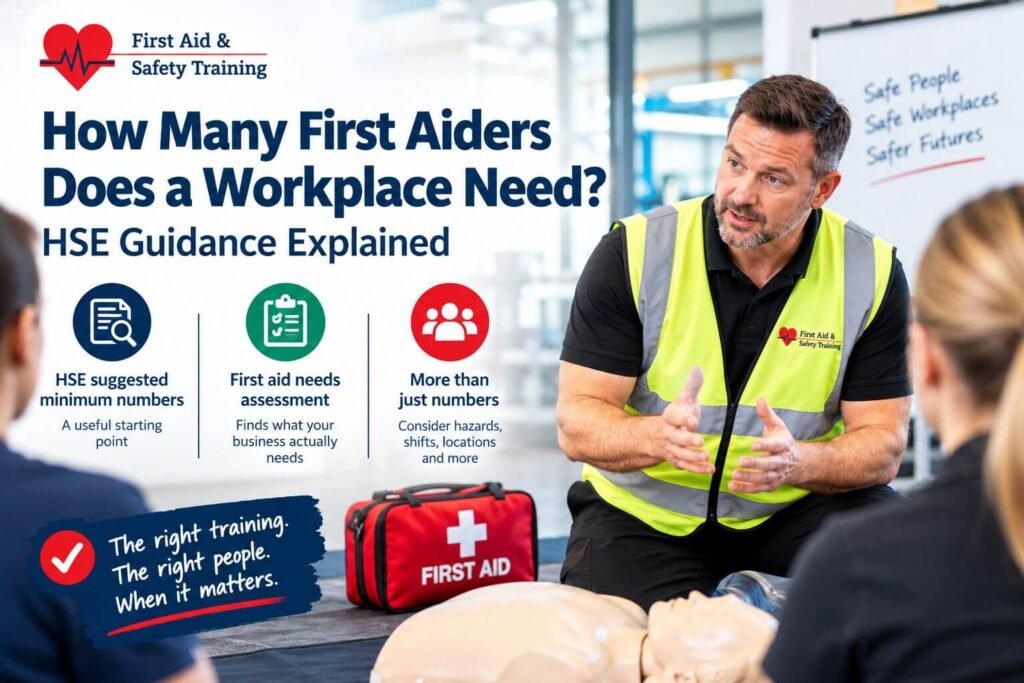
How many first aiders does a workplace need? It is one of the questions we are asked most often by businesses looking to arrange workplace first aid training.
There is a simple answer and a more useful answer.
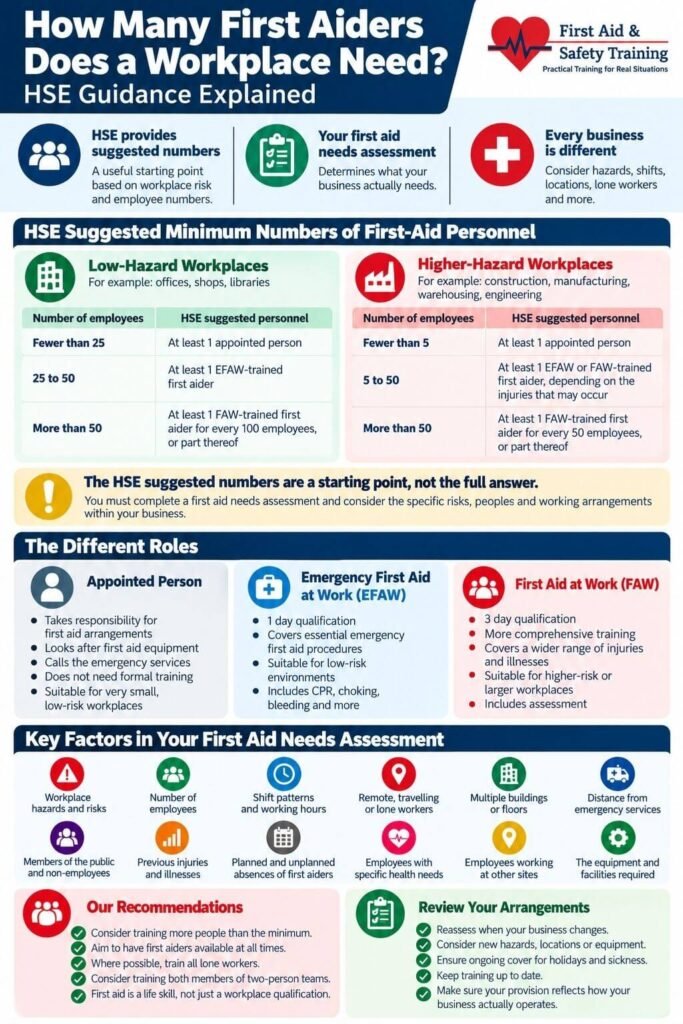
The simple answer is that the Health and Safety Executive, HSE, provides suggested numbers of first aid personnel based on the number of employees and the level of hazard within the workplace.
The more useful answer is that the number of first aiders your workplace needs cannot be decided by employee numbers alone.
Under the Health and Safety (First-Aid) Regulations 1981, employers must provide adequate and appropriate equipment, facilities and personnel to ensure employees receive immediate attention if they are injured or taken ill at work.
What is adequate and appropriate will not be identical for every organisation.
That is why the starting point should always be your first aid needs assessment.
Two businesses can employ exactly the same number of people and still need very different first aid arrangements.
Does HSE Specify How Many First Aiders a Business Needs?
HSE provides suggested numbers of first aid personnel to help employers decide what provision may be appropriate.
However, these figures should be considered alongside the findings of the employer’s first aid needs assessment.
HSE broadly separates workplaces into low-hazard and higher-hazard environments when providing its suggested numbers.
| Workplace | Number of employees | HSE suggested personnel |
|---|---|---|
| Low-hazard, such as offices, shops and libraries | Fewer than 25 | At least 1 appointed person |
| Low-hazard | 25–50 | At least 1 EFAW-trained first aider |
| Low-hazard | More than 50 | At least 1 FAW-trained first aider for every 100 employees, or part thereof |
| Higher-hazard | Fewer than 5 | At least 1 appointed person |
| Higher-hazard | 5–50 | At least 1 EFAW or FAW-trained first aider, depending on the injuries that may occur |
| Higher-hazard | More than 50 | At least 1 FAW-trained first aider for every 50 employees, or part thereof |
These figures are contained within HSE guidance to the Health and Safety (First-Aid) Regulations 1981.
You can read the HSE First Aid at Work guidance for further information.
The figures provide employers with a useful starting point.
But they are not the end of the assessment.
The HSE Suggested Numbers Are a Starting Point
This is where first aid planning can sometimes go wrong.
Imagine a low-hazard business with 40 employees.
Looking only at the HSE suggested numbers indicates:
At least one EFAW-trained first aider.
It would be easy to stop there.
But what if those 40 employees work across two separate buildings?
What if the business operates an early and late shift?
What if the only trained first aider works Monday to Friday, but other employees work weekends?
What happens when that first aider takes two weeks of annual leave?
What if they are off sick?
Suddenly, one first aider for those 40 employees may not provide adequate cover.
This is why the HSE guidance also asks employers to consider factors such as shift work, lone and remote workers, multiple buildings or floors and planned and unplanned absences.
The number of employees gives you a starting point.
The first aid needs assessment helps determine what your business actually needs.
What Is a First Aid Needs Assessment?
A first aid needs assessment looks at your organisation and determines what first aid arrangements are appropriate for the people, workplace and activities involved.
It is not simply a headcount.
The assessment should consider the reality of how your business operates.
Factors to consider include:
- The hazards associated with the work
- The number of employees
- Previous accidents, injuries and illnesses
- Employees who travel, work remotely or work alone
- Shift and out-of-hours working
- Workplaces spread across different buildings or floors
- Distance from emergency medical services
- Employees working at other employers’ sites
- Planned and unplanned absences of first aid personnel
- Members of the public visiting the workplace
- Employees who may have particular first aid needs
The nature and distribution of the workforce can therefore be just as important as the total number of employees.
This is why there cannot be one perfect first-aider-to-employee ratio for every UK workplace.
What Is the Difference Between an Appointed Person, EFAW and FAW?
The HSE suggested numbers refer to different levels of first aid provision.
Understanding these roles is important when carrying out your needs assessment.
Appointed Person
An appointed person takes responsibility for first aid arrangements where the employer’s assessment determines that a qualified first aider is not required.
Their responsibilities can include looking after first aid equipment and facilities and calling the emergency services when required.
An appointed person is not the same as a qualified first aider.
HSE’s suggested numbers include an appointed person for very small workplaces where the assessment indicates that a qualified first aider is unnecessary.
Emergency First Aid at Work
Emergency First Aid at Work, EFAW, provides training in essential emergency first aid procedures.
It may be appropriate for workplaces where the first aid needs assessment identifies this level of training as sufficient.
First Aid at Work
First Aid at Work, FAW, provides more extensive training and covers a wider range of workplace injuries and illnesses.
FAW is more likely to be identified in higher-hazard environments or larger workplaces, although the appropriate qualification should always reflect the findings of the needs assessment.
You can explore our workplace first aid training courses if you are unsure about the differences between the available qualifications.
Why Two Similar-Sized Businesses Can Need Different Numbers of First Aiders
Consider two businesses that each employ 30 people.
The first is an office where everybody works in the same building at approximately the same time.
The second is an engineering company where employees use machinery, work in separate areas and operate different shifts.
Both businesses employ 30 people.
That does not automatically mean their first aid arrangements should be identical.
The engineering business may identify more significant potential injuries, different training requirements and the need for additional first aiders to provide suitable cover.
This is exactly why first aid provision needs to be assessed rather than calculated from headcount alone.
Shift Work Can Completely Change the Number of First Aiders You Need
Employee numbers can be particularly misleading when a business operates different shifts.
Suppose you employ 60 people.
If all 60 work together in one low-hazard workplace, the HSE suggested numbers point towards at least one FAW-trained first aider for every 100 employees or part thereof.
But suppose those employees are divided between:
20 employees on an early shift
20 employees on a late shift
20 employees on a night shift
One FAW-qualified employee cannot provide cover across all three shifts.
The HSE suggested numbers relate to first aid personnel available at all times people are at work.
Your first aid needs assessment therefore needs to consider when employees are actually working, not simply the total number appearing on the payroll.
Holidays and Sickness Need to Be Considered
Another common mistake is training exactly the suggested minimum number and assuming the issue has been resolved.
If your assessment identifies a need for one first aider and you train exactly one person, what happens when that person is:
- On annual leave?
- Off sick?
- Attending a meeting elsewhere?
- Working from home?
- On a training course?
- Visiting another site?
- No longer employed by the business?
HSE specifically tells employers to consider planned and unplanned absences of first aiders and appointed persons.
In practical terms, this can mean having more trained people than the headline suggested minimum.
Multiple Floors, Buildings and Work Areas Matter
Physical layout matters too.
A business may appear to have enough qualified first aiders when viewed purely as a total number, but that does not necessarily mean those first aiders can provide effective cover throughout the workplace.
HSE identifies premises spread across different buildings or floors as something that can affect first aid provision.
Think about how quickly a trained first aider could actually reach a casualty.
A first aider on the third floor of one building may not provide particularly effective immediate cover for someone working in a separate warehouse at the other end of the site.
Your first aid needs assessment should therefore consider where people work, not simply how many people work there.
What About Lone Workers?
Lone working deserves particular attention.
HSE identifies employees who travel extensively, work remotely or work alone as factors that can influence first aid provision.
That does not mean there is a universal HSE rule stating that every lone worker must hold an EFAW or FAW qualification.
The employer must assess the risks and determine appropriate arrangements.
At First Aid and Safety Training, however, we generally encourage employers to consider providing first aid training to lone workers themselves where this is reasonably practicable.
There is a straightforward reason.
If someone works alone, there may be nobody else immediately available to provide first aid.
Training cannot remove all of the risks associated with lone working. A seriously injured person may be unable to treat themselves, so businesses also need suitable communication, emergency and lone-working procedures.
But first aid knowledge can still be extremely valuable.
A lone worker who understands how to control bleeding, recognise a serious medical emergency and respond appropriately to an injury is better prepared than someone who has never received that training.
What About Teams of Two?
Similar thinking applies to employees who regularly work in pairs away from the main workplace.
Imagine two employees travelling together to carry out work at a remote location.
One is first aid trained.
The other is not.
That may initially appear to provide first aid cover.
But what happens if the trained person becomes the casualty?
The remaining employee may suddenly be expected to deal with a serious emergency without the training their colleague received.
For this reason, where teams of two work remotely or undertake higher-risk activities, we would normally encourage an employer to consider training both members of the team.
This should not be confused with a universal HSE requirement.
It is a practical, risk-based recommendation that can be considered as part of the first aid needs assessment.
Distance From Emergency Services Matters
The location of your workplace can also influence your first aid arrangements.
Professional medical help does not arrive instantly.
Some workplaces are further away from emergency services or may be difficult for an ambulance crew to access.
A city-centre office and a remote outdoor worksite could employ exactly the same number of people but have very different circumstances.
The first aid needs assessment should therefore consider the location of the workplace and the potential response time of emergency services.
This can be particularly important for:
- Remote workplaces
- Construction sites
- Forestry and agricultural work
- Outdoor activities
- Isolated industrial sites
- Employees travelling between locations
The longer employees may have to wait for professional medical assistance, the more important appropriate immediate first aid provision can become.
Look at the Injuries That Could Actually Happen
A good first aid needs assessment should connect your workplace risk assessment with your first aid provision.
Think about the injuries and illnesses that could realistically occur.
For example, consider businesses involving:
- Dangerous machinery
- Sharp equipment
- Construction activities
- Chemicals
- Vehicles
- Working at height
- Remote outdoor work
- Confined spaces
- Significant risks of serious bleeding
The question should not simply be:
“Do we have a first aider?”
It should also be:
“Does our first aid provision match the injuries our risk assessment says could happen?”
The answer can influence the qualification required, additional training, equipment and number of people who should be trained.
Could EFAW or FAW Training Be Insufficient for Some Workplaces?
Yes.
EFAW and FAW provide defined workplace first aid training, but some businesses have hazards that may require additional competence or equipment.
A first aid needs assessment may identify the need for additional training beyond a standard first aid qualification.
This can be particularly important for businesses with unusual or specialist hazards.
Completing a three-day First Aid at Work qualification does not automatically resolve every first aid risk identified within a workplace.
The training and equipment provided should reflect the risks employees may actually encounter.
What About Members of the Public?
The Health and Safety (First-Aid) Regulations 1981 specifically concern first aid provision for employees.
However, HSE recommends that employers consider non-employees when assessing their first aid provision.
This can be particularly relevant to:
- Gyms and leisure facilities
- Shops
- Hospitality businesses
- Visitor attractions
- Schools and colleges
- Community venues
- Event spaces
- Training centres
Imagine a leisure facility employing ten people but receiving hundreds of visitors each day.
Its circumstances are very different from an office employing ten people where virtually nobody else enters the premises.
Again, employee numbers alone do not tell the whole story.
Should You Only Train the Minimum Number of First Aiders?
This is where it is important to separate HSE guidance from our own approach to first aid training.
HSE provides suggested numbers to help employers assess appropriate first aid provision.
At First Aid and Safety Training, we would rarely encourage a business to think about first aid purely in terms of:
“What is the smallest number of people we can train?”
Where practical, there are significant advantages to having more trained people.
It can make it easier to provide cover for:
- Holidays
- Sickness
- Different shifts
- Meetings
- Remote working
- Multiple buildings
- Staff turnover
It also increases the likelihood that somebody with first aid knowledge will be nearby when an incident occurs.
And there is another reason we encourage businesses to consider training more people.
First Aid Is a Life Skill, Not Just a Workplace Qualification
A workplace may pay for somebody’s first aid training because it needs to meet its responsibilities as an employer.
But the skills that person learns do not stay at work.
They take those skills home.
They may use CPR at a sports club.
They may recognise the signs of a stroke while visiting a relative.
They may help somebody who is choking in a restaurant.
They may use first aid while travelling or attending an event.
They may need those skills when a member of their own family becomes ill or injured.
The immediate purpose of workplace first aid training is to help provide appropriate first aid provision at work.
But creating more people who have the knowledge, practical skills and confidence to help in an emergency can have a much wider benefit.
That is why, where practical, we would rather see businesses develop a strong first aid culture than simply train the smallest possible number of people.
More First Aiders Does Not Replace a Proper Needs Assessment
Training more people is something we strongly support.
But simply saying “everyone is first aid trained” does not replace a proper first aid needs assessment.
You still need to consider:
- Whether employees have the appropriate qualification
- Whether their training matches the workplace hazards
- Whether suitable cover exists across every shift
- Whether different work areas are adequately covered
- What happens during planned and unplanned absences
- Whether additional specialist training is required
- What first aid equipment and facilities are needed
- How emergency services will be contacted
- How emergency services will reach the casualty
Numbers matter.
But competence, availability, location and appropriate training matter too.
A Better Question Than “What Is the Minimum?”
When businesses ask us how many first aiders they need, it is understandable that they want a number.
But instead of beginning with:
“What is the minimum number of first aiders we legally need?”
A more useful question is:
“What first aid provision would we need if somebody became seriously ill or injured here today?”
Then consider:
Who is at risk?
What could happen?
Where could it happen?
When are people working?
Who would respond?
What happens if that person is absent?
What if the trained person is the casualty?
What skills would the responder need?
What equipment would they need?
How quickly could professional help arrive?
Those questions give you a much better picture of the first aid provision your organisation actually needs.
How Many First Aiders Does a Workplace Need in Practice?
So, how many first aiders does a workplace need once the HSE suggested numbers and first aid needs assessment are considered together?
Start with the HSE suggested numbers.
But do not stop there.
Your employee numbers and the level of hazard within your workplace provide a useful baseline.
Your first aid needs assessment then determines what adequate and appropriate provision looks like for your particular organisation.
A low-hazard office with 20 employees working together may reach one conclusion.
A business with 20 employees spread across different sites and shifts may reach another.
A five-person team carrying out higher-risk work at a remote location may need something different again.
Every organisation is different.
The aim should not simply be to reach the lowest number shown in a table.
It should be to make sure that if somebody becomes injured or seriously ill, the right person, with the right training and the right equipment, is available to help them.
Review Your First Aid Needs Assessment When Things Change
A first aid needs assessment should not be completed once and forgotten.
Businesses change.
You may:
- Employ more people
- Introduce new shifts
- Move premises
- Open another building
- Purchase new machinery
- Introduce different processes
- Begin using new substances
- Employ more lone workers
- Start sending teams to remote locations
- Change working patterns
When significant changes occur, review whether your existing first aid arrangements are still appropriate.
You should also review arrangements if accidents or incidents indicate that your existing provision may no longer be sufficient.
Your first aid arrangements should continue to reflect how your business actually operates.
Need Help Working Out How Many First Aiders Your Workplace Needs?
If you are trying to work out how many first aiders your workplace needs, start by completing a first aid needs assessment rather than simply booking training based on your headcount.
First Aid and Safety Training can help businesses understand the difference between the HSE suggested numbers and the additional provision that may be identified when factors such as hazards, shifts, holidays, sickness, lone working, site layout and remote working are considered.
We provide workplace first aid training courses for organisations across the North East, including Emergency First Aid at Work and First Aid at Work qualifications.
You can book a first aid course or contact First Aid and Safety Training to discuss the first aid training appropriate for your organisation.
You can also find First Aid and Safety Training on Google and see our business information and customer reviews.