If you are arranging allergy training for a school, nursery, workplace or other organisation, one of the first questions is often: how long does anaphylaxis training take?
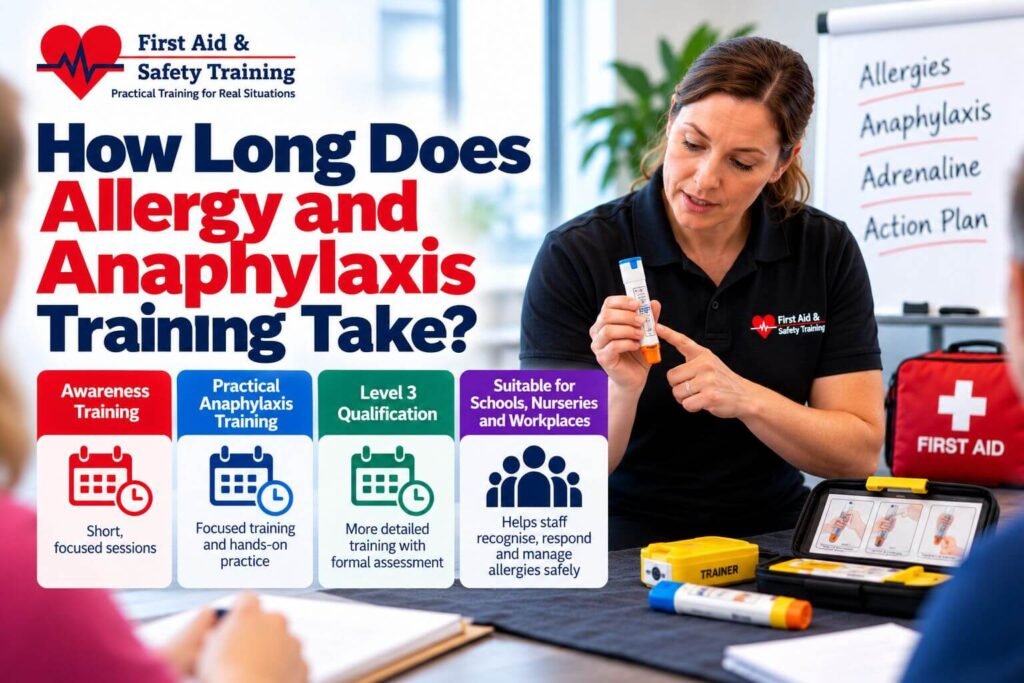
There isn’t one single answer because allergy and anaphylaxis training can range from focused awareness sessions through to more comprehensive training and nationally regulated qualifications.
The right course should therefore be chosen according to what your staff need to know and be able to do, rather than simply selecting the shortest option available.
A short awareness session can help a wider team understand allergies, recognise warning signs and know how to respond.
More detailed training can explore allergy management, anaphylaxis and emergency procedures in greater depth.
Where an organisation wants a formal qualification, First Aid and Safety Training also provides the Level 3 Award in Allergy and Anaphylaxis Awareness, delivered through our approved Qualsafe Awards Centre.
The important question is not simply how long is the course?
It is:
What level of allergy and anaphylaxis training does your organisation actually need?
What Is Allergy and Anaphylaxis Training?
Allergy and anaphylaxis training helps people understand allergic reactions and respond appropriately if someone develops a serious reaction.
Anaphylaxis is a severe and potentially life-threatening allergic reaction that requires urgent treatment.
Allergies can be triggered by many different substances. Depending on the person, triggers may include foods, medicines, insect stings, latex and other allergens.
For organisations responsible for other people, good allergy safety goes beyond knowing how to use an adrenaline device.
Staff may need to understand:
- What an allergy is
- Common allergens
- How allergic reactions can develop
- Signs and symptoms of an allergic reaction
- How to recognise possible anaphylaxis
- The importance of individual allergy plans
- Reducing exposure to known allergens
- Emergency procedures
- Adrenaline and emergency treatment
- Adrenaline auto-injector awareness
- When to call 999
- Recording and reviewing incidents
- Their own responsibilities within the organisation
The depth required will depend on the setting and the responsibilities of the people being trained.
How Long Does Anaphylaxis Training Take?
There is no universal duration for every course described as anaphylaxis training.
That is because the term can describe very different types of training.
For example, an organisation may want a focused session to help staff recognise anaphylaxis and understand emergency procedures.
Another organisation may need wider allergy-awareness training covering prevention, policies, risk management and emergency response.
Someone who requires a formal regulated qualification will need a course that meets the requirements of that particular qualification.
This is why it is worth looking beyond the course title.
Two courses advertised as “anaphylaxis training” may have very different learning outcomes.
What Are the Different Types of Allergy and Anaphylaxis Training?
At First Aid and Safety Training, we separate allergy training according to what the learner or organisation is trying to achieve.
Allergy and Anaphylaxis Training
This is the wider area of training for organisations wanting to improve their understanding and management of allergies and severe allergic reactions.
It can be particularly relevant to:
- Schools
- Nurseries
- Childcare providers
- Hospitality businesses
- Leisure organisations
- Community organisations
- Workplaces
- Anyone responsible for someone with a known allergy
You can explore our full range of Allergy and Anaphylaxis Training options to identify the appropriate level of training.
Practical Anaphylaxis Training
Some organisations primarily need their staff to become more confident recognising anaphylaxis and responding to an emergency.
Practical training is valuable because an emergency is not the ideal time to encounter an adrenaline trainer device for the first time.
Staff can become familiar with emergency procedures and practise with training devices in a controlled environment.
For organisations in our region, find out more about Anaphylaxis Training in the North East.
Level 3 Allergy and Anaphylaxis Awareness
For organisations and individuals wanting a formal qualification rather than awareness training alone, FAST also provides a regulated Level 3 qualification for more formal training.
This is delivered through First Aid and Safety Training as an approved Qualsafe Awards Centre.
That distinction is important.
A training provider can issue its own attendance or course certificate for an awareness session. A regulated qualification is awarded through a recognised awarding organisation and has defined qualification requirements.
The best option depends on why you need the training.
Is Allergy Awareness Training the Same as Anaphylaxis Training?
Not necessarily.
They overlap, but they can have different objectives.
Anaphylaxis training tends to concentrate heavily on recognising and responding to a severe allergic reaction.
Allergy awareness training can be broader.
It can include preventing exposure, understanding allergens, managing people with known allergies, communication, organisational procedures and preparing for emergencies.
For some organisations, particularly schools, that wider understanding is becoming increasingly important.
Do Schools Need Allergy Training?
This is an area that changed significantly in England during 2026.
New statutory Allergy Safety in Schools guidance was published by the Department for Education in July 2026. It requires affected schools to put allergy-safety training in place for staff, alongside an allergy safety policy, appropriate Individual Healthcare Plans and arrangements for recording and learning from serious incidents and near misses. GOV.UK
The Children’s Wellbeing and Schools Act 2026 also introduced requirements around school allergy-safety policies, including annual review and publication of the policy. Legislation.gov.uk
This means allergy training should not be viewed simply as an optional extra for a school that happens to have a pupil with a known allergy.
It forms part of a much wider approach to allergy safety.
Does Every Member of School Staff Need Allergy Awareness Training?
The 2026 statutory guidance requires schools within its scope to put allergy-awareness training in place for all staff.
The purpose is broader than training one designated first aider.
A serious allergic reaction can happen in:
- A classroom
- The dining hall
- A playground
- A sports lesson
- An assembly
- An after-school club
- A school trip
- A school vehicle
The first adult present may not be the school’s designated first aider.
Staff therefore need an appropriate level of awareness so they can recognise a problem and know what to do next. GOV.UK
That does not necessarily mean every employee needs the same depth of training or the Level 3 qualification.
A sensible training structure may involve wider allergy awareness across the workforce, supported by more detailed training for people with particular responsibilities.
Is Anaphylaxis Covered in Paediatric First Aid?
Yes.
Anaphylaxis forms part of Paediatric First Aid training.
However, this is an important distinction:
Paediatric First Aid is not a dedicated allergy-management qualification.
PFA needs to cover a wide range of childhood emergencies and medical conditions, including CPR, choking, bleeding, seizures, injuries, burns, asthma and anaphylaxis.
Dedicated allergy and anaphylaxis training allows considerably more attention to be given to allergy management itself.
That can be particularly useful where a school, nursery or childcare organisation has children with known allergies.
If you are deciding between courses, our guide to how long Paediatric First Aid lasts explains the full PFA and Emergency PFA options.
Does First Aid at Work Cover Anaphylaxis?
First-aid training can include recognising and responding to anaphylaxis, but employers should not automatically assume their normal workplace first-aid provision covers every additional training need.
An employer’s first-aid needs assessment should consider the circumstances of the workplace and the people within it.
Where an organisation knows someone is at risk of anaphylaxis, additional training may be appropriate.
Government guidance also recognises that where emergency prescription-only medication may need to be administered, an employer may consider additional training so first aiders understand the condition and can administer lifesaving medication in an emergency. GOV.UK
Does Anaphylaxis Training Include Adrenaline Auto-Injectors?
Training around anaphylaxis should help learners understand the role of adrenaline in an anaphylactic emergency.
Depending on the course, practical training may also include trainer versions of adrenaline auto-injectors.
Trainer devices do not contain a needle or medication. They allow learners to become familiar with how a device is operated without administering adrenaline.
This is particularly useful because different adrenaline auto-injector devices can operate differently.
People who have been prescribed an adrenaline auto-injector should receive instruction in their particular device, and practising with the appropriate trainer device can help maintain familiarity. Cambridge University Hospitals
What Should Staff Know About an Anaphylactic Emergency?
Training should give people the confidence to recognise that anaphylaxis is a medical emergency.
Where anaphylaxis is suspected, adrenaline should not be unnecessarily delayed.
After adrenaline is administered, 999 should be called for an ambulance. Government guidance also emphasises that the casualty should not be encouraged to stand or walk around. GOV.UK
The exact emergency procedure should reflect the person’s allergy plan, prescribed device and current guidance.
Training is valuable because it allows these actions to be discussed and practised before somebody has to make decisions during a genuine emergency.
Can Schools Keep Spare Adrenaline Auto-Injectors?
Yes, schools in England can currently obtain and hold spare adrenaline auto-injectors for emergency use in the circumstances allowed by the relevant regulations and guidance.
Children at risk should still have their own prescribed devices available; a school’s spare device is not intended simply to replace a pupil’s prescribed supply. GOV.UK
This is another reason staff training matters.
Having emergency medication available is only part of the system.
People also need to know:
- Where it is kept
- How it can be accessed
- Who it may be used for
- How to recognise anaphylaxis
- How the relevant device works
- What to do after it has been administered
- How the incident should be recorded
What About Adrenaline Nasal Sprays?
This is a developing area, so schools should be careful not to treat proposed changes as if they are already established requirements.
As of 21 October 2026, the MHRA is consulting on proposals that would allow schools to purchase and hold spare adrenaline nasal sprays alongside adrenaline auto-injectors.
The consultation opened on 19 October 2026.
Schools can already hold spare adrenaline auto-injectors under the existing arrangements, but the proposed extension to spare nasal sprays is currently a consultation, not something schools should assume has already changed the law. GOV.UK
Training and policies will need to keep pace with any future changes.
Do Nurseries Need Allergy and Anaphylaxis Training?
Allergy safety is also important in early years settings.
Paediatric First Aid already includes anaphylaxis, but a nursery may decide that additional allergy training is appropriate because of:
- Children with diagnosed allergies
- Food preparation and meal times
- Snacks
- Staff turnover
- Multiple rooms
- Agency staff
- Outings
- Individual healthcare arrangements
- Adrenaline auto-injectors
- Communication with parents and carers
The Department for Education’s school allergy guidance also notes that it may be useful for early years settings, even though its specific statutory application needs to be understood correctly. GOV.UK
Dedicated allergy training can therefore complement rather than replace Paediatric First Aid.
Who Else Should Consider Allergy and Anaphylaxis Training?
Allergy emergencies are not limited to education.
Training may be useful for:
- Restaurants and cafés
- Hotels
- Catering businesses
- Sports clubs
- Leisure centres
- Children’s activity providers
- Care organisations
- Community groups
- Employers with staff at risk
- Event organisations
The appropriate level of training will differ.
A restaurant manager may have different responsibilities from a teaching assistant.
A nursery practitioner may have different needs from an office first aider.
This is why we recommend matching the course to the organisation rather than treating all allergy training as interchangeable.
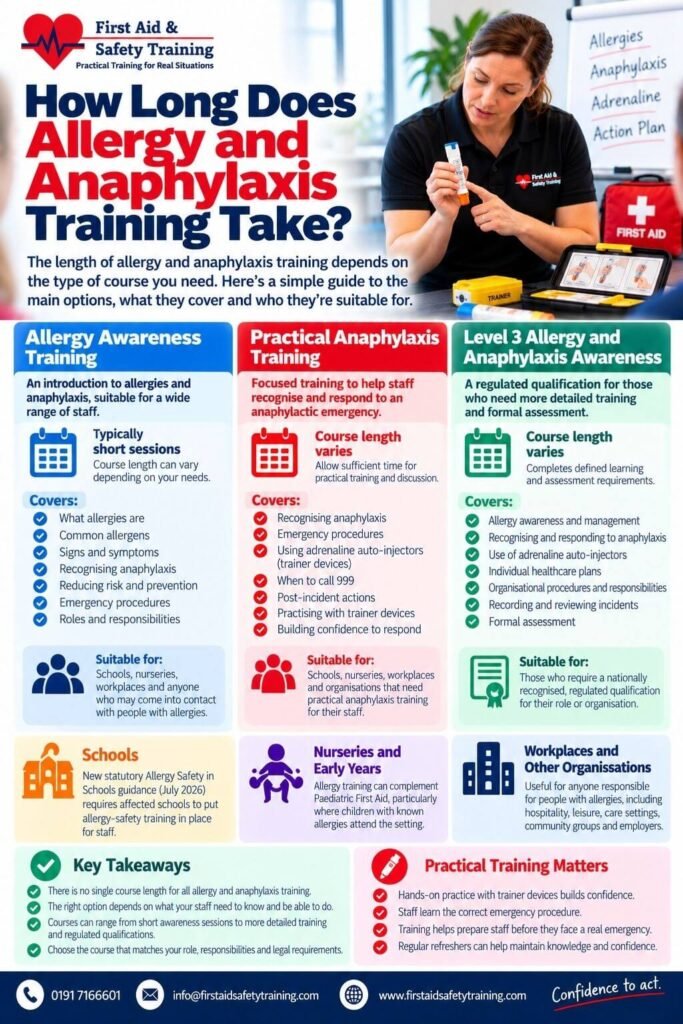
Should We Choose Awareness Training or a Regulated Qualification?
Start by asking why you need the training.
If the objective is to give a wider workforce basic allergy awareness, an appropriate awareness programme may be sufficient.
If employees need greater practical confidence around anaphylaxis, more focused practical training may be appropriate.
If the learner or organisation specifically requires a nationally regulated qualification with formal assessment and external quality assurance, the Level 3 Allergy and Anaphylaxis Awareness qualification may be the better route.
There can also be a case for using more than one level.
For example, a school could provide appropriate allergy awareness across the workforce while selected employees complete more detailed or formally regulated training.
That creates depth without assuming every person needs exactly the same qualification.
Is the Level 3 Allergy and Anaphylaxis Course an Ofqual-Regulated Qualification?
The important terminology here is regulated qualification, rather than saying FAST itself is regulated by Ofqual.
First Aid and Safety Training is an approved Qualsafe Awards Centre.
Qualsafe Awards is an Ofqual-recognised awarding organisation.
Our relevant Level 3 course therefore leads to a regulated qualification awarded through Qualsafe Awards, rather than simply being an attendance certificate created by FAST.
For organisations comparing courses, that is an important distinction to check.
Look at what qualification or certificate you actually receive, not simply whether the words “Level 3” appear in a course title.
Can Allergy and Anaphylaxis Training Be Delivered Onsite?
Yes, onsite training can be particularly useful for organisations training several employees.
It can reduce travel and make it easier to arrange training around staffing requirements.
There is another advantage too.
Allergy safety is highly dependent on the environment.
Training delivered for a particular organisation can help staff think about practical questions such as:
- Where emergency medication is stored
- How quickly it can be reached
- What happens during breaks
- Who is responsible during trips
- How substitute or temporary staff are informed
- What happens in dining areas
- How an ambulance would access the premises
- How incidents and near misses are reported
Those conversations can make training more meaningful than treating allergy safety as a purely theoretical subject.
How Often Should Allergy and Anaphylaxis Training Be Refreshed?
Do not assume that completing a course once means the subject never needs revisiting.
The appropriate refresher frequency depends on the course, qualification, workplace requirements and organisational arrangements.
Schools also need to think more broadly than certificate expiry dates.
Policies, pupils, staff, prescribed devices and individual healthcare arrangements can change.
Under the new statutory school allergy-safety requirements, the school’s allergy safety policy must be reviewed at least annually. Legislation.gov.uk
That creates a natural opportunity to review whether staff knowledge and training remain appropriate.
Practical familiarity matters as well.
Someone may understand an adrenaline auto-injector immediately after training but feel far less confident if they have not handled a trainer device for a long period.
Is Practical Anaphylaxis Training Worthwhile?
Yes, particularly for people who may be expected to respond to an emergency.
Reading instructions and watching videos are useful ways to build knowledge.
Practical training adds something different.
Learners can handle trainer devices, practise the sequence and ask questions in a safe environment.
That familiarity matters because anaphylaxis can progress quickly.
The aim is not simply to remember facts.
It is to build the confidence to act when somebody needs help.
How Does Allergy Training Fit With Paediatric First Aid?
For nurseries, schools and childcare organisations, the two subjects complement each other.
Think of it this way:
Paediatric First Aid develops broad emergency first-aid competence involving babies and children.
Allergy and Anaphylaxis Training allows greater focus on preventing, recognising and managing allergic reactions.
Level 3 Allergy and Anaphylaxis Awareness provides a formal regulated qualification for people or organisations wanting that additional level of recognition and assessment.
One does not necessarily make the others unnecessary.
The right combination depends on the setting.
How Long Does Allergy and Anaphylaxis Training Take? The Simple Answer
There isn’t one standard duration for every course carrying the name allergy or anaphylaxis training.
The duration depends on the depth and purpose of the training.
A focused awareness session may be relatively short.
Practical anaphylaxis training needs sufficient time for learners to understand the emergency response and become familiar with trainer devices.
A formal Level 3 regulated qualification has defined learning and assessment requirements that must be completed for the qualification to be awarded.
Rather than choosing a course purely because it is the shortest, ask:
What do our staff need to know?
What do they need to be able to do?
Do we need awareness, practical competence or a regulated qualification?
Are there specific legal, school, workplace or organisational requirements that apply to us?
Those answers will determine the most appropriate training.
Arrange Allergy and Anaphylaxis Training
First Aid and Safety Training provides allergy and anaphylaxis training for schools, nurseries, workplaces and organisations across the North East, alongside our nationally regulated Level 3 qualification.
If you are unsure which option you need, you can explore our specialist allergy training options to compare the available routes.
Organisations looking for practical staff training can learn more about training for organisations across the North East.
If you need a formal regulated qualification, take a look at our Level 3 qualification.
You can also contact First Aid and Safety Training to discuss which option is appropriate for your organisation or find First Aid and Safety Training on Google to view our business information and customer reviews.