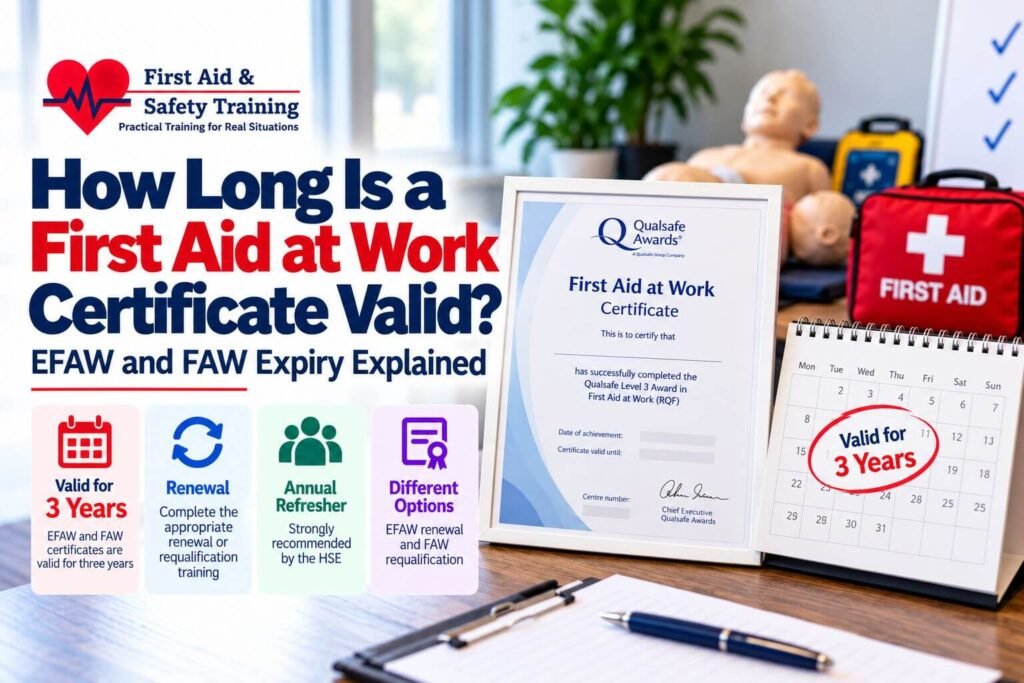
If you hold an Emergency First Aid at Work or First Aid at Work qualification, an important date to keep track of is the expiry date on your certificate. So, how long is a First Aid at Work certificate valid?
The simple answer is:
Three years
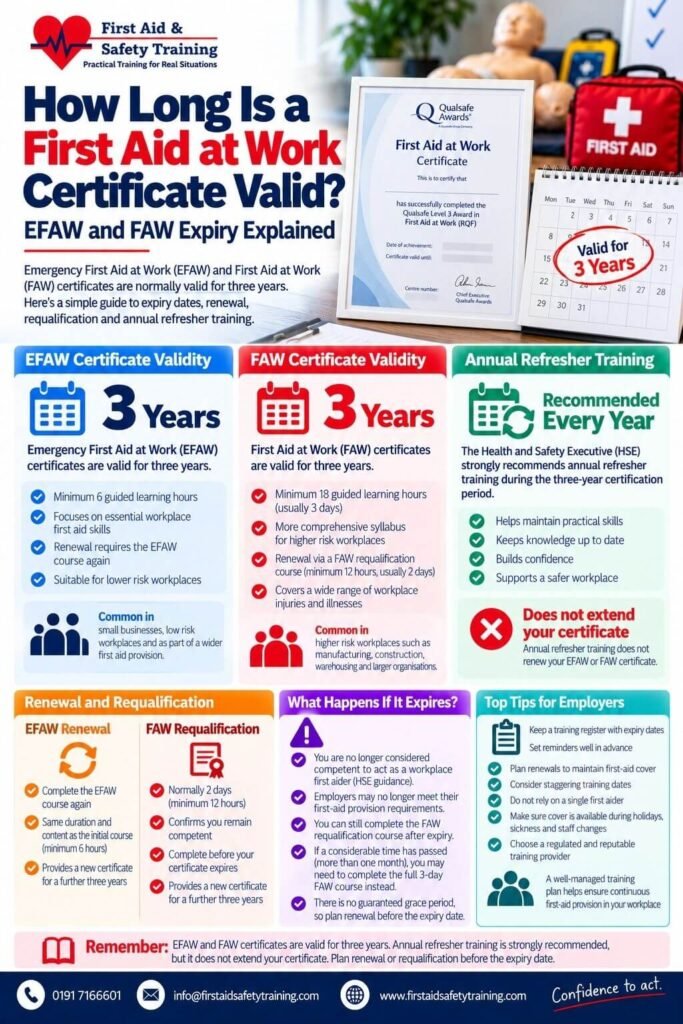
Both Emergency First Aid at Work, EFAW, and First Aid at Work, FAW, certificates are valid for three years.
Employers should arrange the appropriate retraining or requalification before a certificate expires.
The Health and Safety Executive also strongly recommends that workplace first aiders undertake annual refresher training during the three-year certification period.
However, there is an important distinction:
Annual refresher training does not renew your EFAW or FAW certificate.
This guide explains certificate validity, expiry, renewal, FAW requalification, annual refreshers and what employers should do to avoid gaps in workplace first-aid provision.
How Long Does a First Aid at Work Certificate Last?
A First Aid at Work certificate is valid for:
3 years
This applies to the full First Aid at Work qualification.
HSE guidance states that first-aid training certificates, including FAW and EFAW, are valid for three years and employers need to arrange retraining before certificates expire. HSE
The expiry date shown on the certificate is therefore important.
If your FAW certificate expires on 30 November, you should not simply assume that you remain a qualified workplace first aider throughout December while you arrange another course.
Ideally, renewal or requalification should be planned before the existing certificate reaches its expiry date.
How Long Is an Emergency First Aid at Work Certificate Valid?
An Emergency First Aid at Work certificate is also valid for:
3 years
EFAW is the shorter workplace first-aid qualification, normally involving at least six guided learning hours.
Although EFAW covers a smaller syllabus than the full FAW qualification, the certificate validity period is still three years.
When an EFAW certificate needs renewing, HSE guidance says the requalification course should be of the same duration and content as the initial EFAW course. HSE
In practical terms, an EFAW first aider normally completes the EFAW course again.
EFAW and FAW Certificate Validity at a Glance
| Qualification | Initial training | Certificate validity | Renewal |
|---|---|---|---|
| Emergency First Aid at Work, EFAW | Minimum 6 guided learning hours | 3 years | EFAW training again |
| First Aid at Work, FAW | Minimum 18 guided learning hours | 3 years | FAW requalification, normally minimum 12 guided learning hours |
| Annual First Aid Refresher | Short skills update | Does not extend certificate | Recommended between qualifications |
The crucial point is that annual refresher training and certificate renewal are not the same thing.
What Happens When a First Aid at Work Certificate Expires?
Once an EFAW or FAW certificate has expired, the person is no longer considered competent by HSE to act as a first aider in the workplace on the basis of that expired certificate. HSE
This can create a problem for the employer as well as the individual.
Under the Health and Safety (First-Aid) Regulations 1981, employers must provide adequate and appropriate equipment, facilities and personnel so employees can receive immediate attention if they are injured or become ill at work.
The employer’s first-aid needs assessment determines what provision is required.
If the business relies on a particular employee as one of its qualified first aiders and that person’s certificate expires, the employer may no longer have the first-aid provision identified as necessary by its assessment.
Certificate expiry should therefore be treated as a workplace planning issue, not simply an individual’s training problem.
Is There a Grace Period for an Expired First Aid Certificate?
This is where first-aid information online can become confusing.
You may see training providers referring to a 28-day or one-month grace period.
That description can give the wrong impression.
HSE does not say that your expired certificate remains valid for another month.
Once the expiry date has passed, HSE says you are no longer considered competent to act as a workplace first aider on the basis of that certificate. HSE
There is, however, some flexibility around FAW requalification.
HSE says a person can requalify after their FAW certificate has expired by completing the two-day requalification course.
However, where a considerable period has passed since expiry — HSE gives more than one month as an example — it may be prudent to complete the full three-day FAW course instead. The employer must decide which training is most appropriate. HSE
So the safest way to describe it is:
There is no extra month of certificate validity after expiry.
Do not plan your workplace first-aid provision around a supposed grace period.
How Do I Renew a First Aid at Work Certificate?
If you hold the full FAW qualification, you can normally renew it through a First Aid at Work requalification course.
The initial FAW qualification normally involves at least:
18 guided learning hours
The FAW requalification course normally involves at least:
12 guided learning hours
This is commonly delivered over two days.
Requalification revisits the knowledge and practical skills from the original qualification and confirms that the learner remains competent.
On successful completion, a new certificate is issued with a further three-year validity period.
Do I Have to Take the Full Three-Day FAW Course Again?
Not necessarily.
This is precisely why the FAW requalification route exists.
Someone holding the appropriate FAW qualification can normally complete the shorter requalification course rather than repeating the initial three-day programme.
However, allowing the certificate to expire can complicate matters.
HSE says a person can still requalify after expiry, but where the certificate has been expired for a considerable period — indicated as more than one month — completing the full three-day FAW course may be prudent. HSE
The sensible approach is therefore simple:
Requalify before your existing certificate expires.
That avoids uncertainty and prevents a gap in the employer’s qualified first-aid provision.
How Do I Renew an EFAW Certificate?
Emergency First Aid at Work works differently from FAW requalification.
HSE says an EFAW requalification course should have the same duration and content as the initial EFAW course. HSE
That means an EFAW holder normally completes the appropriate EFAW training again.
Successfully completing it provides a new certificate for the next three-year period.
There isn’t a shorter two-day-versus-three-day arrangement because EFAW is already the shorter workplace qualification.
What Is an Annual First Aid Refresher?
HSE strongly recommends that first aiders complete annual refresher training during the three-year EFAW or FAW certification period.
The purpose is to help first aiders maintain their basic skills and remain aware of changes to first-aid procedures. HSE
A simple training cycle might therefore look like this:
Year 0: Complete EFAW or FAW qualification
Year 1: Annual refresher
Year 2: Annual refresher
Before the end of Year 3: Complete the appropriate EFAW renewal or FAW requalification
Then the three-year cycle begins again.
Is Annual First Aid Refresher Training Mandatory?
HSE strongly recommends annual refresher training, but it is not generally a mandatory requirement under the Health and Safety (First-Aid) Regulations simply because someone holds EFAW or FAW.
HSE’s own guidance describes annual refresher training as strongly recommended rather than mandatory. HSE
An employer may still decide that refresher training is appropriate or necessary for its workforce.
For example, an organisation may place particular importance on regular skills practice where:
- First aiders rarely use their skills
- Workplace risks are significant
- Employees work remotely
- Emergency medical assistance may take longer to arrive
- The organisation has identified additional first-aid risks
- Staff need to maintain confidence in practical procedures
Regular practice can be valuable even when the qualification itself remains valid.
Does an Annual Refresher Extend My Certificate?
No.
This is one of the most important distinctions in this article.
An annual refresher helps maintain skills.
It does not extend the expiry date of your existing EFAW or FAW certificate.
For example, imagine you complete FAW in October 2026.
You then complete annual refresher training in October 2027 and again in October 2028.
Those refreshers do not turn the original qualification into a five-year certificate.
You still need to complete the appropriate requalification before the original three-year certification period ends.
If you want a more detailed explanation, read our guide to first aid refresher training and requalification.
Why Does First Aid Training Need Renewing?
First aid involves practical skills.
Someone may understand CPR perfectly on the day of their course but then go a long time without performing CPR on a casualty.
The same applies to:
- Choking
- Recovery position
- Severe bleeding
- Using an AED
- Primary survey
- Shock
- Seizures
- Other emergency procedures
Hopefully, first aiders will rarely need to use many of these skills in a genuine emergency.
However, limited real-world use means knowledge and confidence can deteriorate.
HSE therefore recommends annual refresher training and also encourages first aiders to regularly review their course manual and other instructional materials. HSE
Should Employers Keep Records of First Aid Certificate Expiry Dates?
Yes.
A business should not rely on individual employees remembering when their certificates expire.
A simple first-aid training register can record:
- Employee name
- Qualification
- Training provider
- Date qualification completed
- Certificate expiry date
- Annual refresher dates
- Planned requalification date
- Any additional first-aid training
This makes it much easier to identify upcoming expiry dates.
It also helps employers review their first-aid arrangements as staffing changes.
How Early Should Employers Arrange First Aid Requalification?
There is no benefit in deliberately waiting until the final few days.
Start planning several months before expiry.
For example, an employer could introduce reminders at:
Six months before expiry
Check whether the employee still needs FAW or EFAW and review the workplace first-aid needs assessment.
Three months before expiry
Identify an appropriate course and book the employee’s place.
One month before expiry
Confirm attendance and check that adequate first-aid cover will remain available while the employee attends training.
After successful completion
Update the training register and retain the new certificate.
The exact system is up to the organisation, but the objective is straightforward:
Do not allow essential first-aid cover to disappear because somebody forgot an expiry date.
Should All Workplace First Aiders Renew at the Same Time?
Not necessarily.
If twelve employees complete FAW together, their certificates may all expire at approximately the same time three years later.
That can create a significant training and staffing problem.
Where practical, an employer might stagger future training dates.
This can help maintain first-aid coverage while people attend requalification courses and reduce the risk of several certificates expiring simultaneously.
It is particularly useful for organisations operating:
- Multiple shifts
- Several sites
- Large premises
- Remote locations
- Seven days a week
- With relatively small teams
Certificate management should support the employer’s actual first-aid arrangements.
What If Our Only First Aider’s Certificate Expires?
The employer should address the situation immediately.
If the first-aid needs assessment identifies that the workplace requires a trained first aider, an expired certificate may leave the employer without the personnel it has identified as necessary.
Do not simply continue treating the employee as a qualified first aider until a convenient course becomes available.
Arrange appropriate training and review what interim provision is required.
This is another reason why relying on a single trained person can create practical problems.
Annual leave, sickness, training, shift changes and staff turnover can all affect first-aid coverage even when certificates remain valid.
Does a First Aid Certificate Automatically Make Someone a Workplace First Aider?
Holding an appropriate certificate is important, but employers still have responsibilities.
They must assess their workplace’s first-aid needs and provide adequate and appropriate arrangements.
That means considering matters such as:
- Number of employees
- Workplace hazards
- Accident history
- Working patterns
- Shift work
- Lone workers
- Remote workers
- Multiple buildings
- Holidays and absences
- Distance from emergency medical services
- Members of the public where relevant
- Additional training required for specific hazards
A certificate therefore forms part of the employer’s overall first-aid arrangements rather than replacing the need for an assessment.
You can read our separate guide to the legal requirements for first aid at work for a fuller explanation.
Are EFAW and FAW the Same Qualification?
No.
Both are workplace first-aid qualifications, but they have different scopes.
Emergency First Aid at Work, EFAW
EFAW is normally a one-day qualification with at least six guided learning hours.
It focuses on essential emergency first-aid skills.
First Aid at Work, FAW
FAW is a more comprehensive qualification, normally requiring at least 18 guided learning hours over three days.
It covers a broader range of workplace injuries and illnesses.
The employer’s first-aid needs assessment should determine which level of training is appropriate.
The useful thing to remember for certificate management is that both are valid for three years.
If you are comparing the courses themselves, see our guide to how long a First Aid at Work course takes.
Can I Still Give First Aid If My Certificate Has Expired?
There is an important difference between helping somebody in an emergency and being the employer’s designated competent workplace first aider.
HSE guidance says that if a first aider does not retrain or requalify before their certificate expires, they are no longer considered competent to act as a first aider in the workplace for the purposes of that provision. HSE
That does not mean an ordinary person is prohibited from helping somebody who suddenly becomes ill or injured.
If somebody collapses in cardiac arrest, for example, the priority remains to call 999, start CPR and use an AED as soon as possible.
Certificate expiry relates to workplace first-aid competence and provision. It should not be interpreted as a rule telling someone to stand back from a life-threatening emergency.
Do First Aid Certificates Have to Be HSE Approved?
No.
HSE no longer approves individual first-aid training providers.
Employers are responsible for selecting an appropriate and competent training provider.
One route is to choose regulated first-aid qualifications delivered through an approved centre.
First Aid and Safety Training is an approved Qualsafe Awards Centre.
Our relevant EFAW and FAW courses lead to regulated qualifications awarded through Qualsafe Awards, an Ofqual-recognised awarding organisation.
That provides employers with an externally awarded and quality-assured qualification rather than a certificate created solely by FAST.
What Information Should Be on a First Aid Certificate?
HSE guidance sets expectations around first-aid certificates so employers can identify what training has been completed.
From an employer’s perspective, the important practical details include:
- Learner’s name
- Qualification or training completed
- Training organisation or awarding information
- Completion or issue details
- Certificate validity or expiry information
When an employee joins an organisation with an existing first-aid qualification, the employer should check the certificate rather than simply accepting “I’ve done first aid before”.
The remaining validity period matters.
So does whether the qualification is appropriate for the workplace.
Is a First Aid Certificate Valid Between Different Employers?
A certificate does not normally become invalid merely because the learner changes employer.
However, the new employer still needs to determine whether that person’s qualification is appropriate for its own workplace.
For example, someone may hold EFAW from a relatively low-risk environment but move into an organisation where the first-aid needs assessment identifies FAW or additional specialist training.
The certificate may still be current, but it may not be sufficient for the new role.
Employers should therefore check both:
Is the certificate still valid?
and
Is this the right level of training for our workplace?
What About Additional First Aid Training?
Some workplaces identify training needs beyond standard EFAW or FAW.
Examples might include training related to:
- Catastrophic bleeding
- Particular chemicals
- Confined spaces
- Remote working
- Specialist equipment
- Other workplace-specific risks
HSE recognises that additional training may be appropriate where the employer’s first-aid needs assessment identifies particular hazards. HSE
Do not assume that the three-year validity of an EFAW or FAW certificate automatically determines how often every piece of additional specialist training should be refreshed.
Those requirements should be considered separately.
How Long Is a First Aid at Work Certificate Valid? The Simple Answer
For most employers and first aiders, the key facts are straightforward:
EFAW certificate: 3 years
Emergency First Aid at Work certificates are valid for three years.
FAW certificate: 3 years
First Aid at Work certificates are also valid for three years.
Annual refresher: recommended
HSE strongly recommends annual refresher training during the three-year certification period.
Annual refresher does not renew the certificate
You still need the appropriate renewal or requalification training.
FAW requalification: normally 2 days
Complete this before expiry wherever possible.
EFAW renewal: complete EFAW again
The requalification should be the same duration and content as the initial EFAW course.
Once the certificate expires, it is expired
Do not treat references to a one-month period around FAW requalification as an extra month of certificate validity.
HSE’s guidance is clear that employers should arrange retraining before certificates expire. HSE
Keep Your Workplace First Aid Qualifications Current
First-aid certificate renewal is much easier when it is planned rather than left until the expiry date.
First Aid and Safety Training provides regulated workplace first-aid qualifications through our approved Qualsafe Awards Centre, including Emergency First Aid at Work, First Aid at Work and FAW requalification training.
If you are not sure which qualification your workplace requires, start by exploring our first aid training courses.
You can also book a first aid course or contact First Aid and Safety Training to discuss training for your organisation.
For the underlying employer guidance, the Health and Safety Executive’s First Aid at Work guidance explains certificate validity, requalification and refresher training.
You can also find First Aid and Safety Training on Google to view our business information and customer reviews.