Skip to content
If you have experience in first aid and enjoy teaching people practical skills, becoming a first aid trainer can be a rewarding career or an additional source of income.
However, completing a first aid course does not automatically qualify you to teach first aid.
To become a first aid trainer in the UK, you normally need to demonstrate current first aid knowledge and practical competence, suitable teaching or training competence and, where you will assess learners, appropriate assessment competence.
If you want to deliver regulated first aid qualifications, you must also meet the requirements of the awarding organisation and approved centre you work with.
There is therefore no single qualification that automatically makes someone a first aid trainer for every type of course.
Your route will depend on what you want to teach, your existing experience and how you intend to work.
What Does a First Aid Trainer Do?
A first aid trainer teaches people the knowledge and practical skills needed to respond to illness and injury.
Depending on the courses you deliver, learners could include employees, managers, teachers, childcare professionals, sports coaches, volunteers and members of the public.
Training may cover subjects such as:
- casualty assessment
- CPR
- using an automated external defibrillator, or AED
- choking
- unconscious casualties
- bleeding and shock
- burns
- fractures and other injuries
- medical emergencies
- workplace first aid responsibilities
A trainer needs to do much more than present information.
You must be able to demonstrate practical techniques accurately, supervise learner practice, recognise incorrect or unsafe techniques, answer questions appropriately and assess competence where this forms part of the qualification.
Is a First Aid Trainer the Same as a First Aid Instructor?
The terms first aid trainer and first aid instructor are often used to describe very similar roles.
You may therefore see courses, jobs and online searches referring to first aid instructors, first aid trainers or first aid trainer assessors.
The job title itself is less important than your competence and the requirements of the organisation or qualification you are delivering.
For regulated qualifications, you need to meet the trainer and, where applicable, assessor requirements specified for that qualification.
Do You Need a Specific First Aid Trainer Qualification?
There is not one universal UK qualification called a “First Aid Trainer Qualification” that gives you automatic permission to teach every first aid course.
Instead, competence normally comes from a combination of:
- current first aid knowledge and practical competence
- an appropriate teaching or training qualification
- first aid teaching experience where required
- assessment competence where applicable
- ongoing continuing professional development
- meeting the requirements of the awarding organisation or training provider you work with
The Health and Safety Executive guidance on selecting a first aid training provider considers both first aid competence and training and assessing competence when looking at the suitability of trainers and assessors.
This distinction matters.
Being a highly experienced first aider does not automatically make someone an effective trainer. Likewise, holding a teaching qualification does not automatically demonstrate competence in first aid.
You need both sides.
What First Aid Qualification Do You Need?
If you intend to deliver workplace first aid training, you need appropriate and current first aid competence.
HSE guidance identifies several ways a trainer may demonstrate first aid knowledge and competence. These include holding a current First Aid at Work certificate or having appropriate current professional registration, such as being a registered doctor, nurse or paramedic.
When delivering a regulated qualification, however, you must check the specific trainer requirements contained within the current qualification specification.
Different awarding organisations and qualifications may set their own requirements.
Do not assume that a qualification accepted for one course automatically allows you to deliver another.
If you are still deciding which workplace qualifications you want to teach, our guide to the different types of first aid training explains the main options.
Do You Need a Teaching Qualification to Become a First Aid Trainer?
You normally need to demonstrate suitable training or teaching competence.
One common route is the Level 3 Award in Education and Training, although this is not the only qualification that may be accepted.
HSE guidance lists a range of training and assessing qualifications that can demonstrate competence, including teaching qualifications and other recognised training credentials.
What matters is that the qualification or evidence you hold is appropriate for the role you intend to perform.
A competent first aid trainer should be able to:
- plan and structure training
- explain subjects clearly
- demonstrate practical skills accurately
- adapt delivery to different learners
- supervise practical activities safely
- check learner understanding
- provide constructive feedback
- manage a group effectively
- assess competence where authorised to do so
Holding a teaching qualification provides an important foundation, but practical teaching experience is also valuable.
Do First Aid Trainers Need an Assessor Qualification?
This depends on what you are doing.
Teaching and assessing are related roles, but they are not automatically the same thing.
Regulated first aid qualifications include assessment of learner competence. If you are responsible for conducting those assessments, you must meet the relevant assessor requirements.
HSE guidance makes this distinction clear. Trainers who also assess learner competence should hold a qualification, or suitable combination of qualifications, that enables them to perform both roles.
Some recognised teaching qualifications may demonstrate both training and assessment competence. In other circumstances, additional assessor training or qualifications may be required.
The awarding organisation’s current qualification specification should always be checked before you begin delivering or assessing a qualification.
Do You Need Teaching Experience?
Potentially, particularly when you want to deliver regulated first aid qualifications.
An awarding organisation may require evidence that you have suitable experience delivering first aid training.
Someone completely new to training may therefore benefit from working alongside an experienced trainer, observing courses and completing supervised or observed teaching.
This can help you develop skills that are difficult to learn from a teaching qualification alone.
For example, real first aid courses require trainers to manage practical exercises, answer unexpected questions, identify poor technique and give feedback without undermining learner confidence.
Experience also helps you learn how to manage course timings while still giving learners sufficient practical practice.
What First Aid Courses Could You Teach?
The answer depends on your competence and the requirements of the qualification or training programme.
Common workplace qualifications include:
Emergency First Aid at Work
Emergency First Aid at Work is designed for workplaces where the first aid needs assessment identifies this level of provision as appropriate.
EFAW involves a minimum of six hours of training.
First Aid at Work
First Aid at Work provides more extensive training and involves a minimum of 18 hours.
It is commonly delivered over three days.
Our guide to how long First Aid at Work courses take explains the difference between EFAW, FAW and FAW requalification.
Paediatric First Aid
Paediatric training requires appropriate competence in first aid for babies and children and can involve additional requirements.
If this is the area you want to move into, read our detailed guide to how to become a paediatric first aid trainer.
You may also choose to deliver specialist or additional training, but you should only teach subjects where you have the knowledge, competence and authority required to do so.
Can You Deliver Regulated First Aid Qualifications Independently?
Not simply because you hold first aid and teaching qualifications.
A regulated qualification is awarded through a recognised awarding organisation and delivered under its approved arrangements.
Ofqual regulates recognised awarding organisations and regulated qualifications in England. It does not regulate ordinary training providers simply because they deliver courses.
If you want to deliver regulated first aid qualifications, you might:
- deliver on behalf of an existing approved training centre
- work as an associate or freelance trainer for approved centres
- become part of an organisation that already has centre approval
- establish your own training organisation and seek the appropriate centre approval
First Aid and Safety Training, for example, is an approved Qualsafe Awards Centre.
Our regulated workplace and paediatric first aid qualifications are awarded by Qualsafe Awards, an Ofqual-recognised awarding organisation.
That is different from saying that FAST itself is “Ofqual regulated”.
Does HSE Approve First Aid Trainers?
No.
You may still encounter websites using terms such as “HSE approved first aid course” or “HSE approved first aid trainer”.
That terminology can be misleading.
HSE no longer approves individual workplace first aid training providers in the old way.
Instead, employers have a responsibility to select an appropriate competent training provider.
HSE explains this in its guidance on choosing a competent first aid training provider.
Providers can include those offering regulated qualifications as well as other types of competent training organisation.
Do You Need to Join an Awarding Organisation?
If you want to deliver regulated first aid qualifications, you need to operate within the appropriate awarding organisation arrangements.
That does not necessarily mean establishing your own approved centre immediately.
Many trainers begin by working for existing training providers.
This can be a very useful route because you gain practical experience while learning about:
- course registration
- learner records
- assessments
- certification
- internal quality assurance
- awarding organisation requirements
- course paperwork
- reasonable adjustments
- trainer observations
Once you understand the complete training process, you can decide whether remaining an associate trainer or establishing your own centre is right for you.
What Equipment Does a First Aid Trainer Need?
First aid is a practical subject, so you need suitable equipment.
The exact requirements depend on the course and awarding organisation, but a trainer may need equipment including:
- adult CPR manikins
- child and infant manikins where appropriate
- AED training units
- first aid kits and dressings
- bandages
- training tourniquets where relevant
- wound packing equipment where relevant
- choking training equipment
- training adrenaline auto-injectors for relevant courses
- cleaning and hygiene supplies
- presentation equipment
- learner manuals and course resources
Awarding organisations can specify minimum equipment requirements and ratios.
Providing sufficient equipment matters because learners need enough time to practise.
A trainer demonstrating CPR to a room full of people is not the same as every learner having adequate hands-on practice.
Do You Need Insurance as a First Aid Trainer?
If you work independently, insurance should form part of your business planning.
Depending on your activities, this may include areas such as:
- public liability insurance
- professional indemnity insurance
- business equipment cover
- employers’ liability insurance if you employ people
Your exact requirements depend on how your business operates, so appropriate professional advice should be taken rather than assuming one generic insurance policy covers everything.
If you work as a freelance trainer for another training provider, establish what their insurance covers and what cover you are expected to maintain yourself.
Can You Become a Freelance First Aid Trainer?
Yes.
Freelance and associate training can be a useful way to enter the industry.
Training companies often use associate trainers to deliver courses in different areas or to increase their capacity.
Working as an associate can allow you to gain experience without immediately having to find your own customers or establish an approved training centre.
However, you should understand exactly what the provider expects from you.
This can include requirements relating to:
- qualifications
- insurance
- equipment
- travel
- course paperwork
- assessment
- learner records
- quality assurance
- invoicing
- cancellation terms
Don’t assume that every training company operates in the same way.
Can You Start Your Own First Aid Training Business?
Yes, but becoming a competent trainer and running a training business are two different challenges.
Once you begin operating independently, you need to think about much more than delivering the course.
That can include:
- business structure
- insurance
- awarding organisation arrangements
- training equipment
- policies and procedures
- quality assurance
- course administration
- learner records
- venues
- pricing
- bookkeeping
- websites
- marketing
- generating enquiries
- managing repeat customers
It is entirely possible to be an excellent trainer but struggle with the business side.
Likewise, good marketing cannot compensate for poor training standards.
Both need to work together.
First Aid Trainers Vault
The practical side of becoming and working as a first aid trainer is one of the reasons we are developing First Aid Trainers Vault.
The aim is to create a dedicated resource for first aid trainers and training businesses.
As it develops, the Vault will focus on the practical challenges that come after becoming a trainer, including areas such as running courses, administration, resources, business development and marketing.
We are deliberately not linking to the Vault from this guide yet while its structure and resources are being developed.
Once the new platform is ready, this article will be updated with the appropriate resources.
How Do First Aid Trainers Keep Their Skills Current?
Trainer development does not finish once you have met the initial requirements.
First aid guidance changes.
Qualification specifications change.
Training methods develop.
Good trainers therefore maintain both their first aid competence and their training competence.
Continuing professional development may include:
- renewing relevant first aid qualifications
- attending CPD training
- reviewing current first aid guidance
- practising practical skills
- maintaining teaching records
- attending standardisation activities
- completing trainer observations
- reviewing awarding organisation updates
- reflecting on learner feedback
- updating lesson plans and training resources
Keeping good CPD records can also provide useful evidence of your continued professional competence.
A Typical Route to Becoming a First Aid Trainer
There isn’t one pathway that applies to everyone.
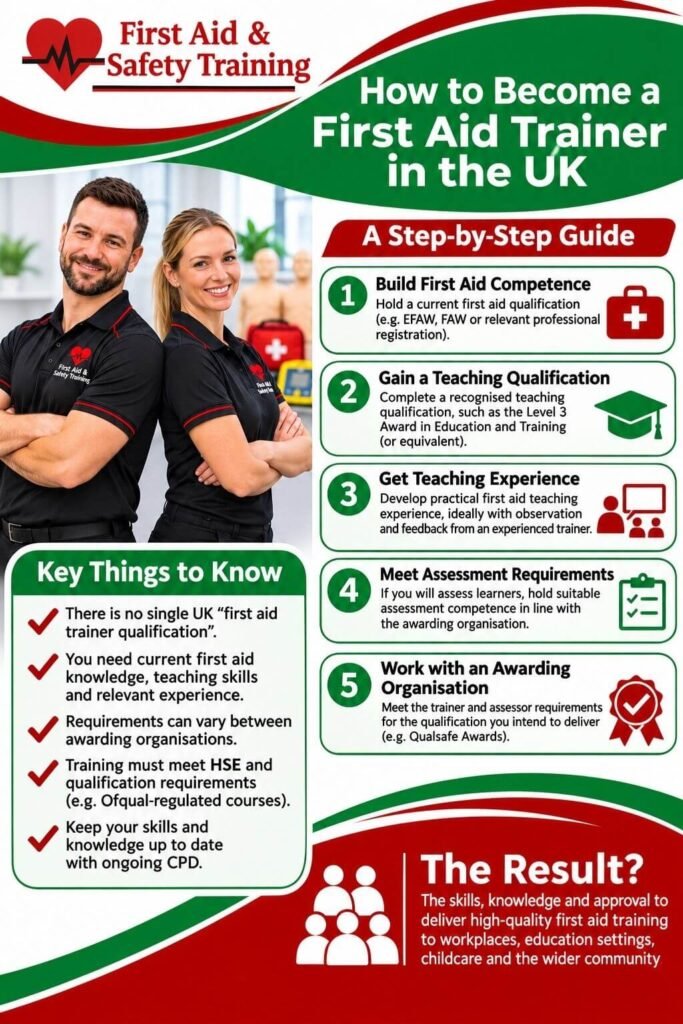
However, a typical route might look like this:
- Develop strong practical first aid competence.
- Hold an appropriate current first aid qualification or relevant professional registration.
- Gain an acceptable teaching or training qualification.
- Develop practical first aid teaching experience.
- Meet the relevant assessor requirements if you will assess learners.
- Decide which qualifications or courses you want to deliver.
- Check the specific trainer and assessor requirements for those qualifications.
- Work through an appropriate approved centre if delivering regulated qualifications.
- Maintain your first aid and teaching competence through ongoing CPD.
If you eventually establish your own training company, you’ll then need to develop the business and quality assurance systems that sit around your actual course delivery.
Is Becoming a First Aid Trainer Worth It?
For the right person, it can be an extremely rewarding role.
You get to teach practical skills that people may genuinely use to help someone during an emergency.
It can also offer considerable variety.
One day you might train employees in a workplace. Another could involve teachers, construction workers, office staff, sports coaches or people attending an open course.
However, good first aid training carries responsibility.
Learners may later rely on what you taught them during a real emergency.
That is why becoming a first aid trainer should be about developing genuine competence rather than simply collecting enough certificates to meet a minimum requirement.
Start by Deciding What You Want to Teach
Before spending money on trainer qualifications, decide what type of first aid training you actually want to deliver.
Ask yourself:
- Do I want to teach workplace first aid?
- Do I want to deliver regulated qualifications?
- Do I also want to teach paediatric first aid?
- Will I work for an existing provider?
- Do I eventually want my own training business?
- What qualifications and experience do I already have?
You can then check the current trainer and assessor requirements for the qualifications you intend to deliver and identify any gaps.
If your particular interest is working with nurseries, schools and childcare professionals, continue with our guide to becoming a paediatric first aid trainer.
For information about workplace first aid qualifications themselves, explore our First Aid at Work training and Emergency First Aid at Work courses.
You can also read the Health and Safety Executive’s first aid at work guidance for further information about workplace first aid responsibilities.