Skip to content
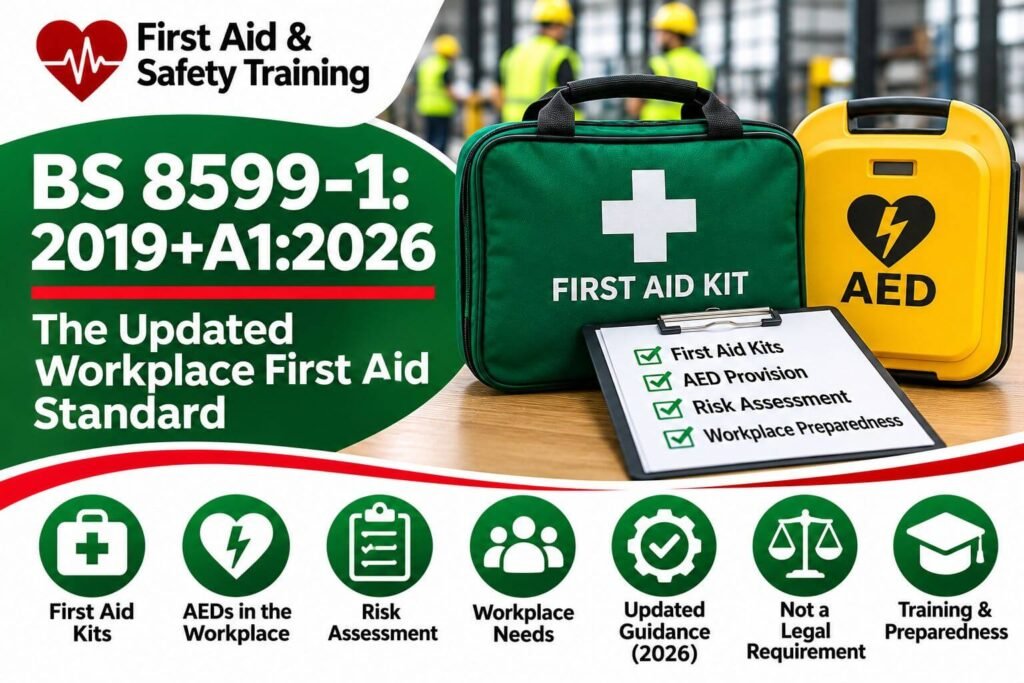
BS 8599-1:2019+A1:2026 is the updated British Standard covering workplace first aid kits and the provision of Automated External Defibrillators, or AEDs, in the workplace.
Published in 2026, the amendment develops the previous 2019 standard and puts greater emphasis on employers considering their actual workplace risks when deciding what first aid provision they need.
One of the most significant developments is the inclusion of workplace AED provision within the standard.
However, employers need to understand an important distinction from the outset:
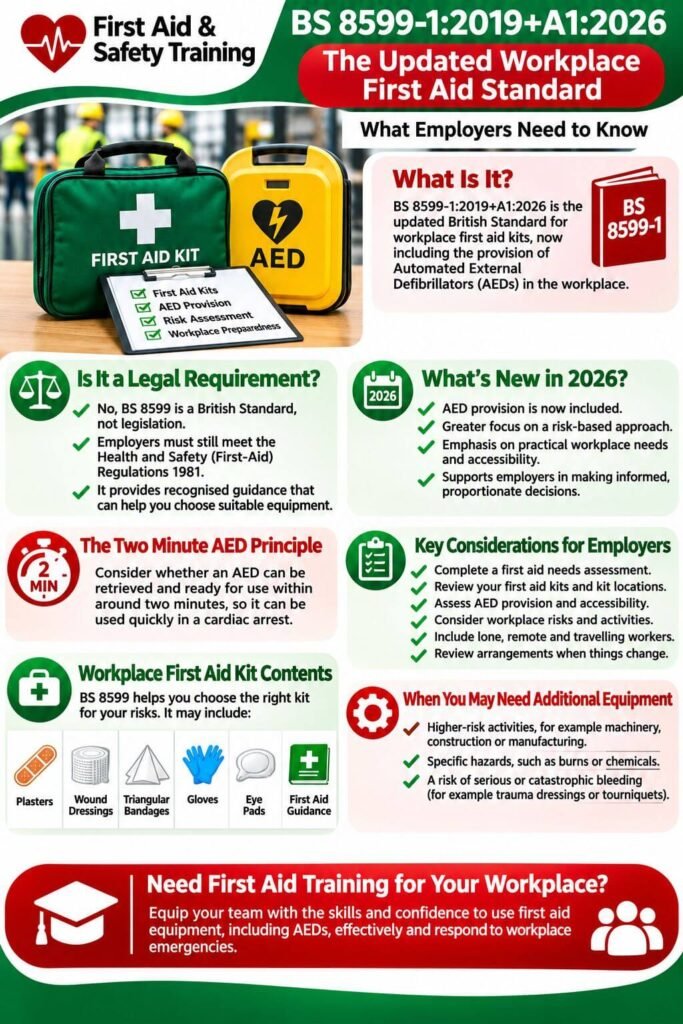
BS 8599-1 is a British Standard. It is not the same as UK first aid law.
Employers still need to base their first aid arrangements on a suitable first aid needs assessment and the requirements of the Health and Safety (First-Aid) Regulations 1981.
This guide explains what BS 8599-1:2019+A1:2026 is, what the 2026 amendment means and what employers should consider when reviewing their workplace first aid arrangements.
What Is BS 8599-1:2019+A1:2026?
BS 8599-1 is the British Standard relating to workplace first aid kits.
The current standard is:
BS 8599-1:2019+A1:2026, Workplace first aid kits, Part 1: Contents of first aid kits and provision of Automated External Defibrillators (AEDs) in the workplace, Specification.
Previous versions of the standard concentrated primarily on the contents and selection of workplace first aid kits.
The 2026 amendment expands the scope to include workplace AED provision.
The standard can help organisations make informed decisions about first aid equipment, but those decisions should still form part of a wider first aid needs assessment.
Is BS 8599-1:2019+A1:2026 a Legal Requirement?
No.
Following BS 8599-1:2019+A1:2026 is not itself a legal requirement.
The legal duties on employers primarily come from the Health and Safety (First-Aid) Regulations 1981.
These require employers to provide adequate and appropriate equipment, facilities and personnel so employees can receive immediate attention if they are injured or become ill at work.
The Health and Safety Executive makes clear that there is no mandatory list of items that every workplace first aid kit must contain.
Instead, employers should decide what they need through their first aid needs assessment.
HSE does, however, specifically identify BS 8599 as a source employers may wish to refer to when determining the contents of workplace first aid kits.
You can read our separate guide to workplace first aid kit requirements for a more detailed explanation of first aid kit contents.
We also explain the wider employer responsibilities in our guide to the legal requirement for first aid at work.
What Changed With BS 8599-1:2019+A1:2026?
The most obvious change is visible in the title of the standard itself.
The current standard covers:
“Contents of first aid kits and provision of Automated External Defibrillators (AEDs) in the workplace.”
This brings workplace defibrillator provision directly into the scope of BS 8599-1.
The amendment also reinforces an approach to workplace first aid provision that looks at actual risk rather than treating first aid as simply buying a particular box for a particular number of employees.
Employers should consider questions such as:
- What injuries and medical emergencies could realistically happen here?
- How quickly can first aid equipment be reached?
- Do we have employees working remotely or alone?
- Are employees spread across different floors or buildings?
- Do people travel as part of their work?
- Are there higher-risk activities or machinery?
- Could catastrophic bleeding occur?
- How quickly could an AED be brought to someone in cardiac arrest?
- Do we have the right number of trained people available when employees are working?
This approach is also consistent with HSE’s existing guidance on assessing first aid needs.
What Does the 2026 Standard Say About Workplace AEDs?
The inclusion of AEDs is probably the most significant development within BS 8599-1:2019+A1:2026.
An AED is used when somebody is in cardiac arrest.
Cardiac arrest is extremely time critical. CPR should be started promptly and an AED used as soon as one becomes available.
The updated standard introduces a much stronger expectation that organisations consider how quickly an AED can actually reach the casualty, rather than simply whether an AED exists somewhere on the site.
This is an important practical distinction.
A defibrillator mounted at reception may appear to provide AED coverage, but that does not necessarily mean it can be retrieved quickly from a distant workshop, warehouse, upper floor or separate building.
What Is the Two Minute AED Principle?
One of the most widely discussed elements of the 2026 amendment is the expectation around AED retrieval time.
The principle is that organisations should consider whether an AED can be retrieved and ready for use within approximately two minutes.
In practical terms, this means considering the time needed for someone to reach the AED, return to the casualty and prepare the device for use.
For a small workplace, one appropriately positioned AED may provide suitable coverage.
For a large site, several buildings, a multi-storey workplace or a large warehouse, the assessment may identify that more than one AED is needed to achieve rapid access.
This moves the discussion away from:
“Do we own a defibrillator?”
towards the much more useful question:
“How quickly can we get a defibrillator to somebody who needs it?”
Does the New Standard Make Workplace AEDs a Legal Requirement?
No.
The publication of BS 8599-1:2019+A1:2026 does not mean that every UK employer is now legally required to purchase an AED.
BS 8599 is a standard rather than legislation.
Employers should nevertheless consider AED provision seriously as part of their first aid needs assessment and emergency planning.
Factors that may influence the assessment include:
- number of people normally present
- size of the premises
- number of buildings
- distance between work areas
- workforce characteristics
- workplace activities
- existing nearby AED provision
- accessibility of any existing AED
- operating hours
- members of the public on the premises
- distance and likely response time of emergency medical services
The important point is to make a considered decision rather than assuming either that every workplace must have an AED or that AED provision can simply be ignored because there is no universal statutory requirement.
Does BS 8599-1:2019+A1:2026 Change Workplace First Aid Kit Contents?
The 2026 amendment does not mean businesses automatically need to throw away existing workplace first aid kits.
The principle remains that the equipment provided should be appropriate for the workplace and the risks identified through the first aid needs assessment.
Employers should review:
- whether existing kits remain suitable
- whether the contents are complete
- expiry dates
- where kits are positioned
- whether additional kits are required
- whether specialist equipment is needed
- whether remote or travelling workers need separate provision
If your existing first aid equipment remains appropriate, stocked and in date, the publication of the amended standard does not automatically make it obsolete.
Risk Assessment Matters More Than Simply Buying a Bigger Kit
One of the most useful principles behind modern workplace first aid provision is moving away from treating employee numbers as the only deciding factor.
Consider two businesses employing 20 people.
One is a small administrative office.
The other operates a workshop involving machinery, cutting equipment and significant manual work.
They have the same number of employees, but their potential first aid requirements could be very different.
A suitable assessment therefore considers the actual hazards and working arrangements.
This could result in additional first aid equipment, specialist training, different kit locations or additional emergency arrangements.
What About Critical Injury and Bleeding Control Equipment?
Some workplaces have a foreseeable risk of serious or catastrophic bleeding.
Examples could include certain:
- manufacturing environments
- engineering workplaces
- construction activities
- agricultural operations
- forestry work
- workplaces using cutting machinery or tools
- remote work environments
Where a first aid needs assessment identifies a significant risk, employers may consider additional equipment beyond the contents of a conventional first aid kit.
This could include:
- trauma dressings
- haemostatic dressings
- equipment suitable for wound packing
- tourniquets
The important principle is that specialist equipment should be linked to the identified risk.
Simply purchasing a tourniquet or bleed kit does not mean employees automatically know when or how to use it.
Appropriate practical training should accompany specialist emergency equipment.
Lone Workers and Remote Workers
Employers should not limit their first aid assessment to employees sitting inside the main workplace.
HSE already recommends considering employees who:
- travel frequently
- work remotely
- work alone
- work shifts or outside normal hours
- work at sites occupied by other employers
Depending on the circumstances, employees may need personal first aid equipment or other emergency arrangements.
The same principle applies when considering BS 8599-1:2019+A1:2026.
A well-equipped first aid room at head office provides little practical benefit to somebody working alone several miles away.
What About Employees Working From Home?
Home and hybrid working should also be considered within an organisation’s wider health and safety arrangements.
This does not mean every employee working from home automatically needs a large workplace first aid kit delivered to their house.
Instead, employers should consider the nature of the work and the risks involved.
Someone carrying out computer-based administrative work at home presents a very different risk profile from an employee performing practical or higher-risk work away from the employer’s main premises.
Again, the correct response comes from assessing the actual circumstances rather than applying one rule to everybody.
What About Company Vehicles?
Employees who drive or travel as part of their work should also be considered.
BS 8599 has a separate standard covering motor vehicle first aid kits, BS 8599-2.
Employers should consider:
- the type of vehicle
- number of occupants
- how the vehicle is used
- where employees travel
- how remote their work may be
- the activities performed after leaving the vehicle
A company car used for occasional travel between offices has a different risk profile from a van supporting employees working on remote sites.
Does Every Workplace Need a Written First Aid Needs Assessment?
Employers should be able to demonstrate that they have properly considered their first aid requirements.
A documented assessment is particularly valuable because it records:
- the hazards considered
- the people potentially affected
- the equipment selected
- first aider requirements
- AED considerations
- equipment locations
- arrangements for lone and remote workers
- specialist provision
- reasons behind the decisions made
It also makes future reviews considerably easier.
Rather than starting again, the organisation can determine what has changed since the previous assessment.
When Should First Aid Arrangements Be Reviewed?
First aid provision should not be treated as a one-off exercise.
Review your arrangements when significant changes occur, such as:
- moving premises
- expanding the workforce
- changing working activities
- introducing new machinery
- introducing new chemicals or processes
- opening additional buildings
- changing shift patterns
- increasing remote or lone working
- experiencing an accident that exposes a weakness in existing provision
Regular reviews also help identify expired supplies, missing equipment and changes in current guidance.
The publication of BS 8599-1:2019+A1:2026 is itself a sensible reason for businesses to review their current first aid arrangements.
What Should Employers Do Following the 2026 Update?
There is no need to panic or immediately replace all of your first aid equipment.
A sensible approach is to review what you already have.
1. Review your first aid needs assessment
Check whether it still reflects your current workplace, workforce and activities.
2. Check your first aid kits
Make sure the contents remain appropriate, complete and in date.
Our guide to workplace first aid kit requirements explains this in more detail.
3. Review AED access
If you already have an AED, look beyond simply confirming that it exists.
Consider how quickly it could reach someone anywhere on your premises.
If you do not have an AED, consider whether provision would be appropriate within your workplace.
4. Consider specialist risks
Look at burns, chemicals, serious bleeding, remote work and other hazards specific to your organisation.
5. Review first aider coverage
Make sure trained personnel are available whenever employees are working, including shifts, holidays and foreseeable absences.
6. Consider remote and travelling employees
Do not overlook employees who spend substantial periods away from your main workplace.
7. Record your decisions
Document what you considered and why you decided your current provision is appropriate.
Buying First Aid Equipment After Your Assessment
Once you know what your workplace actually requires, you can select appropriate equipment.
Jax First Aid supplies workplace first aid kits, along with AEDs, bleed-control equipment and other workplace first aid supplies.
The important point is to complete your assessment before simply buying equipment.
A larger kit does not automatically make a workplace safer, and purchasing an AED does not help if nobody can reach it quickly during a cardiac arrest.
Affiliate disclosure: If you purchase through the Jax First Aid link above, First Aid and Safety Training may receive a commission at no additional cost to you. We only include affiliate links where the supplier or product range is genuinely relevant to the information being discussed.
Does the 2026 Standard Change First Aid Training Requirements?
The publication of BS 8599-1:2019+A1:2026 does not replace the need for employers to determine suitable first aid personnel and training through their first aid needs assessment.
Depending on the workplace, this may identify a need for:
- an appointed person
- Emergency First Aid at Work trained first aiders
- First Aid at Work trained first aiders
- additional specialist training appropriate to particular hazards
The equipment and the training should complement each other.
Providing specialist emergency equipment without considering whether employees have the knowledge and confidence to use it can leave a significant gap in workplace preparedness.
First Aid Training for Your Workplace
First Aid and Safety Training delivers practical workplace first aid training across the North East.
Our Emergency First Aid at Work course develops practical emergency skills including casualty assessment, CPR, AED use, choking and bleeding.
Organisations requiring more comprehensive first aid provision can consider our First Aid at Work course.
We can also provide onsite first aid training across the North East for organisations that want to train employees together at their own premises.
Our workplace qualifications are awarded by Qualsafe Awards, an Ofqual-recognised awarding organisation.
If you are reviewing your workplace first aid arrangements following the publication of BS 8599-1:2019+A1:2026, contact First Aid and Safety Training to discuss suitable training for your team.
You can also view our South Shields training location and customer reviews on Google.
BS 8599-1:2019+A1:2026: The Key Points
The new workplace first aid standard should encourage employers to think more carefully about how their first aid provision would work during a genuine emergency.
Remember:
- BS 8599-1:2019+A1:2026 is a British Standard, not legislation.
- Employers still need adequate and appropriate first aid arrangements under UK law.
- First aid provision should follow a suitable first aid needs assessment.
- AED provision is now explicitly included within the scope of BS 8599-1.
- AED accessibility matters, not simply ownership.
- Different workplaces can require very different first aid provision.
- Lone, remote and travelling workers should not be overlooked.
- Specialist risks may justify additional first aid equipment and training.
- Existing first aid equipment does not automatically need replacing simply because the standard has been amended.
- First aid arrangements should be reviewed as the workplace changes.
The best approach is not to ask, “What do we have to buy?”
Instead ask:
“If somebody is seriously injured or becomes seriously ill here tomorrow, do we have the people, equipment and arrangements needed to respond effectively?”
That is a much better test of whether your workplace is genuinely prepared.