Skip to content

Knowing child and baby CPR could help you save a young person’s life.
Cardiac arrest in babies and children is uncommon, but when it happens, immediate action is vital. Unlike adults, cardiac arrest in children is often associated with a breathing or respiratory problem. This is why rescue breaths play such an important role in paediatric CPR.
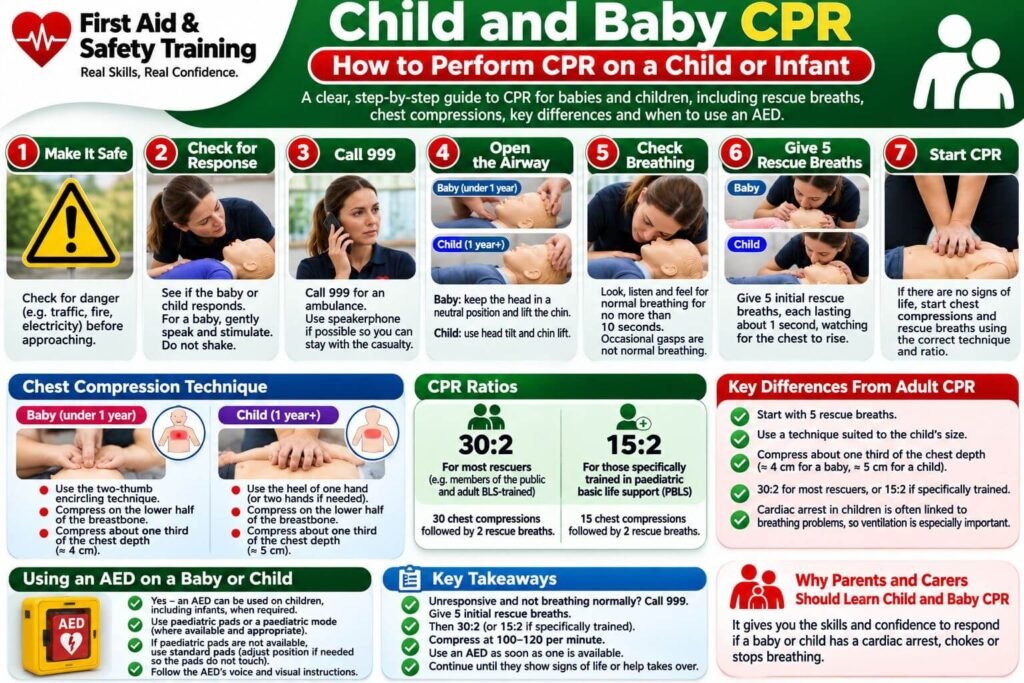
If a baby or child is unresponsive, call 999. Open their airway and assess their breathing. If they are not breathing normally, give five initial rescue breaths and start CPR.
For most members of the public and people trained in adult basic life support, CPR can then continue with 30 chest compressions followed by two rescue breaths.
People specifically trained in paediatric basic life support may use 15 compressions to two breaths.
This guide explains the current UK approach to CPR for babies and children, including the important differences between infant, child and adult CPR.
What Is Child and Baby CPR?
CPR stands for cardiopulmonary resuscitation.
It combines chest compressions and rescue breaths to help circulate oxygenated blood when someone’s heart has stopped effectively pumping blood around their body.
For babies and children, CPR is modified to account for their smaller bodies and the fact that paediatric cardiac arrest is often linked to respiratory problems.
The main principles remain:
- recognise that something is seriously wrong
- call for emergency help
- open the airway
- assess breathing
- provide rescue breaths
- start effective chest compressions
- use an AED when available
- continue until professional help takes over or the child shows clear signs of life
Current Resuscitation Council UK paediatric basic life support guidance provides the UK framework for responding to paediatric cardiac arrest.
What Is the Difference Between a Baby, Child and Adolescent?
For practical first aid, it is useful to understand the age groups.
An infant or baby is under one year old.
A child is generally someone from one year old until adolescence.
For adolescents who have developed adult characteristics, the adult CPR sequence can be used.
If you are uncertain, do not allow uncertainty about someone’s exact age to stop you providing CPR.
The important thing is to recognise cardiac arrest and act.
When Does a Baby or Child Need CPR?
CPR is required when a baby or child is:
unresponsive and not breathing normally.
Occasional gasps or irregular abnormal breathing should not be mistaken for normal breathing.
If you are unsure whether their breathing is normal, treat it as abnormal and follow the instructions from the ambulance service.
Step 1: Make Sure It Is Safe
Before approaching the child, quickly check that you are not putting yourself or them in additional danger.
Potential hazards might include:
- traffic
- electricity
- fire
- water
- falling objects
- chemicals
Deal only with hazards that you can safely manage.
You cannot help the child effectively if you become another casualty.
Step 2: Check for a Response
Check whether the baby or child responds to you.
For a child, speak loudly and gently stimulate them.
For a baby, speak to them and gently tap or stimulate them.
Do not shake a baby.
If there is no response, shout for help.
Step 3: Call 999
If the baby or child is unresponsive, call 999 for an ambulance.
If someone else is available, ask them to make the call while you continue assessing the child.
If you have a mobile phone and you are alone, use the speaker function so that you can remain with the casualty while speaking to the ambulance call handler.
Tell the call handler that you have an unresponsive baby or child.
Follow their instructions.
Current Resuscitation Council UK guidance emphasises calling the ambulance service when a child is found unresponsive so the call handler can support you through the assessment and CPR response.
Step 4: Open the Airway
Place the baby or child on their back.
Opening a Baby’s Airway
For a baby, keep the head in a neutral position.
Gently lift the chin.
Avoid excessive head tilt because a baby’s airway is different from an adult’s and overextension can make airway management more difficult.
Opening a Child’s Airway
For an older child, use a head tilt and chin lift to open the airway.
Older children generally require more head tilt than infants.
Step 5: Check for Normal Breathing
With the airway open, check whether the baby or child is breathing normally.
Look for movement of the chest.
Listen for breathing.
Feel for air movement.
Do this for no more than 10 seconds.
Do not mistake occasional gasps for normal breathing.
If they are breathing normally but remain unresponsive, maintain their airway, place them in an appropriate recovery position where suitable and continue monitoring them while waiting for help.
If they are not breathing normally, start the paediatric CPR sequence.
Step 6: Give Five Initial Rescue Breaths
A major difference between adult CPR and child and baby CPR is the use of five initial rescue breaths.
Rescue Breaths for a Baby
Maintain the baby’s head in a neutral position and lift the chin.
Create a seal over the baby’s mouth and nose with your mouth where possible.
Give a gentle breath lasting approximately one second, watching for the chest to rise.
Allow the chest to fall.
Repeat until you have given five initial rescue breaths.
Use only enough air to make the chest visibly rise.
Rescue Breaths for a Child
Open the airway using head tilt and chin lift.
Pinch the soft part of the child’s nose closed.
Create a seal around their mouth with yours.
Give a breath lasting approximately one second, watching for the chest to rise.
Allow the chest to fall before giving the next breath.
Give five initial rescue breaths.
What If the Chest Does Not Rise?
If the chest does not rise during rescue breaths:
- check the airway position
- reposition the head and chin
- look inside the mouth
- remove an obstruction only if it is clearly visible and easily accessible
Do not perform blind finger sweeps.
Do not spend excessive time repeatedly attempting rescue breaths.
If effective breaths cannot be achieved, begin chest compressions and add rescue breaths as soon as possible.
Step 7: Start Chest Compressions
After the five initial rescue breaths, if there are no signs of life, start chest compressions.
Compressions should be delivered at approximately:
100 to 120 compressions per minute.
Allow the chest to fully recoil between compressions.
Minimise interruptions.
The technique differs between babies and children.
How to Perform CPR on a Baby
Current Resuscitation Council UK guidance recommends the two-thumb encircling technique for infant chest compressions.
This is an important change from older first aid teaching where two-finger compressions were commonly taught to a single rescuer.
Baby Chest Compression Technique
Place both thumbs on the lower half of the baby’s breastbone while your hands and fingers encircle the baby’s chest.
Compress the chest by approximately one third of its depth.
This is approximately 4 cm in an infant.
Allow the chest to recoil fully after each compression.
Continue at 100 to 120 compressions per minute.
For a rescuer using the 30:2 sequence:
30 compressions
followed by
2 rescue breaths.
Then immediately return to chest compressions.
How to Perform CPR on a Child
Place the heel of one hand on the lower half of the child’s breastbone.
Depending on the size of the child and rescuer, one or two hands may be required to achieve effective compressions.
Compress the chest by at least one third of its depth, approximately 5 cm for a child.
Release the pressure completely after each compression.
Continue at:
100 to 120 compressions per minute.
For the standard public first aid sequence:
30 compressions
followed by
2 rescue breaths.
Continue without unnecessary interruptions.
Is Child and Baby CPR 30:2 or 15:2?
You may have seen both ratios used in paediatric CPR.
Both can be correct depending on the rescuer’s training.
30 Compressions to 2 Breaths
Use 30:2 if you are:
- a member of the public following dispatcher instructions
- trained primarily in adult basic life support
- following a first aid sequence based around the adult 30:2 ratio with paediatric modifications
15 Compressions to 2 Breaths
People specifically trained in paediatric basic life support may use:
15 compressions to 2 rescue breaths.
Current Resuscitation Council UK guidance recognises both approaches.
The important thing is not to become so concerned about remembering a ratio that you delay CPR.
If you are unsure, call 999, put the phone on speaker and follow the ambulance call handler’s instructions.
Why Are Rescue Breaths Particularly Important for Children?
Many adult cardiac arrests happen because of a problem originating in the heart.
In babies and children, cardiac arrest is more commonly associated with respiratory failure or another problem that causes oxygen levels to fall.
That makes effective ventilation especially important during paediatric resuscitation.
This is why the paediatric sequence includes five initial rescue breaths before moving into cycles of compressions and breaths.
If you are unable or unwilling to provide rescue breaths, chest compressions are still better than doing nothing.
Start compressions and follow the ambulance service’s instructions.
What If You Are Alone?
If you are alone with an unresponsive baby or child and have a phone available, call 999 using the speaker function so that you can remain with them.
Start the appropriate CPR sequence while following the ambulance call handler’s instructions.
If you have no phone immediately available, current paediatric guidance allows for approximately one minute of CPR before leaving to summon help.
Do not leave the child unnecessarily.
If another person is available, one person should start CPR while the other calls 999 and obtains an AED if one is nearby.
Can You Use an AED on a Baby or Child?
Yes.
An automated external defibrillator (AED) can be used on children, including infants, when required.
If an AED is available, switch it on and follow its instructions.
Use paediatric pads or a paediatric mode where these are available and appropriate for the child’s age or size.
If paediatric equipment is not available, an AED should not simply be ignored during a cardiac arrest.
The exact pad position may need to change on a small child or baby so that the pads do not touch.
Our detailed guide to AED use on children and babies explains paediatric pads, pad positioning and what to do when only standard AED pads are available.
You can also read our general guide explaining how to use an AED.
Should You Stop CPR While an AED Is Being Prepared?
Keep interruptions to CPR as short as possible.
Continue CPR while the AED is being brought and prepared where possible.
Once the pads are attached, follow the AED’s instructions.
Nobody should touch the casualty while the AED is analysing the heart rhythm or when a shock is being delivered.
Immediately resume CPR when instructed by the AED.
When Should You Stop CPR?
Continue CPR until:
- the baby or child shows clear signs of life
- they begin breathing normally
- the ambulance service or another appropriately trained professional takes over
- you become physically unable to continue
- the environment becomes unsafe
If the child begins breathing normally but remains unresponsive, maintain their airway and monitor them carefully.
Is Child CPR Different From Adult CPR?
Yes, although the principles are closely related.
Some of the main differences include:
| Adult CPR | Child and Baby CPR |
|---|---|
| Adult emergency sequence | Paediatric modifications |
| Rescue breaths remain important | Five initial rescue breaths are specifically emphasised |
| Compression depth 5–6 cm | Approximately one third of chest depth |
| Adult hand position | Technique adapted to child’s size |
| Adult compression technique | Two-thumb encircling technique for infants |
| Usually 30:2 | 30:2 for many rescuers, 15:2 for those specifically trained in PBLS |
If you want to understand the adult procedure, read our guide to the seven steps of CPR.
What If the Baby or Child Was Choking?
A severe airway obstruction can cause a baby or child to become unresponsive.
If this happens, begin the appropriate paediatric resuscitation response.
For a conscious choking child over one year old, treatment involves back blows followed by abdominal thrusts if required.
For a baby under one year old, use back blows and chest thrusts, not abdominal thrusts.
If they become unresponsive, start CPR, beginning with five rescue breaths.
Do not perform blind finger sweeps inside their mouth.
Our complete choking first aid guide explains the different procedures for adults, children and babies.
What If a Baby or Child Is Unresponsive but Breathing?
CPR is not required if they are breathing normally.
Maintain their airway and continue to monitor their breathing.
Where appropriate, place them into a recovery position that keeps their airway open.
Call 999 if they remain unresponsive.
Continue checking their breathing because their condition can change.
If they stop breathing normally, begin CPR immediately.
What Causes Cardiac Arrest in Children?
There are many possible causes.
These can include:
- severe breathing problems
- choking
- drowning
- serious illness
- severe allergic reactions
- trauma
- poisoning
- heart conditions
You do not need to identify the exact cause before beginning CPR.
If a baby or child is unresponsive and not breathing normally, the immediate priority is resuscitation and emergency medical help.
Why Parents and Carers Should Learn Child and Baby CPR
Parents naturally hope they will never need to perform CPR on their own child.
Most never will.
But learning child and baby CPR gives parents and carers something extremely valuable: a plan for what to do if the worst happens.
Practical training allows you to experience:
- opening a baby’s airway
- giving effective rescue breaths
- performing infant chest compressions
- performing child chest compressions
- recognising abnormal breathing
- dealing with choking
- using an AED
- responding under pressure
These skills are difficult to fully appreciate from reading alone.
Practising them on training manikins helps turn information into something you are more likely to remember in an emergency.
Child and Baby CPR for Nursery and Childcare Staff
People who work professionally with babies and children need broader first aid knowledge than CPR alone.
Paediatric first aid training covers emergencies including:
- infant and child CPR
- AED use
- choking
- unconscious casualties
- bleeding and shock
- anaphylaxis
- fractures
- head injuries
- medical emergencies
Our guide explaining what Paediatric First Aid covers looks at the qualification in more detail.
You can also read what Paediatric First Aid is if you are deciding which type of training you need.
Child and Baby CPR: What to Remember
If a baby or child is unresponsive:
CALL 999
Open their airway and assess their breathing.
If they are not breathing normally:
GIVE 5 INITIAL RESCUE BREATHS
Then start chest compressions.
For most members of the public and adult-BLS-trained rescuers:
30 COMPRESSIONS : 2 BREATHS
If specifically trained in paediatric basic life support:
15 COMPRESSIONS : 2 BREATHS
Compress at:
100–120 compressions per minute
and approximately:
ONE THIRD OF THE CHEST DEPTH
Use an AED as soon as one is available and follow its instructions.
Most importantly:
Do something.
Calling 999 and starting CPR gives a child a chance that they would not have if nobody acts.
Learn Child and Baby CPR Practically
Reading about child and baby CPR is a useful starting point, but practical training allows you to develop the skills and confidence to respond properly.
First Aid and Safety Training delivers practical Paediatric First Aid training for people working with babies and children.
Our current blended Paediatric First Aid course combines online learning with face-to-face practical training and assessment.
During practical training, learners can develop and demonstrate skills including infant and child CPR, AED use, choking management and responding to other paediatric emergencies.
For general workplace training, we also provide:
You can explore our first aid training across the North East or contact First Aid and Safety Training to discuss the right course for you or your organisation.
Our main training centre is at One Trinity Green in South Shields. You can also view our South Shields location and customer reviews on Google Maps.
Community First Aid for Parents and Families
First aid knowledge should not be limited to people who need a workplace qualification.
Through First Aid Saves Lives CIC, we also work to make practical lifesaving skills more accessible within local communities.
Community first aid workshops can help parents, families and other members of the public develop the confidence to act when someone suddenly becomes seriously ill or injured.
Whether you learn these skills through a regulated qualification or a community workshop, the objective is the same:
Recognise the emergency, call for help and have the confidence to act.
Real Skills, Real Confidence.