Skip to content
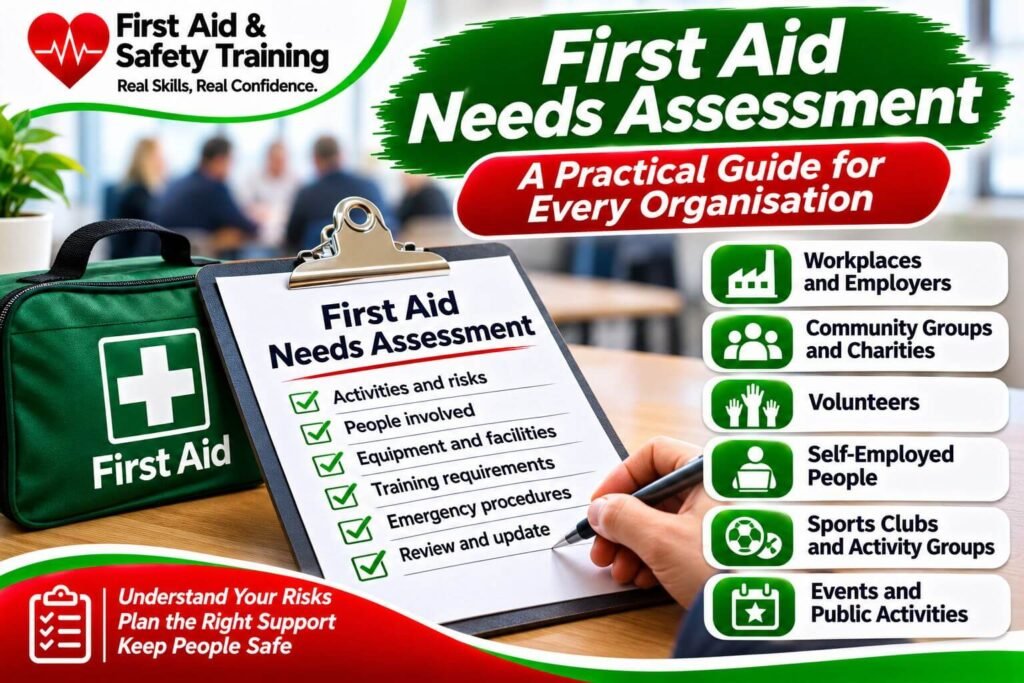
A first aid needs assessment helps an organisation decide what first aid arrangements it should have in place to protect employees, volunteers, participants and visitors.
Whether you run a business, manage a charity, organise community activities or work for yourself, understanding your first aid needs is an important part of preparing for accidents and medical emergencies.
However, the first aid requirements for a manufacturing business employing 50 people are very different from those of a volunteer-led community group meeting once a week.
A self-employed gardener working alone may face different risks from a freelance graphic designer working from home.
Similarly, a community organisation providing activities for older people may need different arrangements from a sports club or a group organising outdoor events.
A first aid needs assessment should reflect the people involved, the activities taking place and the environment in which those activities happen.
At First Aid and Safety Training, we provide practical first aid training for businesses, charities, community organisations and individuals across the North East of England.
This guide explains how to conduct a first aid needs assessment, what UK legislation requires and how to adapt your arrangements to different organisations and activities.
What Is a First Aid Needs Assessment?
A first aid needs assessment is a structured review used to determine the first aid equipment, facilities, personnel and arrangements needed for a particular workplace or activity.
It considers what could happen, who might need assistance and how quickly appropriate help could be provided.
A first aid needs assessment should help answer questions such as:
- What injuries or medical emergencies could occur?
- Who might be affected?
- How many people are likely to be present?
- Are there particular risks associated with the activities?
- Is anyone working or volunteering alone?
- How quickly could emergency services reach the location?
- What first aid equipment should be available?
- Do we need trained first aiders?
- What training would be appropriate?
- Who will take charge during an emergency?
The answers help determine the most suitable first aid arrangements.
There is no single first aid solution that is appropriate for every organisation.
Is a First Aid Needs Assessment a Legal Requirement?
The legal position depends on the organisation and the circumstances.
Employers
Under the Health and Safety (First-Aid) Regulations 1981, employers must provide adequate and appropriate first aid equipment, facilities and personnel so employees can receive immediate assistance if they are injured or become ill at work.
Employers must assess their first aid needs to determine what arrangements are necessary.
These responsibilities apply to businesses with employees, including small businesses.
The law does not automatically require every employer to have someone holding a First Aid at Work qualification.
Instead, the level of first aid provision must reflect the findings of the assessment.
For some low-risk workplaces, an appointed person and suitable first aid equipment may be sufficient.
Other workplaces may require trained first aiders, additional equipment or specialist training.
Self-Employed People
Self-employed workers have responsibilities for their own first aid provision under the First-Aid Regulations.
However, the arrangements should be proportionate to the work undertaken.
Someone working at a computer in their own home is unlikely to need additional equipment beyond normal domestic first aid supplies.
A self-employed tradesperson working with machinery, sharp tools or hazardous materials may need more substantial arrangements.
Community Groups and Volunteer Organisations
The position is different for organisations operating entirely through volunteers.
A volunteer-only community group with no employees will not normally be subject to the same workplace health and safety duties as an employer, unless particular circumstances apply, such as controlling non-domestic premises.
However, organisations and individuals may still have responsibilities under civil law, and other legislation may apply to particular activities.
Even where a formal first aid needs assessment is not legally required, carrying out a proportionate review is sensible.
It helps organisations identify foreseeable risks and make practical arrangements for the people involved.
Important: This article focuses primarily on first aid requirements in Great Britain. Some sectors, activities and settings have additional legal or regulatory requirements.
For official guidance, visit the Health and Safety Executive’s First Aid at Work information.
What Is the Difference Between a Risk Assessment and a First Aid Needs Assessment?
These assessments are closely connected, but they serve different purposes.
A general risk assessment identifies hazards and considers how accidents or harm can be prevented.
A first aid needs assessment considers what assistance may be required if someone is injured or becomes unwell despite those precautions.
For example, a community gardening project might identify sharp tools as a hazard.
Its general risk assessment may require suitable equipment, safe working procedures and protective gloves.
Its first aid needs assessment should then consider whether volunteers might suffer cuts or more serious injuries, what equipment is needed and who could provide assistance.
The two assessments should complement each other.
Risk assessment focuses on preventing harm. First aid needs assessment focuses on preparing to respond if harm occurs.
How to Conduct a First Aid Needs Assessment
The following eight-step approach can be adapted to workplaces, charities, community groups and self-employed activities.
Step 1: Identify the Activities Taking Place
Start by looking at what your organisation actually does.
Consider both routine activities and anything unusual.
Examples include:
- Office work.
- Manual handling.
- Food preparation.
- Gardening and maintenance.
- Sports and physical activities.
- Community workshops.
- Working with children.
- Supporting older or vulnerable adults.
- Outdoor activities.
- Public events.
- Driving or travelling between locations.
Different activities create different first aid considerations.
A small community group holding indoor meetings may have relatively straightforward needs.
The same group organising an outdoor fundraising event could require additional arrangements.
Step 2: Identify Who Could Need First Aid
Think about everyone who may be affected by your activities.
This could include:
- Employees.
- Volunteers.
- Self-employed workers.
- Members of the public.
- Service users.
- Children and young people.
- Older adults.
- People with disabilities.
- Visitors and contractors.
Under the First-Aid Regulations, employers’ specific first aid duties relate to employees.
However, the HSE strongly recommends considering non-employees, such as members of the public, when assessing first aid provision.
Other legislation, contractual requirements or sector-specific rules may create additional responsibilities.
For community organisations, the needs of participants may be particularly important.
For example, a group providing activities for older people may wish to consider how staff or volunteers would respond if someone became unwell, collapsed or experienced a medical emergency.
The aim is to identify foreseeable needs without making assumptions about individuals solely because of their age or disability.
Step 3: Consider the Hazards and Possible Emergencies
Look at the hazards associated with each activity.
Consider both injuries and sudden illness.
Examples might include:
- Cuts and bleeding.
- Burns and scalds.
- Slips, trips and falls.
- Head injuries.
- Fractures.
- Choking.
- Cardiac arrest.
- Allergic reactions.
- Breathing difficulties.
- Heat-related illness.
- Medical emergencies associated with physical activity.
Higher-risk work may require additional arrangements.
For example, work involving chainsaws, industrial machinery or other equipment capable of causing severe injuries may require consideration of life-threatening bleeding.
Where the assessment identifies such a risk, employers should consider whether additional equipment and training are necessary.
The HSE’s updated L74 guidance specifically addresses life-threatening bleeding and the need to consider employees’ mental health within first aid needs assessments.
Step 4: Consider the Number of People and Their Location
The number of people present can influence the level of first aid provision.
However, numbers alone do not determine what is required.
A group of six volunteers carrying out higher-risk outdoor work may need different arrangements from 30 people attending a low-risk indoor meeting.
Consider:
- How many people are normally present?
- Are activities spread across different rooms or locations?
- Are people working alone?
- Do activities take place at weekends or evenings?
- Are trained first aiders available throughout the activity?
- What happens if the usual first aider is absent?
First aid arrangements should remain appropriate whenever activities take place.
Step 5: Consider the Location and Access to Emergency Services
Location can make a significant difference.
A community meeting in a town centre may be relatively close to emergency medical assistance.
An outdoor activity in a remote location may be more difficult for emergency services to access.
Consider:
- The distance from emergency services.
- Mobile phone reception.
- Whether the location has a clear address or grid reference.
- Access for ambulances.
- Whether the activity takes place outdoors.
- Whether participants are spread across a large area.
- How casualties could be reached or assisted safely.
Remote activities may require additional equipment, communication arrangements or training.
Step 6: Decide What First Aid Equipment Is Needed
There is no universal first aid kit that suits every organisation.
The contents should reflect the risks identified.
For a low-risk environment, a suitable first aid kit may include:
- Sterile dressings.
- Assorted plasters.
- Bandages.
- Sterile eye dressings.
- Disposable gloves.
- Other appropriate first aid supplies.
Higher-risk activities may require additional equipment.
For example, an organisation working with machinery may identify a need for equipment to manage life-threatening bleeding.
A group organising outdoor activities may require portable first aid supplies.
Where an automated external defibrillator is available, people should know where it is located and how to access it.
Equipment should be maintained, accessible and checked regularly.
Step 7: Decide What Training Is Appropriate
The first aid needs assessment should help determine whether trained first aiders are required and what level of training is suitable.
Possible options include:
Emergency First Aid at Work (EFAW)
A one-day qualification covering essential emergency first aid skills.
It may be appropriate for lower-risk workplaces and organisations where the assessment identifies this level of training as suitable.
Explore Emergency First Aid at Work Training.
First Aid at Work (FAW)
A more comprehensive qualification covering a wider range of workplace injuries and medical emergencies.
It may be appropriate for workplaces with more significant risks or first aid requirements.
Explore First Aid at Work Training.
Paediatric First Aid
Training focused on emergencies involving babies and children.
It may be particularly relevant to childcare providers, children’s activities and organisations with specific paediatric first aid responsibilities.
Explore Paediatric First Aid Training.
Additional or Specialist Training
Depending on the assessment, additional training may be appropriate.
Examples include CPR and AED awareness, life-threatening bleeding, allergy and anaphylaxis awareness or training for particular outdoor environments.
A first aid needs assessment should determine the level of training required rather than automatically selecting the cheapest or shortest course.
Step 8: Record, Communicate and Review Your Arrangements
Once the assessment is complete, record the important findings and actions.
For employers, a written record provides useful evidence of how decisions were made.
For smaller volunteer groups, a simple checklist may be sufficient.
The record should identify:
- The activities assessed.
- The people who may be affected.
- Relevant hazards.
- The first aid equipment required.
- The first aid personnel or arrangements needed.
- Any training requirements.
- Emergency procedures.
- Who is responsible for implementing the arrangements.
- When the assessment will be reviewed.
The arrangements should also be communicated to the people who need to know about them.
Review the assessment when activities, staffing, locations or risks change, and following relevant incidents.
First Aid Needs Assessments for Community Groups
Community organisations often operate differently from traditional businesses.
Some have paid employees, while others are run entirely by volunteers.
Activities may take place in hired halls, libraries, community centres, schools or outdoor locations.
Participants may also change from one session to another.
This means the assessment should focus on the actual activities and people involved.
Example: A Weekly Community Coffee Morning
Imagine a volunteer-led community group holding a weekly coffee morning for 20 people.
Activities involve preparing hot drinks, serving refreshments and providing an opportunity for social interaction.
Potential considerations include:
- Burns from hot drinks.
- Slips and trips.
- Choking.
- Sudden illness.
- Access to emergency assistance.
- Whether participants may require additional support.
A proportionate assessment might identify the need for a suitable first aid kit, a named person to coordinate an emergency and clear procedures for contacting emergency services.
The group may also decide that having a volunteer trained in basic first aid or EFAW would be beneficial.
This does not automatically mean that every volunteer must hold a qualification.
Example: A Community Gardening Project
A community gardening project may involve tools, uneven ground, lifting, outdoor weather conditions and working at different locations.
The assessment could identify the need for:
- Portable first aid equipment.
- Training appropriate to the tools and activities.
- Arrangements for managing bleeding.
- Reliable emergency communication.
- Procedures for working alone.
- Clear access information for emergency services.
The assessment should reflect the specific tools and activities involved.
First Aid Requirements for Charities and Community Interest Companies
Charities and Community Interest Companies (CICs) may employ staff, engage volunteers, provide services to the public or combine all three.
Their legal responsibilities depend on how they operate.
Charities and CICs with Employees
Where an organisation employs staff, it must meet the relevant employer duties.
This includes assessing first aid needs and providing adequate and appropriate arrangements for employees.
The assessment should also consider volunteers and service users where relevant.
Volunteer-Only Charities and Community Groups
Where an organisation has no employees, the Health and Safety at Work etc Act will not normally apply in the same way, subject to the circumstances and any other relevant duties.
However, it is still sensible to consider:
- What activities are being delivered?
- Who attends?
- What foreseeable emergencies could occur?
- Who would take charge?
- What equipment is available?
- How would emergency services be contacted?
Funders, venues, insurers or commissioning organisations may also have requirements relating to first aid provision.
These should be checked before activities begin.
Community Workshops and Group Activities
Organisations delivering workshops should consider the nature of each session.
A classroom-based awareness workshop may have relatively low physical risks.
An outdoor practical activity, sports session or activity involving tools may require additional arrangements.
Where practical first aid training is being delivered, the provider should also assess the safety of training activities, equipment and the learning environment.
First Aid Needs Assessments for Volunteers
Volunteers make an important contribution to charities, community organisations and public events.
However, volunteering does not automatically mean that someone is required by law to hold a first aid qualification.
The appropriate arrangements depend on the organisation and activities involved.
Do Volunteers Need First Aid Training?
There is no general rule requiring every volunteer to complete a first aid course.
However, some activities may benefit from having trained volunteers available.
For example:
- Supporting community events.
- Leading outdoor activities.
- Supervising sports sessions.
- Working with children.
- Supporting older adults.
- Delivering activities in remote locations.
Some activities may also be subject to specific regulations or governing-body requirements.
A needs assessment helps identify whether training is appropriate and what level is required.
What Should Volunteer Organisations Consider?
Useful questions include:
- Are volunteers working alone?
- Do they supervise other people?
- Are they responsible for children or vulnerable participants?
- Do they use equipment that could cause injury?
- Are they working outdoors?
- Can emergency services access the location easily?
- Is first aid equipment available?
- Who would coordinate an emergency?
Where volunteers work alongside employees, the organisation should ensure that relevant health and safety responsibilities are understood.
First Aid Needs Assessments for Self-Employed People
Self-employed people should assess the risks associated with their work and make appropriate first aid arrangements.
The level of provision will vary considerably.
Example: A Self-Employed Office Worker
Someone working from home on a computer may not need additional first aid equipment beyond normal domestic supplies.
The risks associated with their work are likely to be relatively low.
Example: A Self-Employed Gardener
A gardener may use sharp tools, powered equipment and machinery.
They may also work alone at different locations.
Their assessment should consider:
- Cuts and serious bleeding.
- Eye injuries.
- Falls.
- Working alone.
- Access to emergency services.
- Suitable portable first aid equipment.
- Any additional training appropriate to the work.
Example: A Mobile Hairdresser or Beauty Professional
A mobile professional may work in clients’ homes or temporary premises.
Potential considerations could include minor cuts, burns, chemical exposure or allergic reactions, depending on the services provided.
A portable first aid kit and clear emergency procedures may be appropriate.
Example: A Freelance Personal Trainer
A personal trainer may work with clients during physical activity.
Their assessment could consider:
- Injuries associated with exercise.
- Sudden illness.
- Cardiac arrest.
- Access to an AED.
- Emergency communication.
- Whether clients are supervised individually or in groups.
Training in CPR and AED use may be particularly valuable.
Where a trainer works within a gym or shared facility, they should understand the venue’s emergency arrangements.
First Aid Needs Assessments for Sports Clubs and Activity Groups
Sports clubs and physical activity groups may face additional risks because of the activities involved.
Potential incidents include:
- Sprains and strains.
- Fractures.
- Head injuries.
- Bleeding.
- Heat-related illness.
- Asthma attacks.
- Cardiac arrest.
The assessment should consider the sport, participant ages, location and supervision arrangements.
It should also take account of any first aid requirements established by the relevant sport’s governing body.
Example: A Community Football Club
A football club might consider:
- The number of players and coaches.
- Whether children or adults participate.
- The availability of first aid equipment.
- Access to an AED.
- Head injury and concussion procedures.
- Emergency vehicle access.
- Training requirements for coaches and volunteers.
A club operating across several pitches may need more than one first aid point.
The arrangements should reflect how activities are actually delivered.
First Aid Needs Assessments for Community Events
Events can create additional first aid challenges because attendance, activities and locations may differ from normal operations.
Examples include:
- Community fairs.
- Fundraising events.
- Charity walks.
- Outdoor markets.
- Festivals.
- Public workshops.
- Sports events.
An event assessment should consider:
- Expected attendance.
- Event duration.
- Age and needs of attendees.
- Activities taking place.
- Site layout.
- Weather conditions.
- Access for emergency services.
- Availability of first aid personnel.
- Equipment and communication arrangements.
Larger or higher-risk events may require a separate medical needs assessment and professional event medical provision.
The organiser should consider relevant event safety guidance, venue requirements, licensing conditions and insurer expectations.
A standard EFAW qualification should not automatically be assumed to provide adequate medical cover for every event.
What About First Aid in Shared or Hired Premises?
Many charities, small businesses and community organisations use premises owned or managed by someone else.
Examples include:
- Community centres.
- Village halls.
- Schools.
- Churches.
- Leisure centres.
- Shared offices.
- Co-working spaces.
Before an activity begins, it is sensible to establish:
- What first aid equipment is available?
- Who is responsible for maintaining it?
- Is an AED available?
- Are trained first aiders present?
- What happens outside normal opening hours?
- Who contacts emergency services?
- How can an ambulance access the premises?
- Does the venue have specific emergency procedures?
Organisations should not assume that hiring a room automatically means suitable first aid provision is included.
Where several organisations share premises, responsibilities should be agreed and communicated.
Should Mental Health Be Included in a First Aid Needs Assessment?
Yes, employers should consider employees’ mental health alongside physical health when assessing first aid needs.
The HSE’s updated guidance makes this clear.
This does not mean that every workplace is legally required to appoint a Mental Health First Aider.
Instead, employers should consider the nature of their work, workforce and existing support arrangements.
For example, organisations supporting people in distress may need clear procedures for responding to a mental health crisis.
Community groups and charities may also benefit from considering how volunteers and staff recognise concerns, obtain appropriate help and signpost individuals to suitable services.
Mental health arrangements should be proportionate to the activities and responsibilities involved.
How Many First Aiders Do You Need?
There is no single number of first aiders that applies to every workplace or organisation.
The appropriate provision depends on the first aid needs assessment.
The HSE provides indicative guidance for employers based on workplace hazards and employee numbers.
However, these figures should not be treated as a universal rule.
A small organisation carrying out higher-risk activities may require more first aid provision than a larger organisation undertaking low-risk office work.
When deciding how many first aiders are needed, consider:
- Workplace hazards.
- The number of people present.
- Working hours and shift patterns.
- Staff and volunteer absences.
- Different buildings or locations.
- Lone working.
- The availability of emergency assistance.
- Whether specialist first aid skills are required.
The objective is to ensure appropriate assistance is available when and where it is needed.

First Aid Needs Assessment Examples
The following examples illustrate how arrangements may differ.
These are not fixed legal requirements or substitutes for an individual assessment.
| Organisation or activity | Possible first aid considerations |
|---|---|
| Small office | First aid kit, appointed person, emergency information |
| Volunteer coffee morning | First aid kit, emergency contact arrangements, volunteer awareness |
| Community gardening group | Portable kit, tool-related injuries, bleeding, outdoor access |
| Self-employed tradesperson | Personal kit, lone working, injuries associated with tools and equipment |
| Charity shop | First aid equipment, staff and volunteer arrangements, public access |
| Sports club | Sports injuries, head injury procedures, CPR/AED access, governing-body requirements |
| Community event | Attendance, site layout, event risks, emergency access, appropriate medical cover |
| Children’s activity group | Age-appropriate first aid, safeguarding arrangements, applicable sector requirements |
Each organisation should determine what is appropriate for its own circumstances.
First Aid Needs Assessment Checklist
Use this checklist as a starting point when reviewing your arrangements.
Organisation and Activities
- We have identified the activities taking place.
- We have considered the hazards associated with those activities.
- We have identified employees, volunteers, participants and visitors who may be affected.
- We have considered any additional legal or sector-specific requirements.
First Aid Risks
- We have considered foreseeable injuries and medical emergencies.
- We have considered higher-risk activities and life-threatening bleeding where relevant.
- We have considered lone working and remote locations.
- We have considered access to emergency services.
- We have considered mental health needs where relevant.
Equipment and Facilities
- Suitable first aid equipment is available.
- Equipment is accessible when activities take place.
- First aid supplies are checked and maintained.
- We know whether an AED is available.
- Additional equipment has been considered where appropriate.
First Aid Personnel and Training
- We have identified who will coordinate first aid arrangements.
- We have assessed whether trained first aiders are needed.
- Training is appropriate to the activities and risks.
- Arrangements cover relevant working hours and absences.
- Any specialist training requirements have been considered.
Emergency Procedures
- People know how to contact emergency services.
- Emergency access arrangements are understood.
- First aid equipment locations are communicated.
- Responsibilities are clear in shared or hired premises.
- Relevant incidents can be recorded and reviewed.
Review
- The assessment has been recorded appropriately.
- Actions have been assigned to responsible people.
- Arrangements are reviewed when circumstances change.
- Lessons from accidents and near misses are considered.
How Often Should a First Aid Needs Assessment Be Reviewed?
There is no universal annual review requirement specifically applying to every first aid needs assessment.
However, employers should keep their arrangements under review to ensure they remain adequate and appropriate.
A review may be needed when:
- Employee or volunteer numbers change.
- New activities are introduced.
- The organisation moves premises.
- Working patterns change.
- New equipment or machinery is introduced.
- An accident or near miss highlights a weakness.
- First aid personnel leave.
- New hazards are identified.
Many organisations choose to review their arrangements annually as good practice.
For community groups, it may be useful to review first aid arrangements before each new programme or event.
Common First Aid Needs Assessment Mistakes
Several common mistakes can result in first aid arrangements that do not reflect an organisation’s needs.
Assuming Every Organisation Needs the Same Qualification
EFAW is suitable for many settings, but it is not automatically the correct qualification for every activity.
Some organisations may need FAW, paediatric first aid or additional specialist training.
Focusing Only on Employees
Employers have specific legal responsibilities towards employees, but organisations should also consider volunteers, service users and members of the public.
Assuming a First Aid Kit Is Enough
Equipment is important, but people must know where it is and what to do in an emergency.
Ignoring Lone Working
Someone working alone may need different arrangements from a person working in a fully staffed building.
Forgetting About Staff Absences
If the only trained first aider is unavailable, the organisation may no longer have the provision identified as necessary.
Failing to Review Arrangements
A first aid needs assessment completed several years ago may no longer reflect current activities or risks.
Frequently Asked Questions About First Aid Needs Assessments
Is a First Aid Needs Assessment Mandatory?
Employers must assess their first aid needs under the Health and Safety (First-Aid) Regulations 1981.
Self-employed workers also have duties concerning appropriate first aid equipment.
Volunteer-only groups without employees will not normally have the same legal obligations, although other duties may apply.
Does a Small Charity Need a First Aider?
It depends on whether the charity employs staff, the activities undertaken and the findings of its assessment.
There is no universal rule requiring every charity to have a qualified first aider.
However, trained first aid provision may be appropriate or required in particular circumstances.
Do Volunteers Have to Complete First Aid Training?
Not automatically.
Some activities, governing bodies, commissioners or settings may require particular training.
Other organisations may decide that first aid training is good practice based on the risks involved.
Does a Self-Employed Person Need a First Aid Kit?
Self-employed people should provide appropriate first aid equipment for their circumstances.
Someone working from home in a low-risk role may not need equipment beyond normal domestic supplies.
Someone undertaking higher-risk work may require a more substantial kit.
Does Every Workplace Need a Qualified First Aider?
No.
Some low-risk workplaces may only require an appointed person and suitable first aid equipment.
Other workplaces will require trained first aiders based on their assessment.
Can One First Aid Needs Assessment Cover Several Activities?
Yes, provided the assessment adequately considers the different activities, locations and risks involved.
Additional arrangements may be needed for particular events or higher-risk activities.
Is an AED a Legal Requirement?
There is no general requirement for every workplace or community organisation to provide an AED.
However, some settings or activities may be subject to specific requirements, and an AED may be appropriate based on the risks and circumstances.
Can FAST Carry Out Our First Aid Needs Assessment?
Employers and organisations are responsible for ensuring their first aid needs are properly assessed.
FAST can help explain the different first aid qualifications available and discuss training options based on the needs your organisation has identified.
What Is the Difference Between EFAW and FAW?
Emergency First Aid at Work is a one-day qualification covering essential emergency first aid.
First Aid at Work is a more comprehensive qualification covering a wider range of injuries and medical emergencies.
The appropriate course depends on the first aid needs assessment.
First Aid Training for Businesses, Charities and Community Organisations
A first aid needs assessment is an important starting point for deciding what first aid arrangements your organisation needs.
Whether you employ staff, manage volunteers, run a community group or work for yourself, the aim should be to make practical arrangements that reflect the people, activities and risks involved.
For employers, this is part of meeting legal responsibilities.
For volunteer-led organisations and community groups, it is also a valuable way to demonstrate good planning and prepare for emergencies.
At First Aid and Safety Training, we provide practical first aid qualifications for businesses, charities, community organisations and individuals across the North East of England.
We are a Qualsafe Awards Approved Training Centre, delivering regulated qualifications awarded by Qualsafe Awards, an Ofqual-recognised awarding organisation.
Our courses include:
- Emergency First Aid at Work.
- First Aid at Work.
- Paediatric First Aid.
- Onsite first aid training for businesses and organisations.
We can discuss your activities, staff or volunteer numbers and training requirements to help you identify suitable course options.
Real Skills, Real Confidence.
Contact First Aid and Safety Training to discuss first aid training for your workplace, charity, community group or organisation.
Official Guidance and Further Reading
- HSE: First Aid at Work Legislation
- HSE: First Aid at Work Guidance on Regulations (L74)
- HSE: First Aid at Work, Your Questions Answered
- HSE: Volunteering and Health and Safety
- HSE: First Aid for the Self-Employed
This article provides general guidance on first aid needs assessments in Great Britain. Specific legal, contractual, insurance and sector requirements may apply depending on your organisation and activities.