Skip to content
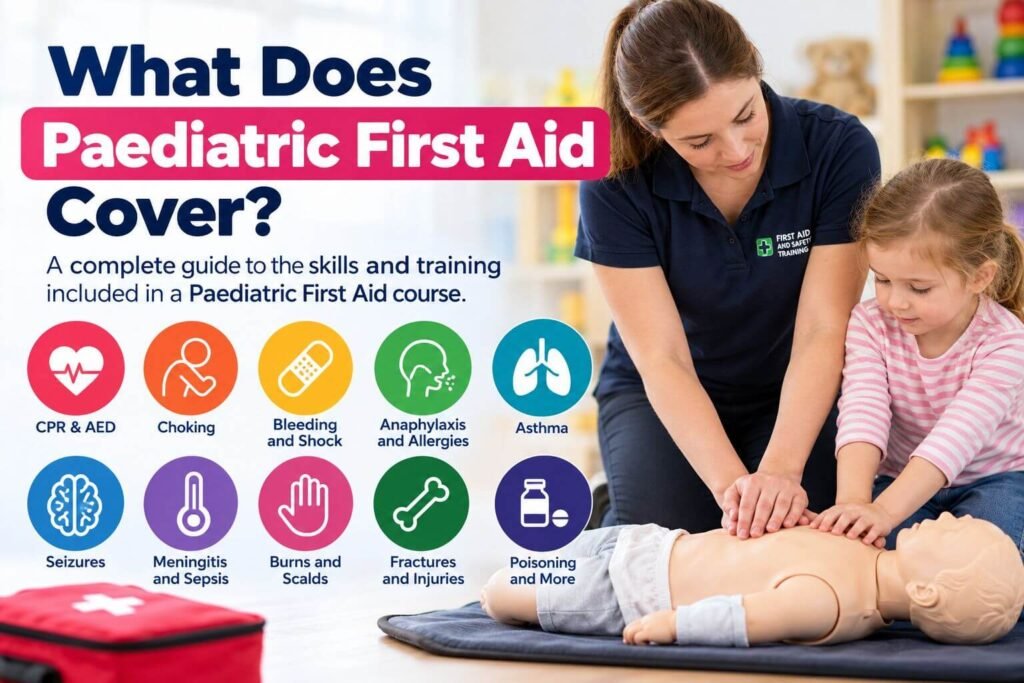
What does Paediatric First Aid cover? A full Paediatric First Aid course teaches you how to recognise and respond to illnesses, injuries and emergencies involving babies and children.
CPR and choking are important parts of the training. However, the course covers much more.
Learners also develop skills in casualty assessment, AED use, bleeding, shock, anaphylaxis, asthma, seizures, burns, fractures and serious childhood illness.
Most importantly, practical training gives you the opportunity to practise essential first aid skills rather than simply learning the theory.
This guide explains what Paediatric First Aid covers, what you will learn and which skills you will practise during a full Paediatric First Aid qualification.
What Is Covered in a Paediatric First Aid Course?
A full Paediatric First Aid course combines first aid knowledge with practical skills.
The current Qualsafe Level 3 Award in Paediatric First Aid covers:
- The role and responsibilities of a paediatric first aider
- Incident and casualty assessment
- Infant and child CPR
- Safe use of an AED
- Choking in babies and children
- Unconscious casualties
- Seizures
- External bleeding
- Shock
- Asthma
- Diabetes
- Allergic reactions and anaphylaxis
- Meningitis and sepsis
- Febrile convulsions
- Burns and scalds
- Electrical and chemical burns
- Poisoning
- Fractures and dislocations
- Sprains and strains
- Head, neck and spinal injuries
- Eye injuries
- Foreign objects
- Extremes of heat and cold
- Bites and stings
- Cuts, grazes, bumps and bruises
- Splinters and nosebleeds
- First aid responsibilities and record keeping
Consequently, the qualification prepares learners for both life-threatening emergencies and the more common injuries they may encounter when caring for children.
If you are still deciding which qualification is appropriate, our guide to the different types of Paediatric First Aid training explains the available options.
Does Paediatric First Aid Cover CPR?
Yes. CPR is one of the most important practical elements of Paediatric First Aid training.
Learners practise resuscitation using both infant and child manikins. As a result, they can experience the differences between providing CPR to babies and older children.
Training includes how to:
- Recognise an unresponsive baby or child
- Open the airway
- Check for normal breathing
- Recognise abnormal breathing
- Call for emergency assistance
- Give initial rescue breaths
- Perform effective chest compressions
- Combine compressions and rescue breaths
- Continue CPR while waiting for further help
Children often experience cardiac arrest following a progressive lack of oxygen. Therefore, rescue breaths remain particularly important during paediatric resuscitation.
The Resuscitation Council UK publishes the current UK resuscitation guidelines that underpin modern CPR practice.
Does Paediatric First Aid Include AED Training?
Yes. Learners also practise the safe use of an Automated External Defibrillator, usually called an AED.
AED training is combined with practical CPR.
During the course, learners practise how to:
- Retrieve an AED
- Switch it on
- Position the pads correctly
- Follow the AED prompts
- Keep other people clear during analysis
- Deliver a shock safely when advised
- Restart CPR immediately when instructed
Where appropriate, paediatric pads or a paediatric setting should be used if available.
However, you should not delay defibrillation simply because paediatric pads are unavailable.
Our guide to using an AED during a cardiac arrest explains how defibrillators fit into the wider resuscitation process.
Does Paediatric First Aid Cover Choking?
Yes. Paediatric First Aid covers choking in both infants and children.
First, learners are taught how to recognise the difference between mild and severe choking.
A child with mild choking may still be able to cough, cry, speak or breathe. In contrast, severe choking can quickly become life-threatening.
Treatment also differs according to age.
For a choking child, training includes:
- Encouraging an effective cough
- Giving back blows when required
- Using abdominal thrusts when appropriate
- Calling 999 or 112
- Starting CPR if the child becomes unresponsive
For an infant, learners practise back blows and chest thrusts instead of abdominal thrusts.
Because these techniques are different, practical training is particularly valuable.
Assessing a Baby or Child
Before giving first aid, you need to identify what has happened and which problems require immediate attention.
Therefore, casualty assessment forms an important part of Paediatric First Aid.
Learners are taught how to assess the scene, protect themselves and others from danger and carry out a structured assessment of the casualty.
They also learn when to call 999 or 112.
For urgent medical problems that are not immediately life-threatening, services such as NHS 111 may also be appropriate.
A structured approach helps first aiders remain focused when faced with a stressful situation.

Unconscious Babies and Children
An unresponsive child does not always need CPR.
If the casualty is breathing normally, the priority is to maintain their airway, position them appropriately and continue monitoring their condition.
Learners practise how to manage an unconscious infant or child who is still breathing.
Equally importantly, they learn to recognise when breathing is not normal and CPR needs to begin.
Does Paediatric First Aid Cover Bleeding?
Yes. The full course covers external bleeding and shock.
Learners are taught how to recognise serious blood loss and control external bleeding.
They also learn about hypovolaemic shock, which can develop when the body loses a significant amount of blood.
Prompt treatment matters because babies and children can deteriorate quickly.
Catastrophic Bleeding
Additional training can also cover life-threatening catastrophic bleeding.
Where appropriate, this may include:
- Wound packing
- Manufactured tourniquets
- Improvised tourniquets
- Management of severe traumatic bleeding
At First Aid and Safety Training, we can incorporate catastrophic bleeding training when it is appropriate to the organisation and its risks.
Does Paediatric First Aid Cover Anaphylaxis?
Yes. Anaphylaxis is included within the full Paediatric First Aid qualification.
Learners explore how to recognise an allergic reaction and identify signs that may indicate life-threatening anaphylaxis.
Training also covers the use of an adrenaline auto-injector.
Importantly, learners can practise the management of anaphylaxis using training devices rather than simply discussing the treatment.
Some organisations need more detailed allergy training in addition to their general first aid provision. Schools, nurseries and childcare providers can therefore explore our dedicated allergy and anaphylaxis training.
Asthma and Breathing Problems
Paediatric First Aid also covers asthma.
Learners explore how the respiratory system works, how to recognise an asthma attack and how to respond appropriately.
This knowledge can be particularly useful for nursery staff, teachers, sports coaches and others who regularly care for children with diagnosed asthma.
Seizures and Febrile Convulsions
The course covers both seizures and febrile convulsions.
Seeing a child experience a seizure can be frightening. Nevertheless, understanding what is happening can help a first aider respond calmly and safely.
Training explains how to protect the child from injury, monitor their condition and recognise when emergency medical assistance is required.
Febrile convulsions are also discussed because they can occur in young children with a high temperature.
Meningitis and Sepsis
Serious illnesses can sometimes be difficult to recognise during their early stages.
For that reason, full Paediatric First Aid training includes meningitis and sepsis.
Learners are taught to recognise concerning signs and understand when urgent medical assistance is necessary.
A first aider is not expected to diagnose meningitis or sepsis.
Instead, the aim is to recognise that a child may be seriously ill and get appropriate medical help.
Diabetes
Diabetic emergencies are also included.
Learners explore how diabetes can affect a casualty and how to recognise and respond when a child with diabetes becomes unwell.
This provides useful background knowledge for anyone responsible for children with a diagnosed condition.
Burns and Scalds
Burns and scalds are common childhood injuries.
Consequently, the course covers several types of burns, including:
- Thermal burns
- Scalds
- Electrical burns
- Chemical burns
Learners develop an understanding of immediate first aid treatment and when a child needs further medical assessment.
Fractures, Dislocations, Sprains and Strains
Children frequently suffer injuries during play, sport and everyday activities.
Full Paediatric First Aid training therefore covers:
- Fractures
- Dislocations
- Sprains
- Strains
Learners practise how to support an injury and reduce unnecessary movement.
Practical training may also include support and elevated slings.
The objective is not to diagnose a particular fracture. Instead, first aiders learn how to recognise a potentially significant injury, support the casualty and arrange appropriate medical care.
Head, Neck and Spinal Injuries
Head injuries are another important part of the course.
Learners explore how to recognise and manage head, neck and spinal injuries while avoiding unnecessary movement.
They also learn to identify warning signs that could indicate a more serious injury.
Our separate guide to assessing a head injury and recognising warning signs provides more information on this subject.
Poisoning
Young children can accidentally swallow medicines, household products or other potentially harmful substances.
Therefore, poisoning is included within the full Paediatric First Aid course.
Learners are taught to recognise a suspected poisoning incident and seek appropriate medical advice.
Treatment can depend on the substance involved. As a result, first aiders should avoid attempting potentially harmful home remedies.
The NHS poisoning guidance provides further information about when urgent medical help may be needed.
Eye Injuries and Foreign Objects
Paediatric First Aid also covers eye injuries and foreign objects affecting areas such as the eyes, ears and nose.
Some objects should not be removed by a first aider because doing so could cause additional injury.
Training helps learners understand what they can manage safely and when professional medical treatment is required.
Heat and Cold Emergencies
Babies and children can be particularly vulnerable to temperature extremes.
The course therefore covers the recognition and treatment of conditions caused by excessive heat and cold.
Learners also consider when a child’s condition requires further medical attention.
Bites, Stings and Minor Injuries
Not every first aid incident is a major emergency.
People working with children are much more likely to encounter minor injuries regularly.
For that reason, full Paediatric First Aid training also covers:
- Bites
- Stings
- Small cuts
- Grazes
- Bumps
- Bruises
- Small splinters
- Nosebleeds
Although these injuries are usually minor, knowing how to deal with them correctly is an important part of everyday first aid.
Does Paediatric First Aid Include Practical Training?
Yes. Practical training forms an essential part of the qualification.
The current Qualsafe blended Level 3 Award in Paediatric First Aid combines 6 hours of e-learning with one day of face-to-face training.
Learners complete knowledge-based subjects online before attending practical classroom training.
The face-to-face session then includes skills such as:
- Infant CPR and AED use
- Child CPR and AED use
- Choking
- Managing an unconscious casualty
- Bleeding and shock
- Anaphylaxis
- Fracture management
- Head, neck and spinal injury management
Learners are expected to practise these skills and demonstrate competence.
This practical requirement is one of the important differences between a regulated qualification and an online-only awareness course.
Our guide to online, blended and classroom Paediatric First Aid explains the differences between the available delivery methods.
You can also compare training times in our guide to Paediatric First Aid course duration.
How Is Paediatric First Aid Assessed?
Learners do more than simply attend the course.
Practical assessment takes place throughout the face-to-face training.
For example, learners must demonstrate essential skills including CPR, AED use and choking management.
The current Qualsafe blended course also includes two multiple-choice theory assessments.
Therefore, assessment considers both practical ability and underpinning first aid knowledge.
What Is the Difference Between Full and Emergency Paediatric First Aid?
Full Paediatric First Aid covers a wider range of illnesses and injuries.
Emergency Paediatric First Aid is a shorter qualification concentrating primarily on immediate life-threatening emergencies.
The full qualification has a minimum training duration of 12 hours. Emergency Paediatric First Aid has a minimum duration of 6 hours.
Which qualification you need depends on your role and the requirements applying to your setting.
Our guide to choosing a Paediatric First Aid course compares the main options in more detail.
Does Paediatric First Aid Cover Adults?
Paediatric First Aid focuses on babies and children.
Therefore, employers should not automatically use a PFA qualification as a replacement for their wider workplace first aid arrangements.
Employers have a legal responsibility to provide adequate and appropriate first aid provision for employees. The Health and Safety Executive’s workplace first aid guidance explains these responsibilities.
Depending on the organisation’s first aid needs assessment, staff may also require Emergency First Aid at Work or First Aid at Work training.
This is particularly relevant to nurseries and schools because they need to consider first aid provision for both children and adults.
Our overview of the main first aid training options can help employers understand the differences.
Who Needs Paediatric First Aid Training?
Paediatric First Aid is particularly relevant for people who work with or care for babies and children.
This can include:
- Nursery practitioners
- Early years staff
- Childminders
- School staff
- Teaching assistants
- Sports coaches
- Children’s activity providers
- Holiday club staff
- Youth workers
- Nannies
- Childcare professionals
Parents, grandparents and carers can also benefit from learning these skills, although they may not need a regulated qualification unless one is required for their work.
Early years providers should also check the current Early Years Foundation Stage statutory framework when deciding which staff require Paediatric First Aid qualifications.
How Long Is a Paediatric First Aid Certificate Valid?
A Paediatric First Aid certificate is normally valid for three years.
Employers and childcare providers should keep a training record and arrange renewal before certificates expire.
This is especially important where maintaining qualified staff is necessary to meet Early Years requirements.
Our guide to renewing a Paediatric First Aid qualification explains certificate validity and renewal in more detail.
What Does Paediatric First Aid Cover at FAST?
First Aid and Safety Training provides practical Paediatric First Aid training for individuals and organisations across the North East.
We are an approved Qualsafe Awards Centre, and our relevant Paediatric First Aid courses lead to regulated qualifications awarded by Qualsafe Awards, an Ofqual-recognised awarding organisation.
Our training combines essential knowledge with practical experience.
As a result, learners do not simply hear about CPR, choking and other emergencies. They get the opportunity to practise important skills in a supportive training environment.
We provide Paediatric First Aid courses for individuals as well as onsite training for nurseries, schools, childcare providers, sports organisations and other businesses responsible for children.
If you need help deciding which course is appropriate, contact First Aid and Safety Training and we can discuss your requirements.
You can also find First Aid and Safety Training on Google Maps and read feedback from previous learners.
Build the Confidence to Act
Understanding what Paediatric First Aid covers is useful when choosing a course. However, the real value comes from being able to use those skills when a child needs help.
Good training combines knowledge, demonstration, practice and assessment.
That combination helps learners recognise an emergency, make appropriate decisions and provide first aid while further medical help is on the way.
Ultimately, Paediatric First Aid is about more than completing a qualification.
It is about developing the confidence to act.