Skip to content

A well-stocked home first aid kit gives you useful equipment for dealing with common minor injuries and providing immediate first aid when something goes wrong.
Cuts, grazes, minor burns, splinters and other everyday injuries can happen in any household. Keeping suitable first aid supplies together means you can find what you need quickly rather than searching through cupboards while somebody needs help.
However, buying a first aid kit is only part of being prepared. You also need to know what is inside it, check the contents regularly and understand when an injury or illness requires professional medical help.
This guide explains what to consider putting in a home first aid kit, where to keep it and how to make sure it remains ready to use.
What Should a Home First Aid Kit Contain?
There is no need to fill your home first aid kit with every first aid product available.
Instead, think about the people in your household, their activities and the types of minor injury you could reasonably encounter.
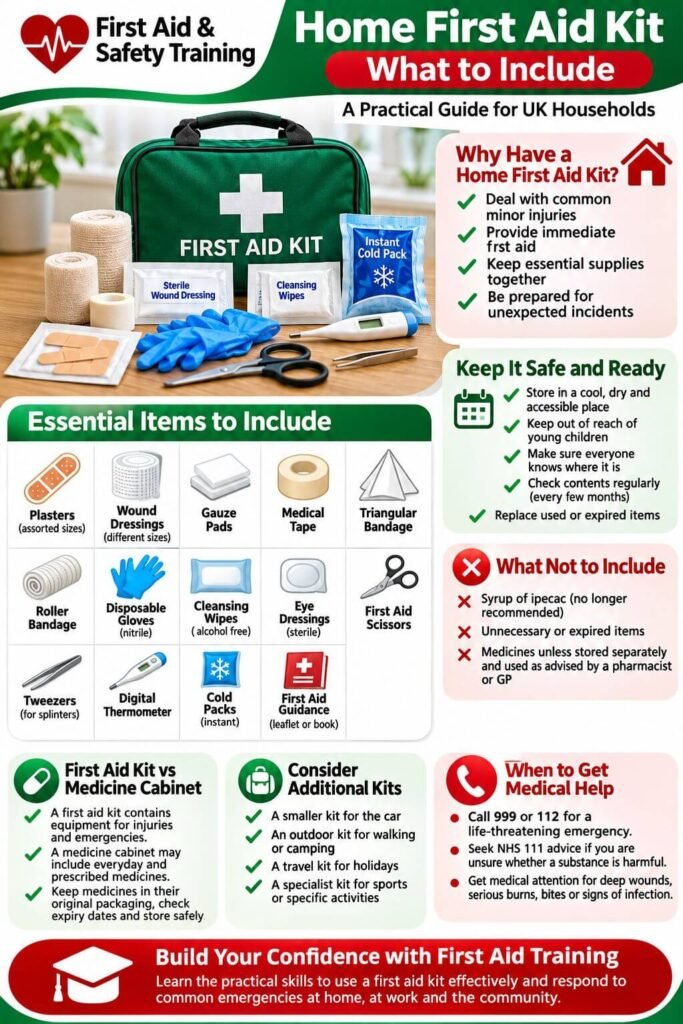
A useful home first aid kit could include:
- assorted adhesive plasters
- sterile wound dressings in different sizes
- sterile gauze pads
- adhesive medical tape
- triangular bandages
- roller or conforming bandages
- disposable nitrile gloves
- alcohol-free cleansing wipes
- sterile eye dressings
- first aid scissors
- tweezers
- a digital thermometer
- instant cold packs
- a basic first aid guidance leaflet or booklet
You can then adapt the contents according to your household.
A family with young children, for example, may have different needs from somebody living alone. Someone who regularly does DIY, gardening or outdoor activities may also decide to keep additional supplies available.
Plasters and Dressings for Your Home First Aid Kit
Cuts and grazes are among the most common minor injuries you may need to deal with at home.
A selection of plasters in different sizes can be useful for small wounds once they have been appropriately cleaned.
Larger sterile dressings are useful when a wound is too large for an ordinary plaster.
Consider keeping:
- small and large plasters
- waterproof plasters
- sterile gauze pads
- small, medium and large sterile wound dressings
- adhesive medical tape
If somebody in your household has a known sensitivity to particular adhesives or materials, choose suitable alternatives.
Significant or uncontrolled bleeding is different from an everyday cut.
Apply firm direct pressure and call 999 or 112 for life-threatening bleeding. Do not delay getting emergency help while searching through your first aid kit.
Disposable Gloves
Disposable gloves help reduce contact with blood and other body fluids.
Nitrile gloves are a practical choice because they avoid the latex allergy concerns associated with some latex products.
Keep several pairs in your kit rather than relying on a single pair.
Gloves do not replace good hygiene. Wash your hands before and after providing first aid whenever possible.
Bandages and Your Home First Aid Kit
Different types of bandage have different uses.
Triangular bandages
A triangular bandage can be used to support an injured arm or help secure dressings.
Roller or conforming bandages
These can help hold a dressing in position and have other first aid uses depending on the injury.
Sterile wound dressings
These combine an absorbent sterile pad with an attached bandage and can be useful when managing bleeding wounds.
Practical first aid training can help you understand when different dressings and bandages are appropriate and how to use them correctly.
Should You Keep Scissors and Tweezers?
Both can be useful additions to a home first aid kit.
First aid scissors can help you cut dressings, tape or clothing when necessary.
Tweezers can be useful for superficial splinters and small objects that can be safely removed.
Do not use tweezers to explore a deep wound or attempt to pull out a large or deeply embedded object.
If an object is embedded in a serious wound, leave it in place, avoid applying pressure directly over the object and seek appropriate medical assistance.
Cleansing Wipes and Cleaning Minor Wounds
Alcohol-free cleansing wipes can be useful for dealing with minor wounds, particularly when clean water is not readily available.
Sterile saline can also be useful for wound or eye irrigation.
Deep wounds, heavily contaminated wounds, animal or human bites and wounds showing signs of infection may require professional medical assessment.
A first aid kit should help you provide immediate care. It should not encourage you to manage an injury at home when medical assessment is required.
Should a Home First Aid Kit Include a Thermometer?
A digital thermometer is a useful addition to a home first aid kit, particularly in households with children.
It gives you a more reliable indication of someone’s temperature than simply feeling their forehead.
Follow the manufacturer’s instructions for the thermometer you use.
Remember that temperature is only one part of assessing somebody who is unwell. Their behaviour, breathing, responsiveness and other symptoms can be equally important.
If you are concerned about someone’s condition, seek appropriate medical advice.
Cold Packs
An instant cold pack can be useful for some minor soft-tissue injuries.
Protect the skin by wrapping the cold pack in a cloth or suitable covering rather than placing it directly against bare skin.
Significant pain, obvious deformity, loss of movement or concern about a fracture should prompt further medical assessment.
Home First Aid Kit vs Medicine Cabinet
It is useful to distinguish between your home first aid kit and your household medicines.
Your first aid kit primarily contains equipment for dealing with injuries and emergencies.
A separate medicine cabinet might contain products such as:
- paracetamol
- ibuprofen
- antihistamines
- prescribed medicines
- treatments recommended for individual household members
Medicines should remain in their original packaging with their instructions.
Pay attention to the correct dose, age restrictions, allergies, interactions, storage instructions and expiry dates.
They should also be kept securely and out of the sight and reach of children.
If you are unsure which medicines are appropriate for you or your family, speak to a pharmacist, GP or other appropriate healthcare professional.
What Should Not Be in a Home First Aid Kit?
Some older first aid advice recommended products or treatments that are no longer considered appropriate.
One important example is syrup of ipecac, which was historically used to cause vomiting following some types of poisoning.
It should not form part of a modern home first aid kit.
If you think somebody has swallowed, touched or inhaled something harmful, seek medical advice immediately.
Do not try to make them vomit and do not give them anything to eat or drink unless a healthcare professional instructs you to do so.
Try to identify the substance involved and keep its packaging or container where possible so you can give healthcare professionals accurate information.
Call 999 for a serious poisoning emergency. If you are unsure whether something swallowed, touched or inhaled is harmful, contact NHS 111 for advice.
You can also read the NHS guidance on poisoning.
Buying a Ready-Made Home First Aid Kit
You do not have to build a home first aid kit completely from scratch.
A ready-made kit can provide a convenient starting point, particularly if it comes in a suitable bag or container that keeps the contents organised.
However, check the contents rather than assuming every kit contains everything your household needs.
For example, Jax First Aid currently sells a compact Home & Travel First Aid Kit containing plasters, cleansing wipes, disposable gloves, a large sterile dressing and a triangular bandage. This is useful as a small basic kit, but it does not contain everything recommended in this guide.
For a more comprehensive starting point, its Small Universal First Aid Kit adds items including conforming bandage, finger dressing, microporous tape and non-adherent dressings.
You can browse first aid kits at Jax First Aid and choose a kit based on the needs of your household rather than simply buying the largest kit available.
Affiliate disclosure: If you purchase through the Jax First Aid link above, First Aid and Safety Training may receive a commission at no additional cost to you. We only include affiliate links where we believe the product or supplier is relevant to the information being discussed.
Where Should You Keep a Home First Aid Kit?
Store your home first aid kit somewhere adults can access quickly but young children cannot.
Choose somewhere that is:
- cool
- dry
- clearly identified
- easy for adults to reach
- out of the reach of young children
- known to other members of the household
Avoid excessively hot or damp locations.
A clearly labelled box, bag or purpose-made first aid container makes supplies easier to find when they are needed.
If children are old enough to understand, it can also be useful for them to know where the first aid kit is kept and when they should get an adult.
How Often Should You Check Your Home First Aid Kit?
A home first aid kit should not be something you buy and then forget about for several years.
Check it regularly for:
- used or missing items
- damaged packaging
- opened sterile products
- expired products
- depleted glove supplies
- dressings that need replacing
- damaged containers
Replace items after they have been used rather than waiting until the next emergency.
A quick check every few months can prevent you discovering that something important is missing when you need it.
Do You Need More Than One First Aid Kit?
Depending on your lifestyle, having more than one kit can make sense.
You might have:
- a main home first aid kit
- a smaller kit for the car
- an outdoor first aid kit for walking or camping
- a travel first aid kit for holidays
- a specialist kit for particular sports or activities
The contents do not need to be identical.
An outdoor kit, for example, may need to take account of the activity, terrain, weather, number of people involved and how far you could be from professional help.
We cover those considerations separately in our guide to choosing an outdoor first aid kit.
Is a Home First Aid Kit the Same as a Workplace First Aid Kit?
No.
Households can decide what first aid equipment is sensible for their individual needs.
Employers have different responsibilities.
UK employers must provide adequate and appropriate equipment, facilities and personnel so employees can receive immediate attention if they are injured or become ill at work.
The amount and type of first aid provision required should be determined through a first aid needs assessment.
We cover workplace provision separately because employers should not simply copy the contents of a household first aid kit.
You can also read our guide to the legal requirement for first aid at work for more information about employer responsibilities.
A Home First Aid Kit Cannot Replace First Aid Skills
Having suitable equipment is useful, but equipment alone cannot tell you what to do.
In a serious emergency, recognising a life-threatening problem and responding appropriately is much more important than owning an enormous collection of first aid products.
Important skills include:
- assessing an emergency safely
- performing CPR
- using an AED
- helping someone who is choking
- controlling severe bleeding
- treating burns
- recognising shock
- responding to anaphylaxis
- recognising a stroke
- helping an unresponsive casualty
If someone develops shock following serious illness or injury, our guide to shock first aid explains the signs to recognise and what to do.
First aid training gives you an opportunity to practise emergency skills rather than trying to learn them for the first time when somebody is already injured or seriously unwell.
When Is a Home First Aid Kit Not Enough?
A home first aid kit is primarily there to help you provide immediate care.
It is not a substitute for professional medical assessment when somebody is seriously ill or injured.
Call 999 or 112 for a life-threatening emergency.
Depending on the circumstances, medical advice may also be available through NHS 111, your GP, a pharmacist or an appropriate urgent treatment service.
Do not delay calling for help while searching for equipment.
Learn How to Use Your Home First Aid Kit
A well-stocked home first aid kit means useful equipment is available when something goes wrong.
First aid training gives you the knowledge and practical skills to use equipment appropriately and, more importantly, to recognise when an injury or illness is more serious than it initially appears.
First Aid and Safety Training delivers practical first aid courses across the North East, including regulated workplace first aid qualifications awarded by Qualsafe Awards, an Ofqual-recognised awarding organisation.
Our Emergency First Aid at Work course develops practical emergency skills including casualty assessment, CPR, AED use, choking and bleeding.
Employers looking to train a group can also arrange onsite first aid training across the North East.
If you would like help choosing an appropriate first aid course, contact First Aid and Safety Training.
You can also view our South Shields training location and customer reviews on Google.