Skip to content

First aid for outdoor workers can present challenges that aren’t always encountered in a conventional office environment. The casualty may be outside, help may not be immediately beside you and the surrounding environment can affect how an incident is managed.
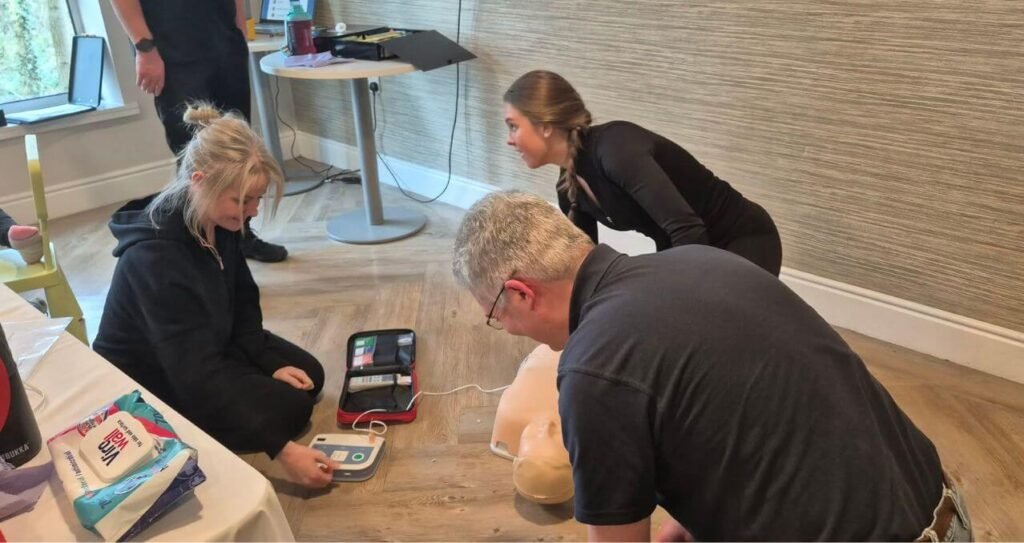
Those issues created plenty of discussion when First Aid and Safety Training delivered a Level 3 Emergency First Aid at Work (EFAW) course in Sunderland on 12 March 2026.
Learners included representatives from:
- Hebburn Litter Pickers
- AquAid Tyne and Wear
- trainers from Sunderland Climbing Wall
The group included community volunteers, people travelling between locations as part of their work and instructors responsible for people taking part in physical activities.
That mix allowed us to explore how the same core first aid principles can be applied in very different environments.
First Aid for Outdoor Workers and Active Environments
Location can make a considerable difference during an emergency.
Someone working outdoors in a public space may need to manage an incident while members of the public are nearby.
A person travelling between sites may find themselves somewhere unfamiliar when an emergency happens.
Climbing instructors face another set of considerations because an injured person could be in a more difficult or unusual location.
The Emergency First Aid at Work qualification provides the core first aid skills, but discussing how those skills could be applied within the learners’ own environments makes the training much more relevant.
Thinking Beyond the Training Room
Throughout the course, we discussed how learners might respond if an emergency happened while carrying out their normal activities.
That included considerations such as:
- making sure the immediate area is safe
- assessing what has happened
- identifying life-threatening problems
- getting appropriate help
- communicating clearly with other people at the scene
- providing first aid until further help arrives
For people working away from a conventional workplace, it is also useful to think about practical questions before an emergency happens.
Where is the first aid equipment kept?
Who would call the emergency services?
How would an ambulance crew reach the casualty?
Where is the nearest accessible AED?
These discussions help connect first aid training with the environment in which somebody may actually need to use it.
Practical Emergency First Aid at Work Training
The Level 3 Emergency First Aid at Work course covered essential workplace first aid skills including:
- the role and responsibilities of an emergency first aider
- assessing an incident safely
- recognising an unresponsive casualty
- adult CPR
- safe use of an Automated External Defibrillator (AED)
- managing an unconscious casualty
- responding to choking
- controlling external bleeding
- recognising and managing shock
Learners then had opportunities to practise the skills themselves before completing the required assessments.
You can learn more about the Emergency First Aid at Work qualification and practical skills included.
Why Practical First Aid Training Matters
Watching somebody demonstrate CPR is very different from physically performing it yourself.
For that reason, practical participation formed a major part of the training day.
Learners practised CPR, AED use and other first aid techniques, with opportunities to repeat skills and receive feedback.
This is particularly important when discussing first aid for outdoor workers and people in active roles. In a genuine emergency, they may have to make decisions quickly in an environment that is considerably less controlled than a training room.
Practice gives learners an opportunity to develop their technique before they ever need to use it for real.
Keeping Serious Training Engaging
First aid deals with serious subjects, but training doesn’t need to feel intimidating.
This group was keen to participate, ask questions and contribute their own experiences.
The day combined:
- clear explanations
- practical demonstrations
- repeated hands-on exercises
- questions and discussion
- examples relevant to the learners’ activities
Creating a relaxed but focused environment made it easier for learners to get involved and practise.
What Did the Learners Think?
Feedback from the course reflected the practical and engaging nature of the day:
“Knowledgeable trainer, covering important skills.” – Jon
“Great course, highly recommended, thank you.” – Emir
“Really enjoyed the course, fun and informative.” – Ethan
All learners successfully completed the qualification. Read more Sunderland reviews.
First Aid Training for Outdoor and Mobile Teams
This Sunderland course demonstrated why first aid training shouldn’t be viewed only through the lens of a conventional workplace.
Community groups, mobile workers, sports instructors and people working outdoors may need to consider where incidents could happen, how emergency services would reach them and what equipment is available.
A suitable workplace first aid needs assessment should take account of the actual circumstances in which people work.
First Aid and Safety Training provides onsite first aid training for organisations in Sunderland and across the wider North East.
For organisations with staff who work outdoors, travel between locations or supervise physical activities, we can discuss how the practical examples used during training can reflect the environments your team works in.
You can also view the Emergency First Aid at Work qualification or contact First Aid and Safety Training to discuss your requirements.