Skip to content
Updated CPR guidelines need to make their way from published clinical guidance into the training room so that learners are taught current first aid practice rather than techniques that have simply been repeated for years.
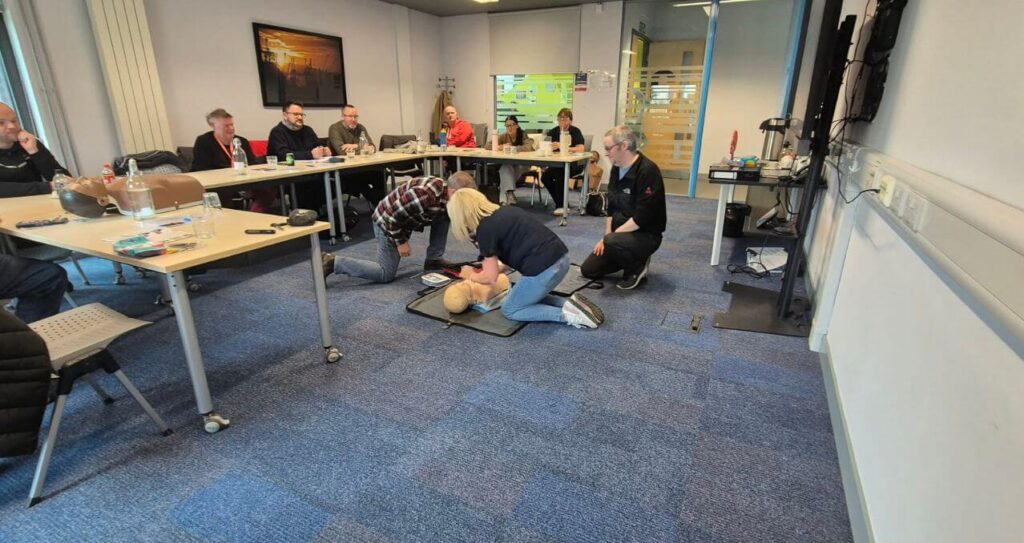
That was an important part of the Level 3 Emergency First Aid at Work (EFAW) course we delivered at One Trinity Green in South Shields on 23 February 2026.
The course brought together learners from several local businesses and working environments, while also giving us an opportunity to incorporate the latest resuscitation guidance into our practical training.
Bringing Updated CPR Guidelines into First Aid Training
First aid guidance changes as evidence and clinical recommendations develop.
For trainers, keeping up to date is therefore part of delivering good first aid training.
It isn’t enough to continue teaching something simply because that was how it appeared in an older training manual or lesson plan.
During this course, current resuscitation guidance was incorporated into the CPR and emergency response training, giving learners the opportunity to practise the techniques rather than simply being told that guidance had changed.
This is particularly important with CPR because learners need to understand the sequence of actions as well as physically practise chest compressions, rescue breaths and the use of an Automated External Defibrillator (AED).
You can read our step-by-step guide to performing CPR during a cardiac arrest for more information about the current approach.
Local Businesses Training Together
The course included learners from:
- The Clifton Hotel
- CPM Retrofit
- a licensed SIA security professional
- Green Fingers Garden Centre
Once again, an open course created a mixture of people who work in very different environments.
That gives learners an opportunity to discuss how an emergency might present within hospitality, security, construction-related work, retail and other workplaces while learning the same core first aid principles.
From a Community Workshop to a First Aid Qualification
One learner from Green Fingers Garden Centre had an additional connection with our work.
She had previously attended a Save A Life Community Workshop delivered through First Aid Saves Lives CIC.
Those workshops are designed to give members of the community practical experience of lifesaving skills and greater confidence to act during an emergency.
After attending the community session, she decided to develop her knowledge further by completing the Emergency First Aid at Work qualification.
This was particularly encouraging for us because it demonstrated a natural progression from accessible community first aid education into a formal workplace first aid qualification.
Practical Emergency First Aid at Work Training
Alongside the updated CPR guidelines, learners developed and practised the core skills required for Emergency First Aid at Work.
Training included:
- assessing an incident safely
- recognising an unresponsive casualty
- adult CPR
- safe use of an Automated External Defibrillator
- managing an unconscious casualty
- responding to choking
- controlling external bleeding
- recognising and managing shock
Learners were shown the techniques before being given time to practise and receive feedback.
You can find more information about the Emergency First Aid at Work qualification and its practical requirements.
Practising CPR and AED Use
CPR is a physical skill.
Reading the sequence or watching somebody demonstrate it cannot replace physically performing chest compressions on a manikin.
Learners therefore practised CPR repeatedly during the course, including the integration of an AED into the response to cardiac arrest.
Training AEDs allow learners to practise following the device prompts, applying pads correctly, making sure nobody is touching the casualty when required and resuming CPR promptly.
That combination of explanation, demonstration and repeated practice helps turn written guidance into something learners can actually perform.
Catastrophic Bleeding Training
The course also incorporated additional catastrophic bleeding training.
Learners considered how they would respond to severe, life-threatening blood loss and practised appropriate techniques and equipment.
Catastrophic bleeding is different from the minor wounds people commonly associate with first aid.
When blood loss is immediately life-threatening, recognising the severity of the situation and taking rapid action becomes particularly important.
Including practical catastrophic bleeding training gave learners experience of managing a more serious trauma scenario alongside the core EFAW content.
Keeping First Aid Training Current
The introduction of updated CPR guidelines into this course also highlights an important responsibility for first aid training providers.
Qualifications shouldn’t become static.
Trainers need to maintain their own knowledge, undertake appropriate continuing professional development and make sure their delivery reflects the current requirements of the qualification and awarding organisation.
First Aid and Safety Training is an approved Qualsafe Awards Centre, and our regulated workplace first aid qualifications are awarded through Qualsafe Awards.
Our objective is not simply to help learners pass an assessment. We want the techniques they practise in the training room to reflect what they should actually do if somebody needs their help.
What Did the Learners Think?
Feedback from the course reflected both the content and the way it was delivered:
“Brilliant trainers, really enjoyed the course.” – Scott
“Great first aid course, learned new information.” – Mark
“Fun and informative course.” – Joseph
“Excellent content and well delivered.” – Andrew
“Great course which was very well delivered. The tone and enthusiasm of the trainer made the course content easy to digest.” – Ian
All learners successfully completed the qualification.
Current, Practical First Aid Training in South Shields
This course demonstrated why first aid training needs to evolve when guidance changes.
Learners didn’t simply hear about the updated CPR guidelines. They had the opportunity to practise CPR, AED use and other emergency skills in a structured training environment and receive feedback on their technique.
For individuals who need a workplace first aid qualification, you can view our upcoming first aid courses in South Shields.
Businesses with several employees to train can also arrange onsite first aid training in South Shields and South Tyneside.
If you’re unsure which course your organisation requires, contact First Aid and Safety Training and we can discuss your first aid needs.
You can also view our South Shields training centre and customer reviews on Google.