Skip to content
First aid training gives people the knowledge, practical skills and confidence to respond when somebody becomes ill or injured.
That could mean performing CPR when someone suffers a cardiac arrest, controlling serious bleeding after an accident, helping someone who is choking or simply knowing what to do when a colleague becomes unwell at work.
However, there is no single first aid course that suits everybody.
In the UK, different first aid courses cover different environments, responsibilities and levels of risk. A workplace may need Emergency First Aid at Work or First Aid at Work, while somebody working with babies and young children may require Paediatric First Aid.
Understanding the differences can help you choose the right training.
What Is First Aid Training?
First aid training teaches you how to provide immediate assistance to someone who becomes ill or injured before professional medical help is available.
The purpose of first aid is not to turn somebody into a doctor, nurse or paramedic.
Instead, a trained first aider learns how to assess what has happened, recognise potentially serious problems and provide appropriate initial treatment.
Practical first aid training can include skills such as:
- Assessing a casualty
- Managing an unresponsive casualty
- CPR
- Using an Automated External Defibrillator, or AED
- Treating choking
- Controlling bleeding
- Recognising and treating shock
- Managing burns and scalds
- Responding to seizures
- Recognising serious medical emergencies
The exact content depends on the course you take.
Why Is First Aid Training Important?
Medical emergencies and accidents can happen almost anywhere.
They can occur at work, at school, while playing sport, at home or when somebody is simply going about their day.
The first few minutes can sometimes be extremely important.
For example, when someone suffers a cardiac arrest, early recognition, CPR and defibrillation form crucial parts of the chain of survival.
Current Resuscitation Council UK guidance emphasises early recognition, calling the emergency services, starting CPR and using an AED as soon as possible.
First aid training allows you to practise these skills before you face a real emergency.
What Are the Main First Aid Courses in the UK?
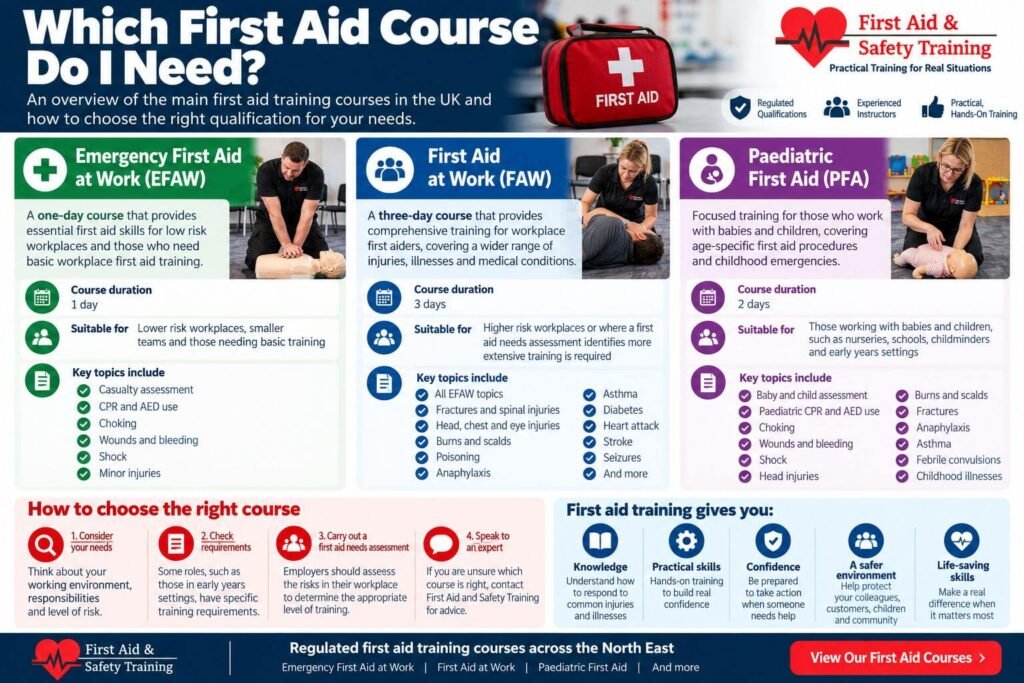
Several types of first aid training are available, but three qualifications are particularly important for workplaces and childcare settings.
These are:
Emergency First Aid at Work, EFAW
First Aid at Work, FAW
Paediatric First Aid, PFA
Although there is some overlap between them, they are designed for different requirements.
Emergency First Aid at Work, EFAW
The Emergency First Aid at Work qualification is normally delivered over one day.
It provides the essential skills needed to act as an emergency first aider in the workplace.
Training covers areas such as assessing an incident, CPR and AED use, an unresponsive casualty, choking, wounds and bleeding, shock and minor injuries.
EFAW can be suitable for many lower-risk workplaces where the organisation’s first aid needs assessment identifies it as the appropriate level of training.
Examples might include some offices, shops and smaller workplaces.
You can find out more about our Emergency First Aid at Work courses.
First Aid at Work, FAW
The First Aid at Work qualification provides more comprehensive training.
It is normally delivered over three days and covers the emergency skills taught within EFAW alongside a wider range of injuries, illnesses and medical conditions.
Depending on the current qualification specification, training includes areas such as:
- CPR and AED use
- Unresponsive casualties
- Choking
- Serious bleeding
- Shock
- Burns
- Head injuries
- Chest injuries
- Fractures
- Spinal injuries
- Eye injuries
- Poisoning
- Anaphylaxis
- Asthma
- Heart attack
- Stroke
- Diabetes
- Seizures
FAW is often appropriate for workplaces with higher levels of risk or where a first aid needs assessment identifies the requirement for more comprehensive first aid provision.
You can learn more about our First Aid at Work training.
What Is the Difference Between EFAW and FAW?
The biggest difference is the breadth and depth of the training.
EFAW concentrates on essential emergency first aid skills and is usually completed in one day.
FAW provides more extensive training over three days and covers a much wider range of injuries and medical conditions.
That does not mean every business should automatically choose FAW.
The correct course should reflect the organisation’s first aid needs.
The Health and Safety Executive explains that employers must provide adequate and appropriate equipment, facilities and personnel to ensure employees receive immediate attention if they become injured or ill at work.
Employers should carry out a first aid needs assessment to determine what provision they require.
The HSE first aid at work guidance provides further information.
What Is Paediatric First Aid Training?
Paediatric first aid focuses specifically on emergencies involving babies and children.
This distinction matters because some first aid procedures differ depending on the casualty’s age.
For example, paediatric CPR and choking procedures differ from those used for adults.
Paediatric training also considers illnesses and injuries that first aiders working with children may encounter.
Training can include:
- Assessing an ill or injured baby or child
- CPR for babies and children
- AED use
- Choking
- Bleeding and shock
- Head injuries
- Burns
- Fractures
- Anaphylaxis
- Asthma
- Seizures
- Febrile convulsions
- Meningitis
- Other childhood illnesses and emergencies
People working in early years settings may need a recognised paediatric first aid qualification that meets the relevant EYFS requirements.
You can view our Paediatric First Aid courses.
Do First Aid Courses Include CPR and Defibrillator Training?
CPR and AED training form important parts of recognised workplace first aid qualifications.
Learners practise how to recognise cardiac arrest, call for emergency help, perform chest compressions and rescue breaths and use an AED.
Modern AEDs provide spoken and/or visual instructions and can be used by members of the public without previous training.
However, practising with an AED trainer during a first aid course can make the equipment much more familiar.
Instead of seeing a defibrillator for the first time during a real cardiac arrest, learners have already practised switching one on, applying the pads, following its prompts and continuing CPR.
You can read our guide to [AED usage statistics](/aed-usage-statistics/) to understand why early CPR and defibrillation are so important.
Is First Aid Training Practical?
Good first aid training should involve practical learning.
First aid is not simply about remembering information.
You need to be able to do something with that knowledge.
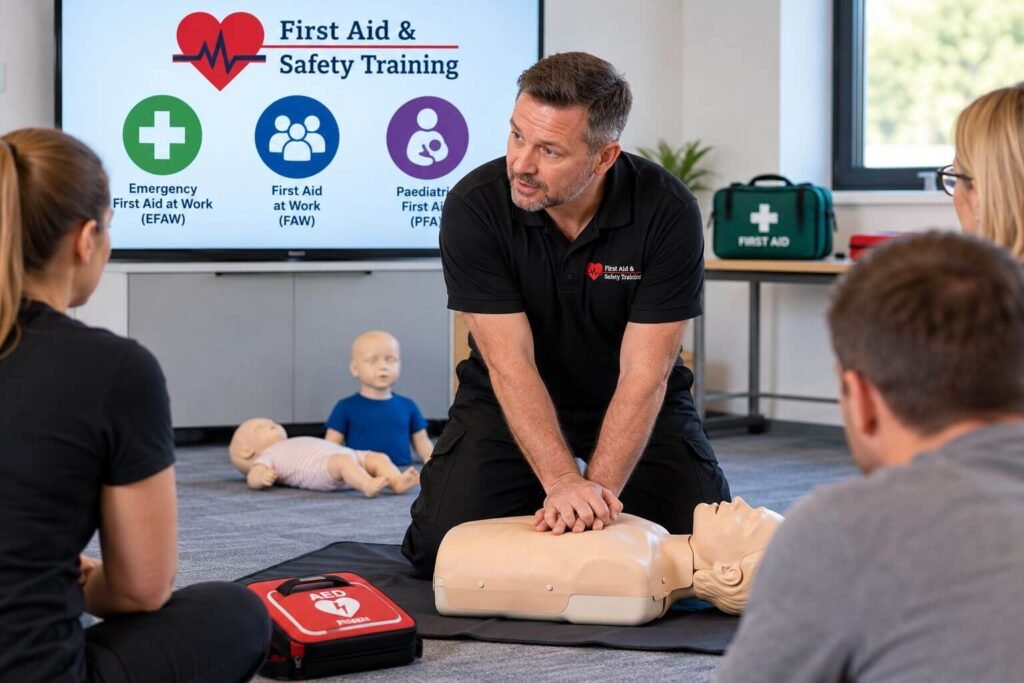
During a practical course, learners can practise skills such as CPR, AED use, recovery position, casualty assessment, bleeding control and other procedures appropriate to their qualification.
An instructor can observe what the learner is doing, correct mistakes and allow them to practise again.
This is particularly important for physical skills such as CPR.
Is Online First Aid Training Enough?
This depends on what you need the training for.
Online learning can be useful for awareness, refresher learning and certain blended training programmes.
However, watching a video of somebody performing CPR is not the same as physically practising CPR yourself.
Where a regulated qualification requires practical training and assessment, an online-only awareness course should not be presented as an equivalent replacement.
If you need first aid training for your workplace or to satisfy a particular professional requirement, check that the course and qualification you choose meet those requirements.
How Long Does a First Aid Certificate Last?
Workplace first aid qualifications such as Emergency First Aid at Work and First Aid at Work are normally valid for three years.
First aiders need to complete the appropriate training again before their qualification expires if they need to remain qualified for their role.
However, three years is a long time to remember practical skills that you may rarely use.
The HSE strongly recommends that workplace first aiders undertake annual refresher training during the three-year certification period.
This helps first aiders maintain their skills and confidence rather than waiting until their qualification approaches expiry.
How Do Employers Decide What First Aid Training They Need?
There is no universal answer based simply on the number of employees.
Employers should conduct a first aid needs assessment.
The assessment can consider factors such as:
- Workplace hazards and risks
- Number of employees
- Working patterns
- Accident history
- Lone workers
- Remote workers
- Distance from emergency medical services
- Employees working across multiple sites
- Members of the public visiting the workplace
- Annual leave and other absences of trained first aiders
A small office and a busy manufacturing site may therefore need very different first aid arrangements.
The HSE provides further guidance through its First aid at work resources.
What Is a Regulated First Aid Qualification?
Not every course advertised as “first aid training” leads to a regulated qualification.
First Aid and Safety Training delivers regulated qualifications through Qualsafe Awards, an Ofqual-recognised awarding organisation.
This provides a defined qualification specification, assessment requirements and quality assurance process rather than the training provider simply creating its own certificate.
This distinction can be particularly important when an employer or organisation needs evidence that someone has completed an appropriate recognised qualification.
What Happens During a First Aid Course?
A first aid course normally combines instructor-led learning, demonstrations, discussion, practical exercises and assessment.
Rather than simply listening to a presentation, learners should have opportunities to practise the skills they may need during a real incident.
At FAST, our aim is not simply to get learners through an assessment.
We want people to leave understanding what to do and why they are doing it.
Someone facing a real emergency months later is unlikely to remember every sentence from a training manual.
They are much more likely to remember a simple process that they have understood and practised.
Who Should Learn First Aid?
First aid training is useful for far more than designated workplace first aiders.
People who can benefit include:
- Employees and managers
- Teachers and school staff
- Nursery and early years practitioners
- Sports coaches
- Fitness professionals
- Community volunteers
- Tradespeople
- People working alone
- Parents and carers
You may need a qualification because of your job, or you may simply want the confidence to know what to do if somebody becomes seriously ill or injured.
Either is a good reason to learn first aid.
How Do I Choose the Right First Aid Course?
Start by considering why you need the training.
If you are an employer, begin with your first aid needs assessment.
If you need training for a particular job or industry, check the qualification requirements for that role.
If you work with babies or young children, determine whether you require paediatric first aid training and whether specific EYFS requirements apply.
Then look at the course itself.
Check the qualification, course duration, practical training, assessment and awarding organisation rather than choosing solely on price.
If you are unsure, speak to the training provider before booking.
A reputable provider should be able to explain which course is appropriate rather than automatically trying to sell you the longest or most expensive option.
First Aid Training With FAST
First aid training should leave you with more than a certificate.
It should give you the knowledge, practical ability and confidence to take action when somebody needs help.
First Aid and Safety Training provides regulated first aid qualifications for individuals and organisations across the North East.
Our courses include Emergency First Aid at Work, First Aid at Work and Paediatric First Aid, alongside specialist training for different workplace requirements.
You can explore our first aid training courses, book a first aid course or contact First Aid and Safety Training if you are unsure which qualification you need.
You can also find First Aid and Safety Training on Google to see our business information and customer reviews.