Skip to content
Knowing asthma attack first aid can help you respond quickly when someone is struggling to breathe.
During an asthma attack, the airways become narrowed, making breathing increasingly difficult. The person may cough, wheeze, feel tightness in their chest or become too breathless to speak normally.
Asthma attacks can become serious very quickly.
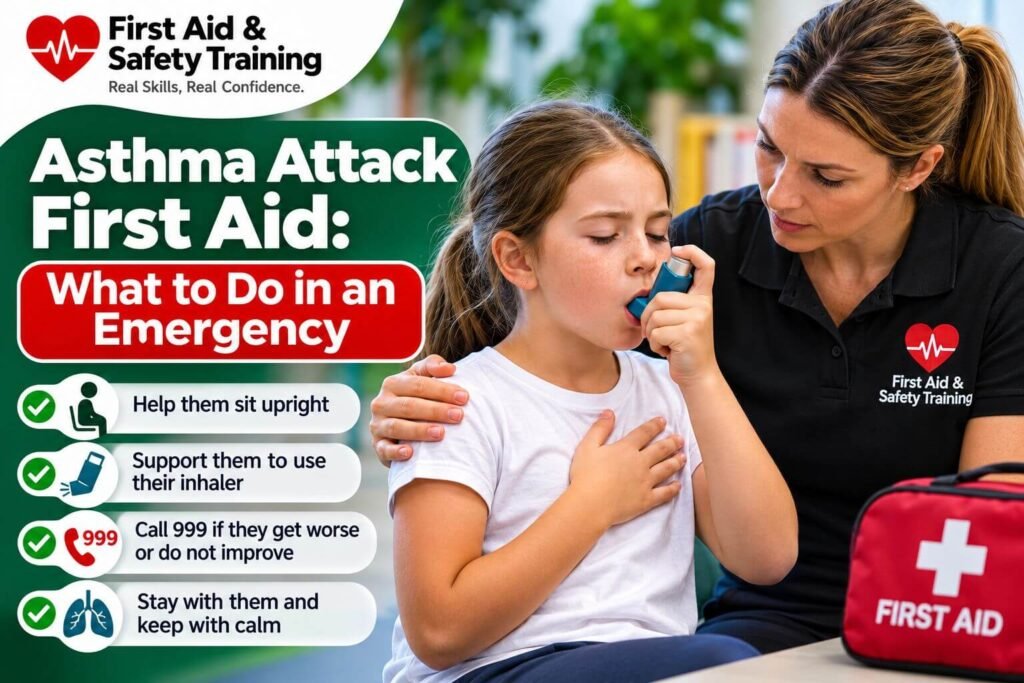
The priority is to help the person sit upright, reassure them, help them use their reliever inhaler according to their asthma action plan and call 999 if their condition becomes worse or the inhaler does not provide sufficient relief.
This guide explains how to recognise an asthma attack, what to do and when emergency medical help is needed.
What Is an Asthma Attack?
Asthma is a long-term condition affecting the airways.
People with asthma can experience symptoms including:
- breathlessness
- wheezing
- coughing
- chest tightness
During an asthma attack, these symptoms become significantly worse.
The person’s airways become narrowed and inflamed, making it harder for air to move in and out of the lungs.
An asthma attack can range from relatively mild symptoms to a life-threatening breathing emergency.
This is why asthma attack first aid should begin promptly rather than waiting to see whether severe symptoms develop.
What Are the Signs of an Asthma Attack?
Someone having an asthma attack may experience:
- increasing breathlessness
- wheezing
- persistent coughing
- tightness in the chest
- difficulty speaking normally
- difficulty walking because of breathlessness
- rapid or increasingly difficult breathing
- their reliever inhaler not helping as much as normal
- needing their reliever inhaler more frequently than usual
Not everyone will wheeze during an asthma attack.
Do not assume someone is safe simply because you cannot hear wheezing.
A person experiencing a severe attack may become increasingly exhausted and unable to speak normally.
If someone is struggling to breathe and you are concerned about their condition, treat the situation seriously.
Asthma Attack First Aid: What Should You Do?
If someone is having an asthma attack:
1. Help Them Sit Upright
Help the person into a comfortable upright position.
They may naturally find a position that makes breathing easier.
Allow them to adopt that position.
Do not make someone experiencing an asthma attack lie down.
Sitting upright generally makes breathing easier.
2. Reassure Them
Stay with the person and try to remain calm.
Breathlessness can be frightening and distressing.
Speak calmly and reassure them while helping them access their medication.
Do not crowd them or encourage unnecessary movement.
3. Help Them Use Their Reliever Inhaler
Most people diagnosed with asthma should know which inhaler they use when symptoms become worse.
Help them locate and use their reliever inhaler.
Whenever possible, follow the instructions in their personal asthma action plan, because the correct emergency instructions can depend on the type of inhaler they have been prescribed.
This is particularly important because asthma treatment has changed and not everyone now relies on the traditional blue reliever inhaler.
Asthma Attack First Aid with a Blue Reliever Inhaler
For someone using a traditional blue reliever inhaler, current NHS guidance is:
- take one puff every 30 to 60 seconds
- shake the inhaler between each puff
- use a spacer if one is available
- continue until they feel better, up to a maximum of 10 puffs
If their personal asthma action plan gives different instructions, follow their plan.
If the person becomes worse at any point, or does not improve after the maximum dose, call 999 for an ambulance.
If they do not have their reliever inhaler and are struggling to breathe, call 999.
Current NHS guidance on asthma provides further information about recognising and responding to an asthma attack.
What About AIR and MART Inhalers?
This is an important area where asthma advice has changed.
Some people use an AIR inhaler or MART inhaler rather than relying on a traditional blue reliever inhaler.
AIR means Anti-inflammatory Reliever.
MART means Maintenance and Reliever Therapy.
These inhalers have different asthma-attack instructions.
Current NHS guidance advises someone using an AIR or MART inhaler for relief to take one puff every one to three minutes, up to a maximum of six puffs, unless their personal asthma action plan gives different instructions.
If they become worse at any point or do not improve after the maximum dose, call 999.
Because different people may have different prescribed asthma treatments, a first aider should not assume that everyone with asthma should follow exactly the same inhaler instructions.
Help the casualty follow their prescribed treatment and personal asthma action plan.
You can also read current Asthma + Lung UK guidance on asthma attacks.
When Should You Call 999 for an Asthma Attack?
Call 999 for an ambulance if the person:
- becomes worse at any point
- does not improve after using the maximum emergency dose of their reliever inhaler
- does not have their reliever inhaler and is struggling to breathe
- becomes increasingly exhausted
- is having severe difficulty breathing
- collapses or becomes unresponsive
Do not delay calling for help because you are worried about overreacting.
An asthma attack can become life-threatening.
When calling 999, clearly tell the call handler that the casualty is having an asthma attack.
Follow any instructions the ambulance service gives you.
What Should You Do While Waiting for the Ambulance?
Stay with the casualty.
Continue to reassure them and allow them to remain sitting upright in the position they find easiest for breathing.
Monitor their condition closely.
If their symptoms have not improved and the ambulance has not arrived after 10 minutes, current NHS guidance advises using the reliever inhaler again, up to the same maximum emergency dose.
Follow the casualty’s asthma action plan where this gives specific instructions.
If their condition deteriorates further, update the ambulance service.

What If the Person Becomes Unresponsive?
A severe asthma attack can lead to a life-threatening emergency.
If the person becomes unresponsive, check whether they are breathing normally.
If they are not breathing normally, call 999 if this has not already been done and begin CPR.
Use an AED as soon as one is available.
Our guide to the seven steps of CPR explains the adult CPR sequence in more detail.
You can also read our step-by-step guide to using an AED.
Should You Use Steam During an Asthma Attack?
No.
Do not use bowls of hot water or steam as asthma attack first aid.
Steam is not a substitute for the person’s prescribed reliever medication or emergency medical treatment.
Introducing very hot water also creates an unnecessary risk of burns and scalds at a time when the casualty is already experiencing a medical emergency.
The appropriate response is to help the person sit upright, assist them with their prescribed reliever medication and get emergency medical help when required.
Should Someone Having an Asthma Attack Lie Down?
No.
Someone struggling to breathe will normally find an upright position more comfortable.
Encourage them to sit upright rather than lying flat.
They may want to lean slightly forward or support themselves while sitting.
Allow the casualty to find the position in which they can breathe most comfortably.
Should You Give Someone Else’s Inhaler?
A first aider should normally help the casualty use their own prescribed medication.
Do not simply give someone medication prescribed for another person.
There are specific arrangements for emergency salbutamol inhalers in schools, but these operate under school policies and government guidance rather than a general rule allowing people to share prescription inhalers.
Asthma Attack First Aid for Children
The basic priorities remain similar when a child experiences an asthma attack:
- stay with them
- reassure them
- help them sit upright
- help them access their prescribed reliever inhaler
- use a spacer where appropriate
- follow their individual healthcare or asthma action plan
- monitor them carefully
- call 999 if they deteriorate or do not respond appropriately to their medication
Signs in children can include persistent coughing, wheezing, difficulty breathing, being unable to speak normally or becoming unusually quiet.
Severe signs can include exhaustion, collapse or changes in skin or lip colour.
Schools should have arrangements for pupils with asthma and may choose to hold an emergency salbutamol inhaler for eligible pupils in accordance with government guidance.
The Department of Health and Social Care provides specific guidance on emergency asthma inhalers in schools.
Why Is a Spacer Useful?
A spacer is a chamber attached to a pressurised metered-dose inhaler.
It can make it easier for the medication to reach the lungs effectively, particularly for children or people who find coordinating an inhaler difficult.
If the casualty normally uses a spacer and it is available, help them use it with their inhaler.
Parents, schools and childcare settings should make sure prescribed inhalers and spacers are readily accessible rather than locked somewhere that creates unnecessary delay during an emergency.
What Can Trigger an Asthma Attack?
Different people have different asthma triggers.
Common triggers can include:
- respiratory infections
- pollen
- dust mites
- mould
- animal allergens
- smoke
- air pollution
- exercise
- cold air
- stress or strong emotions
- workplace substances
A person with asthma may know their own triggers.
However, during an asthma attack the priority is not to spend time trying to identify the cause.
Concentrate on helping them breathe, use their prescribed reliever medication and obtain medical assistance when required.
Asthma in the Workplace
Employers may have workers with asthma or other medical conditions.
A workplace first aid needs assessment should consider the nature of the workforce as well as the hazards created by the work.
Some workplaces can also expose employees to substances capable of causing or aggravating asthma.
First aiders should know the limits of their role.
Their job is to recognise the emergency, provide appropriate immediate assistance and obtain further medical help when needed.
Our guide to the legal requirements for first aid at work explains employers’ wider first aid responsibilities.
Asthma in Schools and Childcare Settings
Schools, nurseries and childcare settings should know which children have asthma and what arrangements are in place for their medication.
Depending on the setting, this can include:
- individual healthcare plans
- accessible inhalers
- spacers
- staff who understand the child’s needs
- emergency procedures
- parental contact information
- arrangements for emergency medication
Staff should be familiar with the procedures applying within their setting rather than trying to work them out for the first time during an emergency.
Paediatric first aid training also helps childcare professionals recognise and respond to breathing emergencies.
You can find out what Paediatric First Aid training covers in our dedicated guide.
What Should You Do After an Asthma Attack?
An asthma attack should not simply be forgotten once the person feels better.
NHS advice recommends medical follow-up after an asthma attack so that treatment can be reviewed and the risk of another attack reduced.
Someone who has recovered should contact their GP surgery for an urgent review.
This provides an opportunity to consider:
- what may have triggered the attack
- whether their medication is controlling their asthma effectively
- whether their inhaler technique is correct
- whether their personal asthma action plan needs updating
Repeated reliance on a reliever inhaler can indicate that someone’s asthma is not well controlled.
Can First Aid Training Help You Respond to an Asthma Attack?
Yes.
Asthma is one of the medical emergencies covered within appropriate first aid training.
Training helps learners understand how to recognise breathing problems, assess the casualty, provide appropriate assistance and know when emergency medical help is required.
More importantly, practical training allows learners to put individual conditions such as asthma into the wider emergency response.
A casualty may deteriorate.
First aiders therefore also need the skills to respond if someone becomes unresponsive or stops breathing normally.
Depending on your role, appropriate training could include:
Asthma Attack First Aid: Key Points to Remember
For asthma attack first aid, remember:
- help the casualty sit upright
- stay calm and reassure them
- help them access their prescribed reliever inhaler
- follow their personal asthma action plan
- use a spacer where appropriate
- remember that not everyone now uses a blue reliever inhaler
- call 999 if the casualty becomes worse
- call 999 if their reliever medication does not provide sufficient relief
- call 999 if they do not have their reliever inhaler and are struggling to breathe
- monitor them while waiting for help
- begin CPR if they become unresponsive and are not breathing normally
- do not use steam or bowls of hot water as treatment
- arrange appropriate medical follow-up after an attack
Learn How to Respond to Medical Emergencies
Knowing asthma attack first aid is one part of being prepared for a medical emergency.
First Aid and Safety Training provides practical first aid qualifications for individuals and organisations across the North East, including Emergency First Aid at Work, First Aid at Work and Paediatric First Aid.
Our training covers real emergencies and gives learners the opportunity to practise the skills they may one day need to use.
Explore our first aid training courses, find out about first aid training across the North East or contact First Aid and Safety Training to discuss the right course for you or your organisation.
You can also view our South Shields training location and customer reviews on Google Maps.
Real Skills, Real Confidence.